When the North Carolina DOT (NCDOT) asked Boggs Paving Inc., a highway/heavy contractor out of Monroe, NC, to identify a few projects they could try a mix design containing post-consumer reclaimed asphalt shingles (PRAS), Rock Hill Church Road in Union County, NC, surfaced as a possibility.
"We had been processing shingles for use in asphalt mixes for several months and preparing our mix designs for submittal to NCDOT," says Greg Tucker, project manager with Boggs Paving. "Once we got the design approvals, we worked with NCDOT to select a good candidate road to utilize the PRAS mixes, and this one was chosen."
Both Boggs Paving and NCDOT wanted a project that had less traffic so the mixes could be tested and the contractor could take its time. "This road was chosen because it's primarily low traffic volume road and a good candidate to try new technology," says Tucker. In addition to a mix containing PRAS, the project was also to be a test the Federal Highway Administration's Safety Edge technique.
The project
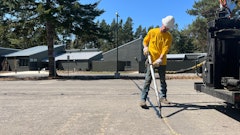
Beginning on October 4, 2010, the project on Rock Hill Church Road consisted of patching and widening (two feet) the existing road from NC 218 to Lawyers Road in Union County. The 2.5-inch strengthening course used 5,350 tons of RI 19.0C mix, while the 1.5-inch surface course used 2,900 tons of RS 9.5B mix.
The 1.5-inch surface course contained 5% PRAS while the strengthening course consisted of 4% PRAS. Paving was performed at approximately 35 fpm for both courses. All mixes used on the project also contained percentages of reclaimed asphalt pavement (RAP) for the hot mix designs.
The original plan for Rock Hill Church Road project was to use PRAS in all three layers of asphalt. However, PRAS was not used in the base course, as Boggs decided to start the project prior to the mix design being approved.
Equipment used included a Roadtec 185-8 paver, DD112 and DD90 Ingersoll Rand steel drums, a PT125 Ingersoll Rand rubber-tire drum, and an Etnyre distributor. The project was completed December 6, 2010.
This was the first state road project that Boggs used PRAS in the mix design, says Tucker. "We have not had prior experience on any NCDOT projects with PRAS," he says. "We have done some smaller parking lots and smaller roads to get testing data, but this was the first state road we did. We have manufactured the mix to assist in mix designs and utilized the produced mix at our facility in Monroe for stockpile areas as well."
Tear-off shingles were used in the mixes on Rock Hill Church Road. "Manufacture-waste products were not accessible as there is no shingle manufacturing plant in our region," says Tucker. "We have a permit that allows us to be an intake and processing center for tear-off shingles from residential construction." (See box, "Roof to Roads Program.")
Mix design challenges
According to Tucker, Boggs Paving didn't experience any challenges during the actual paving on the project. "Our quality control personnel did a great job of managing the design process and working with NCDOT for any necessary changes or additional information they required."
However, Tucker notes that from a mix design standpoint, there were several challenges Boggs Paving faced. "We had to do a fair amount of R&D in a limited time frame with limited expertise in the area," he explains. "Some issues we had included calculating the correct time to add shingles in the mix design process, the appropriate temperature to add the shingles to the mix, and at what temperatures to compact those samples. Another issue was determining exactly how much liquid was being recovered from the shingles and what our equivalent binder content actually was."
Despite these challenges, Boggs Paving is heavily involved in green initiatives, says Tucker, and sees many benefits to utilizing PRAS in its mixes. "Our company has been a leader in the 'green' movement by increasing the amounts of reclaimed asphalt pavements in all mixes, piloting the largest warm mix project in North Carolina – which involved more than 90,000 tons of warm mix asphalt (WMA) on NC 218 in Union and Anson Counties – and now introducing PRAS into our portfolio."
The benefits in utilizing PRAS are numerous, says Tucker.
- The ability to keep waste materials from entering landfills and reusing the products in the manufacturing process
- Lowering the amount of “virgin” liquid asphalt that has to be purchased
- Achieving density more quickly
- Continuing to be an environmental steward in the construction industry
"PRAS is really the next big thing after WMA for our industry," he notes. "The number one benefit for our bottom line is saving money on the liquid asphalt. Achieving density more quickly was a nice surprise. We didn't anticipate that."
Tucker says the quality control personnel on the project weren't sure why the densities were achieved more efficiently. "We ran the mix for eight days and densities were consistent throughout the project," says Tucker. "One theory was that the fiber that holds the shingle together acted almost like a fiber injection mix, creating the faster density."
Safety Edge
Rock Hill Church Road was a good candidate for a PRAS mix, and it was also a good project to try the FHWA's Safety Edge technique. " Since this was going to be another 'pilot' project for Boggs' and NCDOT because of the PRAS mix design, State Construction Engineer Ron Hancock requested that we utilize the FHWA safety edge to see how effectively it would work to eliminate shoulder drop-off issues," says Tucker.
The FHWA recommends that states use the safety edge technique – particularly on two-lane roads with unpaved shoulders. According to its website, during the normal paving process, pavement edges are formed vertical or near vertical. The recommended practice of bringing the adjacent graded material (unpaved shoulder or stabilized soil) flush with the top of the pavement only lasts for a short time and requires frequent maintenance. The exposed vertical edge can contribute to drivers losing control of the vehicle when attempting to recover from a roadway departure.
Recent updated research has shown that almost all drivers and vehicles can recover if the edge is tapered to 30 degrees from the horizontal. Safety Edge is easy to include in the paving process and provides a safer roadway edge and a stronger interface between the pavement and the graded material, notes the website. The additional cost of the asphalt edge is minimal when included as part of resurfacing project.
Tucker notes that the FHWA is starting to require the Safety Edge in contracts for mixes greater than 2 inches.
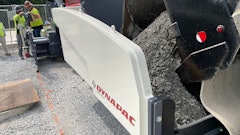
"Basically the Safety Edge is installed on the outside gate of the paver and slopes the edge of the pavement on a 30-degree angle," says Tucker. "This will assist motorists when they run off the edge of the pavement and have to correct back on to the roadway. It works very similar to the Transtech Notched Wedge Joint Maker for centerline joints, which we used on this project as well."
Rock Hill Church Road was a pilot project for both PRAS and Safety Edge, but the project went off "without a hitch," says Tucker, who sees the company increasing its use of PRAS in the future.
"Boggs’ plans are to utilize the PRAS mixes on all possible projects," says Tucker. "NCDOT specifications currently allow RAS mixes on all projects, however, the NCDOT Construction Unit staff has been instrumental in allowing the use of PRAS. Ron Hancock and Todd Whittington have led the charge for the Department by initiating green components in new and existing contracts. The ability to have environmental stewards on the front lines of the Department will be a benefit to the taxpayers of the State of North Carolina for years to come."