
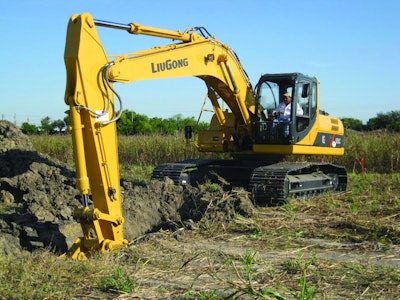
Modern excavators are loaded with productivity enhancing features, but if you don't understand the advantages built into your particular machines, you can't exploit them. Every manufacturer offers it own unique nuances. It is well worth your time to investigate the features and technology and how they can cut cycle times.
"The rule of thumb on excavators, cycle time is king," says Matthew Hendry, John Deere Construction. "To maximize performance, you want to make sure you are getting as fast of cycles as you can get. With a 20-ton machine, you are probably looking at a 9- to 10-second cycle time if you are doing things right. You go up to an 85-ton machine, and you are probably looking at an 18-second cycle time. The bigger machines are a bit slower."
Shorter cycle times reduce cost. "If you start lengthening cycle time, then your cost is going up and your production is dropping," says Hendry.
There are many universal tips that can increase effectiveness, regardless of make and model. "Experienced operators can tell you there are many tricks to maximize productivity and decrease the cost of operating any type of construction equipment," says Rob Brittain, product manager, Link-Belt Excavators. "Having the bucket teeth at the proper angle when digging maximizes productivity. Having the proper tools to assist in lifting applications saves time. You have more lifting power when the boom arm is tucked in closer to the machine. To be efficient, consider a quick coupler to shorten the time required to swap out tools."
Understand unique features
"The most important thing an operator can do to maximize the productivity of any machine is to know the equipment, and that starts with reading the operator's manual," says Brittain.
Different machines may respond better to different techniques. "John Deere and Hitachi excavators have a very strong arm," says Hendry. "We do a lot of our digging cycle with arm input as opposed to bucket curl. It is actually a faster cycle... With our excavators, you get about a 50° down angle on your teeth on the bucket. You arm in and boom up just enough to keep from stalling the arm. At about the 90° phase of the arm coming in, that bucket is about 95% full. Our machines will fill that bucket with just arm force."
Excavators without this added strength will arm in and run out of power. "You have to curl the bucket to fill it," Hendry notes. "We only require a 5° or 10° curl on the bucket to maintain that material and you are out to the spoil pile or out to the truck."
An advantage to the arm digging technique is it allows you a greater chance to feel utilities using the arm and peeling the material back than if you are curling the bucket. "You can curl up underneath it and by the time you feel it, you have usually broken it," says Hendry.
Liebherr Construction Equipment's unique hydraulic system allows the excavator to perform multiple simultaneous functions. "Due to our three-pump hydraulic system in our 30-ton and higher machines, we have a dedicated swing pump with closed loop that does not take hydraulic flow away from the attachment hydraulics," says Jeff Powell. "This allows the operator to boom up, curl or dump the bucket without slowing down."
This substantially reduces the cycle time required to dig, lift the bucket out of the hole and swing it over the side into a truck or add spoil to a pile. "With this dedicated swing hydraulic system, we can see a reduction of up to 20% in cycle time, which equates to the operator being able to move more material faster," says Powell.
Control setups can also affect operator performance. Several excavators on the market now offer short throw controls, including John Deere and Hitachi models.
"Your hands are moving a lot less on our machines than on some of our competitors," Hendry asserts. "Our engineers have done studies and found some of our competitors travel as much as a football field's distance further in a day."
Consider the impact over the course of an 8- or 10-hour work day. "The morning is always the best productive time," says Hendry. "As you advance during the day, you get fatigued and slow down. The more you're moving your arms, the more fatigued you get."
Get in the right mode
Many excavators feature work modes. Take the four selectable modes on the Link-Belt X2 Series, for example.
"SP-Mode, a.k.a. 'Speed Priority', is full engine rpm and pump output for speed in all functions, such as swing, travel, etc.," says Brittain. "H-Mode is a middle of the road work setting is used for general operating conditions. It's useful for both speed and power. A-Mode, which is our power mode, is a fuel-saving mode used in lifting applications or for slow, precise movements. The A-Mode provides additional lifting power with Power Boost always on."
The fourth mode is an attachment mode. The machine is pre-programmed for auxiliary settings, including single- or double-acting flow. Pump output settings are matched to tool requirements.
Some manufacturers, on the other hand, prefer a single work mode. "Unlike competitive systems that have multiple operating modes that few operators use or perhaps understand, LiuGong excavators do not [feature multiple selectable modes]," says George Lumpkins, director of product development and support, LiuGong North America. "Should the LiuGong operator and/or customer job condition not require maximum speed, the operator simply reduces engine rpm to match the job condition. The system compensates with reduced output of power and reduced fuel consumption for a given job."
Likewise, John Deere and Hitachi excavators feature a single work mode system. "Our system is called Powerwise III," says Hendry. "It responds to lever input. Whatever the operator input is, the system is going to automatically give him the performance that he requires. It takes all of the guesswork out for the operator."
Consider the example of a pipe job. "If an operator is doing a pipe job and he is digging hard, then has to lift a heavy pipe section into the trench, on some excavator with EH controls, you have to go from a digging mode to the lifting mode to be able to control that," says Hendry. "With our system, he just swings over, hooks to the pipe and he can crane with very fine movements without having to adjust the controls on the machine."
This system lets the operator transition from heavy digging directly to operations requiring fine control. "He can go from heavy digging to fine grading. It is all in the input from his fingers and the system automatically adjusts," says Hendry. "Most operators rarely, if ever, understand all of those control adjustments in machines that have them. They get in, turn it to the top power mode and go." This can result in abrupt movements when craning materials.
While they have only one work mode, John Deere and Hitachi excavators do feature three power modes based on engine speed: Economy, Power and High Power.
"When you put it in Economy Mode, it is going to drop down 100 rpm from the Power Mode," Hendry notes. This results in a 4% fuel savings. Economy Mode is also beneficial for lighter applications, such as loading a grinder.
Hendry recently worked with a contractor who screens topsoil. "He was running in Power and I turned him down to Economy. He has plenty of performance and he is saving fuel," he points out. "He was a typical operator -- crank it to the top."
The High Power Mode kicks the engine speed up another 100 rpm when the system senses 3,500 psi on the teeth. The added boost enables the machine to break through really hard material. It is automatically triggered in tough digging conditions, but it doesn't stay there indefinitely. "As you break through it and the pressure on the teeth drops below the 3,500-lb. threshold, it will come out of High Power," says Hendry.
A 4% fuel savings can be realized by instead using the Power Mode plus the Power Boost feature located on the right controller. "On a Deere/Hitachi machine, your boom is always in power up," says Hendry. "When you activate the button, you will get eight seconds of increased performance on your arm and bucket."
He adds, "If you are digging in Power Mode and you encounter some hard material, you press that button and it will give you essentially the High Power Mode pressures and let you dig through the hard stuff without kicking your engine [speed] up."
Many manufacturers offer a version of Power Boost. "As the name implies, 'Auto Power Boost' allows the hydraulic system pressure to automatically boost to a higher relief setting for eight seconds, providing additional power in tough applications such as digging in clay or hard, rocky soil or when lifting objects," says Brittain. "It automatically gives you additional power when it's needed most."
"Unlike most power boost functions on competitive machines, the LiuGong power boost system is a One Touch system, in that the operator does not have to hold down a power boost button," says Lumpkins. "He simply touches it and releases, and it is engaged for up to 8 seconds. This not only increases power to the digging attachment, but maintains better control of the unit as the hands remain in the normal position on the joystick."
Some features are unique to specific manufacturers. "LiuGong's selectable 'Heavy Lift System' not only increases lifting forces, but decreases the machine speed in both engine rpm and hydraulic flow to handle these heavy loads more precisely," says Lumpkins. "There is no time limit for this function. The system is engaged using a rocker switch."
Liebherr offers a tool control system on its excavators. "With the Liebherr tool control system, the operator can easily choose the correct hydraulic settings for a given attachment without long downtimes having to reset the hydraulic system to the correct flow and pressure," says Powell. "The service technician can set multiple attachments up in the menu for the operator to choose from for the specific attachments that are present on the jobsite."
This tool control system can be installed with the optional Likufix hydraulic quick-coupler system, which allows the operator to switch between attachments at the push of a button within the cab.
"This not only couples the pins of the attachment to the stick, but it also connects all the necessary hydraulic hoses between the machine and attachment," Powell explains. "All this is done without the operator ever having to leave the cab."
Cut fuel consumption and noise
Automatic engine deceleration is another common feature of excavators.
"Most modern excavators today have an automatic engine deceleration system that can reduce the engine rpm automatically, after 5 to 10 seconds of non-use by the customer, from full rpm," says Lumpkins. "This system can be switched on or off."
He notes, "Some competitors have a 'One-Touch' decel system in that the operator can select to force the engine down in rpm instantly with a button. Each system has its own benefit, being aimed at reduced fuel consumption, reduced noise and/or ease of communication. The LiuGong excavators have both systems available to the operator selectable from inside the cab with two separate switches."
Link-Belt excavators also feature a One-Touch decelerator feature. "One-Touch allows the operator to save fuel by manually controlling the engine rpm by touching a switch on top of the joystick," says Brittain. "The advantage of the One-Touch decelerator is that it allows the operator to determine when he wants to power down to save fuel, as opposed to another feature we also have, which is Auto-Idle.
"When Auto-Idle is engaged, the machine controller automatically idles the engine when the joysticks are in the neutral position," he continues. "A time delay for the Auto-Idle can be programmed from one to 30 seconds."
One-Touch, on the other hand, lets the operator decide when and for how long engine idling occurs. "This feature is always useful, but typically comes into play when waiting on trucks to be loaded," says Brittain.
Read the manual
The features and benefits listed here only scratch the surface. Many contractors don't take advantage of the modern excavator technology they have purchased.
As you have already surmised, there are many technologies and features unique to each excavator brand. Don't leave money on the table. The best place to start? Try the owner's manual. You might be surprised by what you learn!