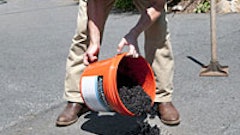
Each year, Mother Nature leaves her stamp on state highways, city and county roads, and even parking lots in the form of potholes. Born from both harsh, cold winter and dry, hot summer weather, potholes show up many times throughout the year and in all regions and climates – no area is immune.
Furthermore, there’s no way to stop them. Regardless of a road’s design and build quality, virtually all asphalt pavement will eventually crack, either from extreme cold, or dry, hot weather. And that crack, combined with heavy traffic, will eventually turn into a full-blown pothole. But those seemingly small holes pack a lot of punch. Potholes potentially cause major damage to vehicles, and since prevention is an impossibility, management becomes key. Cities, counties and states are faced with developing plans to manage pothole repair.
There are numerous methods to repair potholes, from the most basic “fill-and-go” techniques to most complex, where a large area of pavement is removed and replaced. While each offers the same general end-result, the processes, labor requirements, equipment used and final product quality are quite different – and one method has proven itself to be the leader in several areas.
Introduced in the early 1980s, spray injection patching has emerged as the choice method in terms of efficiency, quality and cost-effectiveness. The technique offers several benefits and a considerable potential for return on investment (ROI). Because pothole repair is an ongoing process, and one that has to be dealt with in every city, it only makes sense to consider the method that will offer the greatest productivity, durability and potential for ROI.
Spray Injection Patching
The National Research Council’s Strategic Highway Research Program (SHRP) Report deems spray injection patching as “the most economical and longest lasting method of pothole repair.” It’s also the safest method, as the entire process is done from inside the machine’s cab. The operator doesn’t have to exit the machine and enter a busy roadway to repair a pothole. This is also a major benefit in cold weather operation. Pothole repair, spray patching included, can be done year-round, in a variety of ambient temperatures. Bitter wind chills and freezing temperatures don’t exactly build excitement in crews assigned to head outside and manually fix potholes. Finally, spray patching machines, despite their great size and perceived complexity, are actually very-user friendly. Most untrained workers can learn the process quickly and become proficient at pothole repair.
Spray patching is done via a low-pressure system, which delivers the necessary air, aggregate and emulsion at a rate of just three to four PSI. It includes four basic steps. First, all water, dirt and any debris are removed from the pothole. Next, the hole is sealed with a coat of liquid asphalt to help ensure a strong bond between the aggregate mix and existing asphalt. The hole is then filled with the mix, typically consisting of hot asphalt or liquid-covered rock, which bonds to the existing pavement. Finally, the patch is sealed with a dry coat of aggregate to enhance durability and longevity.
The technology has been around for decades and spray injection is a widely accepted form of pothole repair. In fact, several cities and state agencies across the country have adopted the method. The City of Houston and Tulsa County public works departments are just two examples of southern-area entities, while up in the northeast, both the Pennsylvania DOT and Tri-Borough Bridge Authority in New York have adopted the method as well.
When evaluating the ROI impact of purchasing a spray-patching unit, several questions must be considered. First, what are the major benefits? What’s the overall cost and production compared to the way the process is currently being handled? How will this change the way the current workforce is being utilized? And finally, perhaps most importantly, how do all these benefits translate to ROI?
Just One Minute
How does spray injection patching lead to greater efficiency, production and profit? The key stems from the speed and efficiency of these machines.
Although it involves four steps, the spray injection process provides a faster option because the entire method is mechanized. Because repairs can be completed from inside the cab, the operator doesn’t waste precious minutes entering and exiting after each job. There is also no equipment with which to hassle, translating into time saved from unloading and loading at the site of each new pothole. Finally, cones, arrow boards and other safety precaution items need not be set up, as traffic can continue, uninterrupted while a pothole is being repaired.
Additionally, the entire repair job can take just one minute from start to finish – making it up to four times faster than traditional methods. Increased productivity means more potholes repaired with less interruptions to traffic all resulting in happier motorists. But speed reflects only one factor in overall efficiency. The other is labor savings.
One Man Show
Unlike other methods, spray patching truly is a successful one-man show. While other methods require six laborers subjected to a time-intensive and grueling job, one worker and one machine can easily handle a spray patching job from start to finish. Less manpower means fewer workers to pay and a lower-cost repair – all equaling a strong ROI on the equipment purchase.
But benefits exist beyond dollar savings. With the number of required laborers reduced to one, the remaining five crew members are free to be utilized on other projects. More projects completed with the same amount of laborers translates into a huge productivity benefit. And let’s face it, who isn’t being stretched to do more with less?
Another consideration that adds up, especially over time, is material savings. Between excess mix waste and required equipment, total material costs are often a downfall of traditional patching methods.
Waste Not
The mix used in spray injection patching is a combination of aggregate and emulsion. Traditional methods typically use either hot-mix asphalt or a pre-blended, pre-bagged mix. Several years ago, the price of spray injection mix was significantly lower than alternatives. However, oil prices have since pushed up the price of emulsion, and today the three mix types are closely priced. The greatest factor affecting costs really boils down to the most economical use of material.
Hot-mix asphalt, typically used in two common styles of patching, is the ideal choice over cold-mix in terms of patch quality and longevity. The heat allows a stronger, longer-lasting bond to be formed between the mix and existing asphalt. The drawback of hot-mix is that it must be kept at its optimum temperature, at all times, to remain usable. If hot-mix loses its ideal temperature, it becomes worthless and must be discarded.
Hot-mix has no shelf life and can’t be reused from one day to the next. At the end of a workday, any leftover material must be thrown out. Similarly, pre-mixed aggregate, used in more basic patching techniques, doesn’t store well and isn’t reusable. Any material left at the end of a workday ends up as waste. This can be a huge cost drain if workers improperly calculate material needs or an emergency interrupts the planned projects.
Because spray patch material is mixed just before it’s sprayed down, the process produces minimal waste. At the end of the day, there’s no concern of wasted mix. Therefore, though the initial material costs remain the same, eliminating any chance of wasted material significantly reduces operating costs.
But beyond mix, another material cost worth considering is equipment used during the repair process. Simple repair methods use simple equipment like shovels and rakes, while more complex techniques require complex machines like plate compactors and asphalt pavers. The spray injection method utilizes one machine – a spray patcher. No additional equipment means less time spent on cleaning and maintenance, not to mention eliminating the large initial equipment investment.
After all the benefits and potential savings have been looked at, it’s time to add them up and calculate an expected ROI.
Adding It Up
So how does one take this information and use it to answer all the pertinent questions, including the main one – how do all these benefits translate to cost-effective operation and, ultimately, ROI?
ROI isn’t an across-the-board standard. In fact, it can vary greatly based on factors like hourly labor rate, charge per pothole, and material costs, including mix and equipment like saws, grinders and compactors. Every entity will save in each of these areas. It’s just a question of how much – and how quickly – ROI is achieved. Though the timeline and final number will differ, a few basic calculations will help add it up.
The impact of time savings is best exemplified by looking at total patch count. When factoring in four minutes for the actual repair process and about two minutes for set up, clean up and travel in between, a typical crew performing a traditional technique can get about 10 potholes repaired per hour. Not bad, right? A spray patcher, figuring just one minute for the actual process and about thirty seconds to travel from one to the next (no equipment set up or clean up required), can repair about 40 potholes in an hour – feel free to take that long lunch break, the other guys will still be playing catch-up.
Next, there is the simple hourly labor rate. While this number will differ from one entity to the next, the bottom line is still the same: fewer workers to pay, less operating costs. Combine this with greater productivity and profit and you’ll find it adds up quickly, especially those charging a per-pothole rate.
For example, let’s say a contractor charges a rate of $25 per pothole repaired and pays workers $15 per hour. Using a traditional method and six workers, the total cost of labor per hour is $90. Figuring the crew can repair 10 potholes per hour, the gross profit per hour is $250. Now subtract the labor cost and net profit per hour is $160.
Take the same situation, only this time the company utilizes spray injection patching. Considering a productivity rate now of 40 potholes per hour, the gross profit per hour works out to be $1,000. Because only one worker is needed at $15 per hour, the net profit ends up at $985 per hour. And that’s only considering one hour in one day – imagine how the amount would add up for a company that repairs every day.
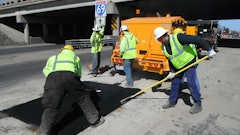
Beyond everyday working hours, this pay savings example is especially evident when looking at overtime hours. As a realistic example, consider a scenario in which a winter storm has struck. After the blizzard clears and the plows finally finish up, it’s 2:00 a.m. – and with the roads clean, it’s now apparent that some potholes need to be repaired before the morning commuter traffic hits. A company or department that offers spray patching is ideally equipped to handle this situation. From a convenience standpoint, it’s much easier to call one worker out to the site at 2:00 a.m. than to wake up six and get them out there quickly – not to mention all the equipment. Factor in overtime (or perhaps after-hours) pay and costs add up quickly. Imagine the difference of paying a single worker for just one hour of overtime versus six workers multiple hours of overtime.
Furthermore, the workforce utilization is a major benefit to consider and must be factored into the ROI calculation. Because only one laborer is required for pothole repair, the remaining workers can be utilized on other projects. This results in more efficient job completion – and, in some cases, a bonus for finishing ahead of schedule.
And the benefit is two-fold. Along with completing projects faster, larger jobs and a greater number of projects can be handled. Without hiring new workers and expanding the company or department, the entity is now equipped to take on additional jobs, and those of greater scope and size. This is especially valuable in a down economy when every company is trying to do more with less, and for government entities that are often on fixed budgets and don’t have the ability to hire additional laborers as workload increases.
Finally, all material savings, including the mix itself and application equipment, need to be factored into the total amount of ROI. Spray patching still requires mix material, and the subsequent cost of it can’t be eliminated. But because the process doesn’t waste material, it ends up working out to be much less cost over time. And with just one piece of equipment needed, fuel, maintenance and repair costs plummet.
While all of the actual numbers will vary depending on each individual operation, it’s clear that savings abound when using spray injection patching.
By Pete Kulp is Product Manager, VT LeeBoy
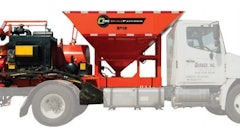
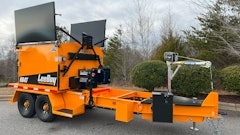
2. Larger models of spray patchers can hold up to 5 cubic yards of aggregate.
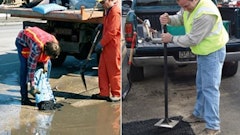
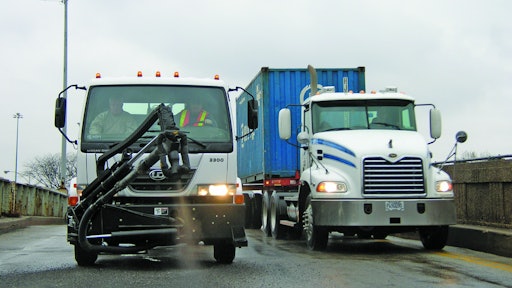
1. A spray patcher is able to operate without interrupting traffic flow. In this photo, the operator is demonstrating the process to the passenger.
3. The low-pressure system cleans, fills and seals the pothole, with the entire process taking just one minute.










![Screen Shot 2023 01 04 At 5 23 30 Pm[35]](https://img.forconstructionpros.com/files/base/acbm/fcp/image/2023/01/Screen_Shot_2023_01_04_at_5.23.30_PM_35_.63bc42696de27.png?auto=format%2Ccompress&fit=crop&h=135&q=70&w=240)

![Patcher4 4edited[66]](https://img.forconstructionpros.com/files/base/acbm/fcp/image/2022/10/patcher4_4edited_66_.63602ddb9e727.png?auto=format%2Ccompress&fit=crop&h=135&q=70&rect=0%2C123%2C1920%2C1080&w=240)

![Cemen Tech C60 5acd09ba7630e[1]](https://img.forconstructionpros.com/files/base/acbm/fcp/image/2022/03/Cemen_Tech_C60.5acd09ba7630e_1_.623c916eea2d7.png?auto=format%2Ccompress&fit=crop&h=135&q=70&rect=105%2C174%2C1725%2C969&w=240)