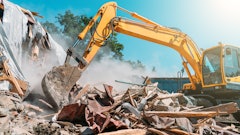
The Northeast Recycling Council estimates that more than 11 million tons of asphalt shingles are scrapped in the U.S. each year; 10 million from installation tear-offs and re-roofing jobs and another one million discarded as waste by asphalt shingle manufacturers. The U.S. Environmental Protection Agency estimates that shingle waste makes up 8 percent of the total building-related waste stream and 1 to 10 percent of annual construction and demolition debris, representing a tremendous burden to landfills across the country.
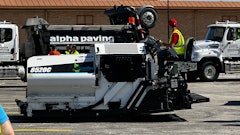
Due to their material composition (asphalt versus wood, metal and other construction materials), shingles are usually separated from other construction-related waste debris, making the discarded roof protectors a prime candidate for the recycling stream. Recycling facilities have responded, and new technology has created some money-saving opportunities for recycled shingle markets - most notably as an additive to asphalt paving preparations. Using hot-mix asphalt with only 5 percent recycled shingle material can save $1 to nearly $3 per ton of hot-mix asphalt, as well as improve the quality of hot-mix asphalt used in paving.
Concerned by the quantity of discarded construction debris that was ending up in the country's landfills and knowing that a lot of it could be put to good use, Mark Pahl saw an opportunity and founded Dem-Con Shingle Processing. Dem-Con Companies, LLC, based in Shakopee, Minn., was founded in 1985 and at first their business was mainly a construction and demolition debris landfill. Over the years, the landfill has evolved to not only demolition and construction debris, but also certain types of industrial wastes and impacted soils.
"Basically, we handle all non-hazardous waste, with the exception of household trash," Pahl says. "Construction and demolition material is still the primary focus and the largest portion of our business. We encompass an area that includes the Minneapolis/St. Paul metro along with surrounding rural communities. We process a lot of different types of construction debris before it enters the landfill, which includes pulling out wood, metal, cardboard, concrete, asphalt, etc. There is a lot of value in removing those materials prior to landfilling."
Researchers have found that using recycled asphalt shingles in hot-mix can actually improve the pavement's performance by increasing its resistance to wear and moisture, and decreasing deformation, rutting and thermal fatigue and cracking. Currently a substantial portion of asphalt shingle recycling involves mixing 5 percent ground up shingles with hot-mix asphalt used in road paving and cold patch applications. Pahl is excited by not having to landfill shingles anymore.
"From our local level each year we process about 10,000 tons (8928.6 tonne) of manufacturing scrap," Pahl says. "That material that comes right from the shingle manufacturer as factory rejects or end runs. Add to that additional scraps from reroofing existing homes, hailstorms, demolition, etc., and the amount increases to somewhere between 25,000 up to 40,000 tons (22,321.4 to 35,714.3 tonne) that used to go directly into the landfill. And that's just at our Shakopee location. Imagine the effect nationwide."
Enlisting a wood-processing trommel for assistance
According to Pahl, the material that Dem-Con receives as factory rejects is ready to be processed without any special preparation because the material is void of any contaminants or construction debris. Shingles originating from reroof projects create a bit more of a problem and necessitate some cleaning and filtering of other materials since this debris often arrives at his facility mixed with a variety of other substances, including tin, metal, roof vents, boards, etc.
"We remove all the debris that doesn't contain asphalt on a sorting line," Pahl explains. "Essentially the material is spread out on a conveyer belt and we have laborers that manually remove all non-asphalt containing materials as they move along the sort line. From there, the shingles are ready to be ground. Generally the grinder then directly feeds the material to a trommel screen to create the desired end product used for the asphalt hot mix."
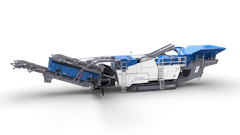
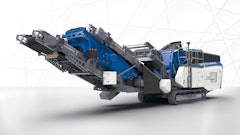
Pahl uses a grinder designed specifically to process shingle material. The raw asphalt shingles are first ground to under a ½-inch (.6 cm) minus size, and that material is then fed to a trommel to reduce the ground shingle material to an even finer size. Dem-Con purchased a Wildcat 626 trommel unit built by Wildcat Manufacturing - a Vermeer owned company - to assist in streamlining the process. "Our spec at the hot mix plant varies across the country but ½-inch minus is fairly standard," Pahl explains. Some states, including Minnesota, require an even finer sizing and that's when the trommel screen is really the only way you can get a product down to the size they want cost effectively."
The trommel can be equipped with different screen sizes to achieve the desired end result. For example, Minnesota Department of Transportation (MDOT) requires the end material to be of a consistency that Pahl describes as similar to a coarsely ground coffee. As the material passes through the different screen, each screen setting gets smaller and reduces the material to the desired end consistency. Pahl explains the process.
"The number four sieve is somewhere in between a 1/8- and 3/16-inch (.3 and .5 cm)," he explains. "The spec calls for 90 percent of the material passing the number four sieve and 100 percent passing the 1/2-inch (1.3 cm). Some states spec a material that is a bit coarser; all are different. We have found that more and more states are requiring a finer material so the Wildcat trommel will play a more important role in the upcoming seasons. The Wildcat trommel with multiple sections of screen that we can adjust quickly helps us to create a lot of variables and flexibility on how we size our final product.
All of the overs (material that is too large to meet the specs) are recycled back through the grinder and end up getting ground down further, a closed-loop process that results in all the raw material being used and no waste - so no asphalt material ever ends up in the landfill. Everything gets used.
Expanding and streamlining the processes
Dem-Con has reached out to recyclers across the country and worked with state Departments of Transportation (DOT) to expand asphalt shingle recycling nationwide. This has required establishing an in-depth knowledge of the asphalt paving industry and the hot-mix process used for completing road construction and parking lot projects.
"When we were getting this started a lot of state DOTs didn't have a hot-mix spec using shingles, but more and more are coming online," Pahl says. "Whatever the DOT spec is, we are able to meet it. We're competing with virgin asphalt because that's what the asphalt recovered from the shingles replace. Using shingles in the mix allows the hot mix producer to lower the use of the high-price virgin asphalt. So it's really a cost savings to them and this is what enables this process to be economically viable."
Dem-Con works hard to pre-sell a majority of the final product, a necessary component of Pahl's business operation because of preparing product specifically for so many different state DOTs and asphalt suppliers. "We have quite a bit of money invested in the process and we make sure the product has a home before we process it," Pahl explains. "We are also working with local recyclers who are involved with collecting shingles throughout the country to help them as well. So there are times where we may assist the company, just trying to market the material, before we ever show up to process it. It benefits everyone to be as cost-effective as possible so we will assist in whatever way possible to try to drive the process."
Growth and expansion expected
According to Pahl, asphalt shingle recycling has been occurring for several years, but the process has just recently become more refined, mainstream and is gaining efficiencies. As more states adopt specs for hot-mix materials, he is optimistic that the industry will continue to grow.
"The key for expansion is to get more and more state DOTs on board," Pahl explains. "Most hot mix manufacturers won't put any material in their mix unless it's approved by the DOT. So, if you don't have the state DOT approving the material for use on their road projects, recyclers and processors aren't going to make the investment in the equipment or technology necessary to make it an efficient business model. We have been an integral part of advancing the process here in Minnesota by working with DOT, the Minnesota Pollution Control Agency, as well as hot mix producers and associations in getting ground tear-off shingle material approved as a permissive spec throughout the state."