

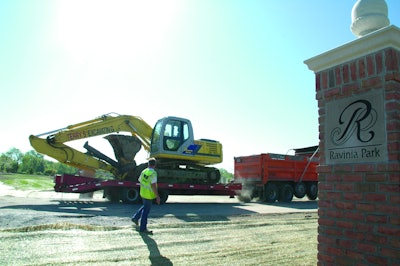
Why risk a major piece of iron by using the wrong equipment trailer? This is not the place to save money. Instead, think of an equipment trailer as a long-term investment.
"A trailer has a life cycle that's over a decade long," says Jim Ladner, Landoll Corp. This longevity means you should take future growth into account. "A trailer purchased today may not fit your needs as you grow."
"Planning for the future may be the most important consideration when matching an equipment trailer to a fleet," agrees Gary Knudsen, Felling Trailer. "Oftentimes, a customer will purchase a trailer just large enough to haul a select piece of equipment. Future projects may require the use of a different, or larger, piece of equipment and the trailer doesn't fit the need."
Before selecting a trailer, ask yourself: What am I hauling today? What am I going to haul next year? Where am I going to haul? "You must match four things: truck, trailer, payload and road regulations," says Ladner.
Look beyond GVWR
Trailer prices can vary drastically, but not all trailers are created equal. "A lot of times, trailers look the same, but they are really not. The first thing is don't shop on price," emphasizes Clint Lancaster, National Association of Trailer Manufacturers.
He recalls a contractor that purchased a 7,000-lb. GVW (gross vehicle weight) car hauler trailer to haul a skid steer. "Even though that skid loader may be within the trailer's weight capacity, the trailer wasn't necessarily designed for it. The skid steer has a very concentrated area of weight."
As Knudsen explains, "Weight distribution is a very important factor when choosing a trailer. The distribution has a huge affect on how the trailer pulls and, even more important, on how it stops. Weight distribution affects how much weight is transferred to the tow vehicle and the resulting load on the axles.
"Some trailers' capacities are rated in 10 ft., some in 16 ft. Others may have a distributed load rating. There are many ways to rate a trailer's capacity," he adds. "The calculation of the GVWR of trailers rated at 10,001 lbs. and above varies by manufacturer. Therefore, an equipment trailer cannot be selected by the GVWR rating alone. The weight of the cargo and distribution has to be considered, as well."
"Concentrated weight deck capacity and manufacturing safety margins are important to understand," Ladner emphasizes. "Spacing on crossmembers and wood type/thickness are important."
All decisions start with the type of equipment to be hauled and the terrain. "It is very important that you have a real understanding of what you are hauling and where you are hauling it," says Ladner. "When you have those answers, then the manufacturer can make sure the trailer has the correct components (axles, suspension, tires), the proper wheelbase, the correct deck length and the overall length. When you are maximizing payload, you must have everything just right.
"No one in the industry designs a product to fail," he continues. "In most cases, when the customer uses the trailer for its intended purpose, there are no problems."
Identify the weak link
Inspect the trailer frame construction. "When you have pieces of equipment that are heavy, you need to make sure there are sufficient crossmembers underneath the vehicle," says Lancaster.
But even that can be misleading if you don't understand the type of steel used in its construction. Consider a trailer with 6-in. channel. In the steel industry, there are three different types of 6-in. channel: 8.2, 10.5 and 13.0 lbs./ft. The strength of the trailer can vary widely depending upon which type of steel was used, so don't take chances.
Because a trailer is only as strong as its weakest link, check the ratings of all components. "Axle size is only one factor of a trailer rating," says Knudsen. "The actual rating is based on the lowest rated component. The various components can be the axle, suspension (springs), rims, tires, hitch coupler, frame, etc."
Lancaster explains that the frame and structure of the trailer are directly related to the axle size and the carrying capacity. For example, you can have two 6,000-lb.-capacity axles for a 12,000-lb. rated trailer, but your frame and structure need to be able to support the weight. The heavier the load capacity, the heavier the frame material needed.
The GVWR of the trailer will determine the strength, size and thickness of the steel used to make the outside frame and crossmembers. The more crossmembers a trailer has, the stronger the structure. But crossmembers also add weight, and the heavier the trailer, the lower the carrying capacity.
"Frame types vary between manufacturers and even between models of the same manufacturer," says Knudsen. "Generally, the manufactured frame main beams will be stronger and lighter than a milled beam or milled channel frame. The higher strength steel translates to a lighter weight trailer for the capacity. Some manufacturers use a beam of channel that is not large enough to meet the capacity needed and add a flat iron strap bridged under the frame to boost the capacity."
The connection point of the suspension to the frame can be a problem spot. "The most common frame failure area is where the suspension is attached to the frame; this area typically receives the most stress," says Knudsen. "The frame has to flex and the suspension contact points limit the frame's ability to flex, which can cause cracks to develop over time. Felling has added additional frame components to spread the stress over a larger area of the frame, therefore reducing the tendency to crack."
Weight vs. payload
The more weight you can remove from a given GVWR trailer, the greater the theoretical payload. But you also need to consider factors such as durability.
"It is possible to 'engineer' some weight out of a trailer, but it has little effect on the smaller capacity trailers," says Knudsen. "The components like axles, rims, tires cannot be changed very much, so the weights of these components remain fairly constant. Larger capacity trailers have larger frames and usually are of longer lengths and are able to reduce weight by frame component material choices, decking material choices, etc."
But removing weight isn't a simple task. "There is always give and take when you design weight out of a frame," says Ladner. "You will sacrifice life cycle if you take too much iron out. When possible, Landoll uses aluminum to minimize the trailer's tare weight. This is a much better way than just taking iron out. It's also important that the buyer minimize the weight of his truck and equipment that is hauled. Everything plays a part. You can't just ask the trailer to do it all."
Ensure tires and axles are rated for the task. "In some cases, tires do limit the carrying capacity of a trailer," says Ladner. "Landoll uses tires that match the load distribution for the overall GVWR rating of the trailer. The trailer buyer also needs to know if he will be hauling under permit or just legal loads. The buyer may need to upgrade the tires to have the load ratings required when hauling under permit."
Payload is calculated by taking the GVWR and subtracting the weight of the trailer. The allowable payload will vary according to the region of the country and whether you travel state or federal roads.
"You must know what states you are hauling in," says Ladner. Consider the case of pulling equipment with a tag trailer behind a dump truck. "Your limits are the number of axles and the hitch load. Heavy-duty pintle hooks normally have a 15,000-lb. vertical load limit and 25-ton tow ratings. Your dump truck will also have a Gross Combined Weight Rating (GCWR). This may be the limiting factor more times than trailer capacity."
According to Knudsen, the largest typical load allowable behind a 10-wheel dump truck is 42,000 lbs. However, there are a few factors that contribute to this.
"Federal regulations only allow 42,000 lbs. on a three-axle group with a 49-in. spread configuration," he explains. In addition, the weight of the truck and trailer added to the cargo may not exceed 80,000 lbs., which is the federal regulation limit. "The ability to haul 42,000 lbs. of cargo is also based on the weight distribution of the cargo. The cargo will have to be situated to distribute enough weight to the tongue equal to the empty weight of the trailer. If not enough weight is transferred to the axle, the weight will exceed the allowable federal weight limit."







![Ft 24 I Ds p265962 Ntu 04 [1]](https://img.forconstructionpros.com/mindful/acbm/workspaces/default/uploads/2026/09/ft-24-i-dsp265962ntu-04-1.dBRR8eNbbT.png?ar=16%3A9&auto=format%2Ccompress&bg=fff&dpr=2&fill-color=fff&fit=fill&h=135&q=70&w=240)


