What’s the difference between a drum sander and an orbital sander? The best explanation goes something like this: “A drum sander is like a chainsaw; an orbital sander is like a hedge trimmer. They both cut wood, but at much different rates.”
That explanation comes to us compliments of Jim Staalesen, president of Hiretech, who points out, “On some jobs, only a chainsaw will work and vice versa.” In other words, you don’t send a hedge trimmer to do a chainsaw’s job, or the other way around.
With this in mind, it’s important for rental employees to understand the difference in these two very different types of machines in order for your customers to achieve their desired effect.
"The drum sander receives a sleeve piece of sanding paper that slides on to a drum which is lowered to the floor using a drum lowering handle," explains Paul Albrecht, national rental manager at Nilfisk Advance & Clarke. "The drum spins at 1,800 rpms and because only a small portion of the paper/drum is in contact with the floor at a given time, the result is a very aggressive cutting action."
Staalesen adds, “A drum sander cuts; an orbital grinds."
“If your floor is in rough shape, cupped or damaged, or has a very heavy finish, a drum sander is what you need,” he adds. “An orbital won’t relevel your floor.”
On the other hand, an orbital sander is perfect for light sanding and refinishing, or if you just want to put down a fresh coat of varnish.
"Over the years the trend has leaned toward the orbital sander because the majority of renters are beginners with not much experience with sanding floors," says Albrecht. "This has allowed a rental house to rent a sander that would be far less likely to damage the customer's floor due to a lack of expertise. However, due to the fact that an orbital sander cannot level warped floors, a rental house should carry the drum, orbital and edge sanders."
Staalesen adds, “The machine that makes the most sense is dictated by the state of your customer's floor. Any rental operator that has floor sander utilization should have drum and orbital sanders.”
Nothing beats a drum
There are several varieties of drum sanders. The difference has to do with how the paper is applied to the drum itself. Generally, there are three main types:
Clamp bar – In this type of drum sander, a clamp bar is screwed tightly to the drum, holding the paper in place. This type is most prevalent.
Expandable – This variety is gaining in popularity because it’s a little easier and less complicated for DIYers to handle. In this case, a belt slides over the drum, relying on centrifugal force to hold the paper in place. The downside is the paper for this type of sander is twice as expensive as that used in clamp bar models.
Cam-lock – A cam-lock, or slotted drum is an older technology, but is still being used today. It can be somewhat difficult to train DIYers on its proper use and it requires the use of a wrench to lock the paper to the drum.
“Cam-lock sanders can be retrofitted to become clamp-bar models,” says Staalesen, “but it’s not practical to convert it to an expandable drum, as it’s an entirely different chassis.”
Frank Barous, president of Essex Silverline, explains that with drum sanders, the speed of the drum, the pressure applied by the operator and the controlled pace of the operator, plus the grit of the sand paper determine the cutting and finishing of the wood floor. "The contact line is typically an 8-inch wide, ¼-inch thick line, which can provide pressure of 18 pounds per square inch or more," he says.
Going into orbit
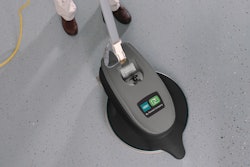
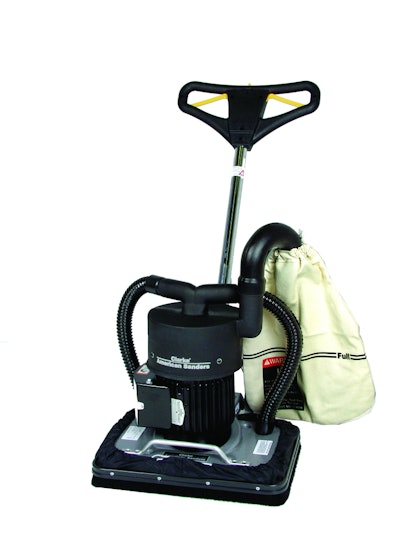
"The orbital sander is just that, orbital in nature," says Albrecht. "The drive plate oscillates in a random fashion, resulting in a slower but less risky sanding experience."
Orbital sanders rely on the weight of the machine to provide the pressure needed to sand off the materials on the floor. "The pressure applied by the weight of the machine is about 2 pounds per square inch," Barous says. "The orbital is random sanding, which doesn't have to follow the grain of the wood."
He continues, "The orbital sander is very much less aggressive as sanding pressures are about 10 times less than the drum sander. However, the orbital does an acceptable job with new floors by applying the same grits as with a drum sander. The orbital does screening and blending on your floor before your first coat of finish. The orbital is the sander to use if you do not need to remove your old finish. It does a fine job of dirt removal and roughing for application of the new finish."
According to Staalesen, when orbital sanders first caught on, they were based on the assumption that bigger is better, but that is no longer the case.
“It used to be the typical size pad was 12 by 24 inches. It was the bigger is better mentality, but the science didn’t support it,” Staalesen says. “In sanding, the effectiveness is based on pounds per square inch (PSI).”
In order to achieve greater PSI, the pads had to be made smaller. Today, you see a lot of 12- by 18-inch pads, while Hiretech’s HTF Orbital offers a 4 ½- by 15 ¾-inch pad that produces three times more PSI on the paper than 12- by 18-inch pads. “And the machine weighs only 96 pounds versus the usual 125 pounds,” Staalesen says.
The right questions
“The perception is that drum sanders can be a tool that in inexperienced hands can cause damage to floors,” Staalesen says. “Rental businesses are afraid that the user will damage their floor, so they rent them an orbital when they really need a drum sander. The result is a dissatisfied customer.”
Your customer's success really comes down to asking the right questions. Those questions include:
- What shape is your floor in?
- Do you need to relevel the floor?
- Is there heavy varnish to strip?
- Does your floor have any warping?
“If the answer to any of these questions is yes, your customer needs a drum sander,” says Staalesen. “If you customer’s floor is in good shape, an orbital will be fine.”
Training is key
As with any piece of rental equipment, there is always the potential that your customers will not achieve their desired results. One way to avoid this is to provide all the tools necessary to ensure their success. Those tools include paper instructions on machine operation and good old-fashioned practice. Staalesen suggests DIYers invest in a piece of plywood and use the sanding equipment on the scrap wood before hitting their floor with it. Rental businesses could even go one step further and offer a demo area in their store for customers to try out machines before taking them home.
"The drum sander does require a little practice, and its aggressive cutting action can create unevenness in the end result," says Albrecht. "With that said, even with just a little practice a novice can expect excellent results with a drum sander."
Staalesen agrees, adding, “With a drum sander, if you can get comfortable with it, you’ll have more success. The key is to always keep it moving evenly. As long as it’s in contact with the floor, you can’t stop or it will cause a ‘drum stop,’” or a noticeably depressed area.
Floor sanding trends
Among innovations in the floor sanding business is dust control. "The professional side of floor sanding has been recently visited by the EPA," says Barous. "They are demanding almost complete dust control. The rental industry is not yet under the new regulations, but it's probably on the horizon."
Regardless of regulations, Staalesen says dust control appeals to customers. “Market research shows a hindrance to DIY is the creation of dust. The traditional cloth dust bag has been around for 50-60 years, but they do allow a lot of dust to escape. Hiretech is the only company to bring disposable paper bags to market.”
Staalesen says effectively controlling dust "results is a cleaner jobsite and eliminates airborne dust particles that might contain small amounts of lead from old varnishes.”
What to look for
Whether you're looking for a drum or orbital sander for your rental inventory, there are some important things to keep in mind.
"With regard to the drum sander, look for ease of paper changes, the ability to lower the drum to the floor while keeping the sander on a steady three-point stance and the ability for the sander to be disassembled for transportation purposes," Albrecht says. "And finally, choose a unit that can be hooked into a tank vacuum for superior dust collection."
When it comes to orbitals, Albrecht says to look for a unit that has a long track record of solid performance and accepts non-proprietary sand paper. "This allows the house to purchase paper from many different places, ensuring that they are getting the sand paper at a fair price. And again, look for a unit that can be hooked into a tank vacuum for superior dust collection."
When it comes to floor sanding equipment, it's all about providing a solution to the customer. "Physics defines pressures, speeds and control – and our ability to package them for use to solve problems," says Barous. "And solving problems is our aim in the floor sanding universe."