
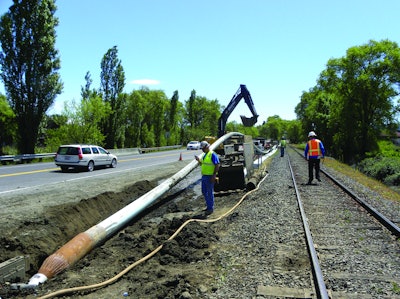
Over the last decade, pipe bursting has been increasingly accepted by project owners as a less costly, less disruptive alternative to open cut trenching for replacing underground utilities.
“In regions where the pipe bursting process has become well established, cost savings of 20% to 40% vs. open cut are typical,” says Collins Orton, pipe bursting specialist, TT Technologies.
Application flexibility is another reason for its growing popularity. It can be used to install service lines, sewer, water and gas pipelines, and even electric and communications ducts. “You can install virtually any pipe that you want,” says Alan Goodman, national sales manager, Hammerhead. “You’ll see it used on everything from 1-in. pipe up to, say, 36 in.” While 36 in. tends to be a practical limit, applications have been extended to as large as 54-in. mainlines.
There are environmental and social benefits, as well. “Bursting projects are generally about 80% to 90% trenchless,” says Orton. “Thus, substantially less material is removed from the site and much less material for backfill and paving needs to be brought in. This also results in a sizable reduction in emissions from construction equipment, and even more emissions savings for traffic that is not impeded.”
Pipe size and length
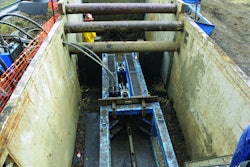
The principle behind pipe bursting is to break or split existing pipe in the ground, push the fragments into the surrounding soil as the hole is expanded and simultaneously pull new pipe back through.
Pipe bursting can be used for size-on-size pipe replacements or to upgrade to a larger size. “This ability to upsize the existing pipe is a unique feature to the pipe bursting process,” Orton notes.
However, even size-on-size replacement calls for careful planning. Different methods are used to join sections of pipe, which can influence the expansion requirements for the hole. The composition of the length of pipe to be replaced can also be a factor. In some cases, the line may consist of more than one type of pipe material due to segmented repairs.
“It’s critical to go out before you burst and CCTV that existing sewer, water or gas line,” says Goodman. “That will tell you how the joints are connected... or whether there is a transition from PVC to cast or to steel or ductile, whatever it may be.”
The connections used on the new pipe also affect expansion requirements. “When you’re pipe bursting, you have to open up a hole big enough for the pipe,” says Goodman. “When you start using types of pipe that require collars or bell joints, then you have to expand that hole even more to allow that pipe to slide through.”
Pipe bursting runs vary in length, but are generally limited to about 400 ft. “There are contractors who have gone 600 or 800 ft.,” Goodman says. “But that goes back to whether they’re going to be upsizing a lot or a little, and if the ground stays open, which will help their chances of going further in distance.”
Distance is also dictated by the number of services along the line. “Pipe bursting for mainlines is usually done on a block-to-block basis or whatever segment is reasonable,” says Orton. “Sewers are usually done on a manhole-to-manhole basis. Water mains are replaced from valve cluster to valve cluster, usually at or near intersections. Services are perpendicular to mainlines and are usually rather short — 20 to 100 ft. in length.”
The more services, the less cost effective pipe bursting becomes. “If you have a line where every 15 to 20 ft. there is a service that comes out and connects, it may not be beneficial to pipe burst because you have to dig up each service,” says Goodman.
Deeper isn’t always better
The depth of the pipe to be replaced can determine whether pipe bursting is the most practical solution.
“Any jobsite that is suited for open cut construction is suitable for pipe bursting,” Orton asserts. “However, the best cost benefit is realized with deeper pipe replacements.”
Due to expansion of the soil around the hole, there is a risk of heaving at shallow depths. “Say there is an existing 10-in. sewer line that’s 4 ft. deep and the project owner wants to install a 16-in. line. You’re not going to be able to pipe burst at that depth because the expansion that takes place would actually heave whatever is on top of that,” Goodman explains. “If there is a road, other utilities or a water line running across that, it would actually fracture and crack that water line, gas line or road.”
“Depth of cover is an important issue,” agrees Orton. “It is critical not to burst pipe that is too shallow in the ground. Measurements should be taken to evaluate the depth of pipe.”
As a rule of thumb, Goodman recommends having 10 in. of cover for every inch you plan to upsize. But even size-on-size installations produce a certain amount of expansion. For example, a 12 1/2-in. expander may be used to replace a 10-in. pipe with new pipe of the same diameter. “So really, we’re expanding from a 10-in. line to a 12 1/2-in. hole,” says Goodman. Round that up to 3 in. for easy figuring, and it would require the pipe to be at least 30 in. below the surface.
Yet, he cautions against trying to pipe burst too deep. “Depth can also work against you,” Goodman indicates. “Let’s say you want to do a 10-in. upsize to 12 in. If you’re 25 ft. deep, that ground is extremely compact and it’s very, very difficult to expand...
“So you can have jobs that may not be a pipe burst candidate because they’re too shallow and you’re concerned about heaving or breaking another utility,” he states, “or you can have a project that requires replacement of a line that is really deep and may be too difficult to expand, depending on your requirements for installation and new pipe diameter size.”
A more friendly solution
Pipe bursting can offer both environmental and social benefits.
According to Matt Timberlake, vice president and senior project manager, Ted Berry Company Inc., Livermore, ME, you can reduce carbon emissions by as much as 95% with trenchless construction. “The cost of trenchless technologies, and primarily pipe bursting, is coming down in North America,” he states. “Contrary to that, the costs of open cut construction are becoming more expensive due to the increased cost of fuel, disposal, environmental and social impacts.”
Timberlake cites a project his company performed in York Beach, ME, involving total replacement of 1,000 linear ft. of sewer line. To replace 12-in. VCP with 12-in. HDPE, the open cut method would require a 1,777-sq.-yd. excavation, including replacement of 666 sq. yds. of pavement. Estimated total cost for the application, equipment, personnel, etc. was $275,000. In contrast, pipe bursting would require 99 sq. yds. of excavation and 43 sq. yds. of pavement removal/replacement, at an estimated total cost of $125,000.
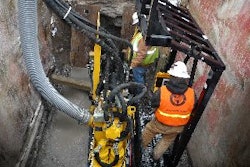
“On a pipe bursting process, there is much less support equipment needed,” Goodman comments. “When you’re open cutting, you have an excavator digging the entire line. There are support trucks to [haul material]. So from a ‘green’ perspective, there is much more fuel consumed, there is much more exhaust... Whereas, with pipe bursting, you’re only excavating one or two pits along with your services, if you have them.”
Just as telling is the estimated number of business disruptions anticipated in Timberlake’s example — five for pipe bursting vs. 15 for open cut.
“We are seeing more ‘downtown’ type applications for pipe bursting,” says Orton. “Project designers are beginning to recognize the advantages of pipe bursting in difficult locations.”
The benefits are readily apparent in urban installations involving multiple utilities. “When you’re dealing with congested areas, you wouldn’t want to start digging due to concerns about breaking other utilities,” Goodman states. “That’s an area where [the ability] to minimize disruption would be beneficial.”
Installations along easements can also benefit from bursting. “Easement areas are usually troublesome for all but pipe bursting because of poor access and the need to maintain existing hardscape, landscape and buildings,” says Orton. “Many pipebursting jobsites may be in difficult access easement areas behind homes or down steep slopes. Open cut is virtually impossible in many situations.”
Pipe bursting eliminates such challenges, while minimizing disruption to businesses and residents. “Most bursting work takes place in the public right of way or in established easement areas,” Orton notes. “Driveways and cross streets remain open so the public has continuous access to roads and property. Many utility owners and engineers recognize these benefits and take advantage of the pipe bursting process on a regular basis.”




![[VIDEO]Hear the Hush with Vermeer's Quiet New S3 Series Directional Drills](https://img.forconstructionpros.com/files/base/acbm/fcp/image/2015/10/default.560ed0d6eea1b.png?ar=16%3A9&auto=format%2Ccompress&dpr=2&fit=crop&h=135&q=70&w=240)


