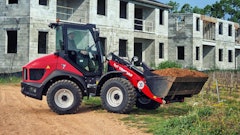
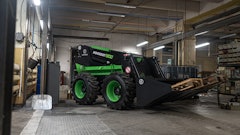
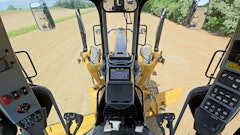
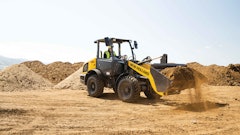
Skid steers are arguably the most common, most popular and most highly utilized piece of equipment on a typical construction site. Along with their tracked brethren, they make up the largest percentage of construction machines sold in North America; there are over a dozen suppliers; and as of CONEXPO-CON/AGG 2011, you have even more models and brands to choose from.
Following is a look at some of the latest entries into the skid-steer market. For more information on these models, turn to the reader service card following page ??, or visit the Equipment Network at ForConstructionPros.com.
Bobcat M-Series Models
Since its introduction nearly two years ago, Bobcat continues to build upon its M-Series loader line. The latest additions are the S750 skid-steer and A770 all-wheel-steer loaders, both of which boast rated operating capacities of over 3,000 lbs.
The S750 delivers 11 ft. of vertical lift — 3.5 in. higher than the S300 it replaces — and features a 23-gpm standard hydraulic flow, a boost of 11%. Its operating weight is 8,730 lbs., with a rated operating capacity (ROC) of 3,200 lbs. Power is supplied by an 85-hp turbo-diesel engine.
The 9,460-lb. A770, which replaces the A300, offers 132 in. of vertical lift height, 31.5 in. of reach and a 42° dump angle for easy truck loading. ROC is 3,325 lbs. and tipping load is 6,650 lbs. Power is provided by a 92-hp liquid-cooled Tier 3 diesel engine. The standard two-speed transmission provides a 12.3-mph travel speed in high range and 7.1 mph in low range.
All-wheel-steer (AWS) capability is designed to minimize ground disturbance, reduce tire wear and enable faster travel speed. For applications where it’s not needed, the operator can switch to skid-steer drive at the press of a switch.
In addition to the features found on all M-Series models — such as a cab-forward design and added creature comforts — the hydraulic system has been engineered for higher standard flow and pressure to give attachments more power for quicker operation. New job-enhancing features have also been added to the optional deluxe instrumentation panel. A 5-in., full-color LCD screen offers better readability and interaction, and easy-to-read virtual sweep gauges allow the operator to quickly read and understand machine performance.
Case Alpha Series and New Holland 200 Series
While initially unveiled at The Rental Show, CONEXPO-CON/AGG provided the first chance for contractors to check out the new Case Alpha Series loaders.
The series includes the SR130, SR150, SR175, SR200, SR220 and SR250 radial lift and SV185, SV250 and SV300 vertical lift models. They range from 46 to 90 hp, with ROCs from 1,300 to 3,000 lbs. and bucket breakout forces up to 8,585 lbs.
Improved visibility, operator comfort, climate management and operator controls are hallmarks of the Alpha Series. Cabs are 25% larger and feature an ultra-narrow wire side-screen design that improves operator visibility. The glass surface is increased to provide 360° visibility. Creature comforts have been added inside the cab, as well, to enhance operator productivity.
The new Power Stance chassis design includes a longer wheelbase combined with a 30/70 front/rear weight distribution. This keeps the center of gravity from moving when the loader arms are raised.
On the New Holland side are seven new 200 Series skid-steer loaders, also offering longer wheelbases for added stability.
The L218, L220, L223, L225 and L230 are rated from 57 to 84 hp, and feature the vertical lift Super Boom design. The L218 has an operating weight of 5,850 lbs. and a bucket breakout force of 5,435 lbs. The L230 has an 8,300-lb. operating weight and a bucket breakout force of 8,585 lbs.
A new self-leveling bucket feature allows attachments to maintain the preset location throughout the lift cycle. A 53° dump angle lets operators empty the bucket faster. And an optional Glide Ride feature delivers a smooth ride over rough terrain.
The 43-hp L213 compact radial lift skid steer has an ROC of 1,300 lbs., while the 9-hp L215 has a 1,500-lb. ROC. Both models offer a bucket breakout force of 4,150 lbs. A full-size cab includes air ride seats, heat and air conditioning. The models also offer Glide Ride and self-leveling buckets.
Both the Case Alpha and New Holland 200 Series models offer 16- to 25.5-gal. fuel tanks that allow the loaders to provide extended operation without refueling.
Volvo Single-arm C-Series
Volvo unveiled its first skid-steer models produced through its manufacturing agreement with JCB, and announced plans to add more models later this year. Two tracked models are also available to the North American market.
The new MC110C, MC115C, MC125C and MC135C offer ROCs from 2,250 to 3,000 lbs., with Tier III engines providing 84 to 92 gross hp. The single loader arm has been designed with more steel than the equivalent B-Series model, with large pivot pin diameters for greater strength and effective load distribution over the arm. All hydraulic connections use O-ring face seal fittings to eliminate hydraulic leaks and resist line vibrations/twists.
The design of the single arm supplies improved visibility, safety and enhanced cab access via a large, wide-opening side cab door. A bolt-on non-slip step under the door increases safe entry and exit. In addition, the cab features a large top window for added visibility during truck loading.
The operator’s environment has been redesigned for increased space, comfort and ease of use. All controls and gauges are ergonomically placed.
A forward-tilting cab and large rear compartment service door provide improved service access. Side cab entry/exit make it possible for the operator to engage the loader arm support without the aid of a second person.
JCB New Generation Additions
Not resting on its laurels, JCB has added two models to its own New Generation lineup. The 225 skid-steer loader and 225T compact track loader feature radial lift configurations with an ROC of 2,250 lbs.
All New Generation models feature multifunction joysticks; an isolated, sealed and pressurized cab with reduced noise levels; heated air suspension seat with adjustable armrests; tilting cab with increased service access; and O-ring face seals for all hydraulic connections. They also offer a larger left side entry door and a 17% larger cab than previous generation models.
The “PowerBoom” design uses a single arm, eliminating the need for a torque tube across the back of the machine. This provides an unobstructed rear view and better all-around visibility. The mesh screen on cab models has been replaced with laminated glass to further enhance visibility.
Parallel lift and two-speed options make it easier and faster to maneuver around the jobsite. The optional Smooth Ride System (SRS) eases transport of materials over rough terrain.
A mechanical or optional hydraulic quick hitch offers compatibility with a new range of more than 30 types of JCB attachments.
Mustang Vertical Lift 3300V
The model 3300V is a vertical lift machine designed to achieve lifting heights of more than 131 in. Its heavily constructed boom provides considerable forward reach at trailer loading and dumping heights. An extra-long wheelbase and new chassis design enhance stability and provide optimal weight distribution.
The loader has an ROC of 3,300 lbs., and is powered by an 84-hp, 215-ft.-lb. Yanmar Tier III turbocharged diesel engine. The electronic engine control and foot throttle allow operation at partial throttle, reducing sound levels and fuel consumption.
Thick steel plating and heavy-duty pins and bushings provide strength and durability. A standard rear bumper/counterweight enables enhanced load capacity, rear protection, as well as a tow hitch.
An ergonomically designed cab includes a standard joystick pilot control system in hands-only or hand/foot pattern. A high-flow auxiliary hydraulics option is available.
LiuGong 365A and 385A Loaders
LiuGong’s new 82.6-hp 385A skid steer is equipped with a Yanmar Tier 4 Interim turbocharged engine, while the compact 365A is powered by a 67.3-hp Yanmar water-cooled, four-stroke engine. Both models incorporate industry proven hydrostatic transmissions and offer travel speeds of up to 7.6 mph.
A radial lift path loader arm design enables maximum dump heights from 7 ft. 4 in. to 8 ft. The standard level-lift function provides stability while transporting materials. The 385A has a 2,300-lb. rated load, static tipping weight of 4,600 lbs. and breakout force of 5,900 lbs. The 365A offers a 1,750-lb. rated load, 3,500-lb. static tipping weight and 4,590 lbs. of breakout force.
Hydraulic pressure of 3,000 psi enables the loaders to power a variety of attachments. An auxiliary high flow valve is available for work tools that require additional power with switchable flows from 21 to 31 gpm.
The operator station includes a ROPS/FOPS deluxe enclosed cab with climate-controlled air conditioning, AM/FM radios, front window safety interlock, backup alarms and rotating beacons. Work functions are controlled with the standard dual mechanical operating lever with H-pattern. A control safety interlock system disables operations when the operator is not actively running the machine.