The stripes can often seem brighter when parking lot marking contractors consider road marking as an expansion option, and it’s no wonder: The contracts are bigger, the lines are longer, the gallons put down are greater – and the profit potential can be seductive.
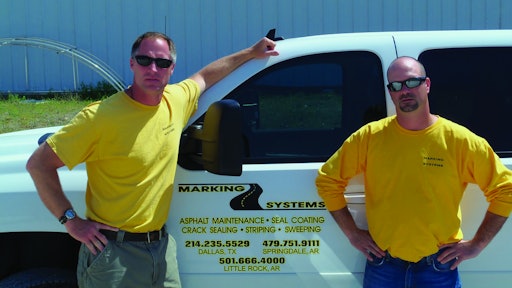
But Mike Cumming, president of Marking Systems, Little Rock, AR, knows those stripes aren’t always as bright as they seem. The owner of a three-location pavement marking company headquartered in Little Rock, AR, has been there, done that – and it almost cost him his business. Since then he’s developed a model for opening additional pavement marking locations, and he is well on the way to growing his company within the parking lot striping niche he knows best and enjoys most.
“We want to be recognized as the best or one of the best in striping, first and foremost, and that will always keep our doors open,” Cumming says. “Then we can add other services once we reach that point.”
That’s the plan that got the company started in 1992 and the plan that pulled Marking Systems through ten years later after its brief but scary foray into the long-line striping business. It’s a plan that requires learning the business, hands-on management, a focus on pavement marking, and developing a reputation that makes current customers ask you to do more work for them.
“I think I’ve got a model that works on which to expand. I think I could take somebody with a very little bit of knowledge in parking lot work and train him and open up another office,” Cumming says.
And other than an ill-fated foray into road striping that almost destroyed the company, Cumming and Marking Systems are on a slow and steady path to growth. Today Marking Systems covers Arkansas, Oklahoma, Louisiana, Missouri, Tennessee, Mississippi, and parts of Texas from three locations: Little Rock, the first branch in Springdale, AR; and the most recent expansion, Dallas.
The headquarters in Little Rock was started in 1992 and currently employs 10 people doing work on parking lots, small highways, and intersections. Cumming says 60% of the work is pavement marking including thermoplastic, and 40% is pavement maintenance and repair including sealcoating, cracksealing, and pothole repair. “That 60 used to be 90,” Cumming says.
And that’s part of the model.
A Business Model That Works
“I focused only on striping from 1992 to 1998 and had great luck with it,” Cumming says. “But I wanted to grow and pavement maintenance was a big growth area I saw. My commercial clients liked dealing with me and they called me and wanted me to do more work for them, they wanted me to take on more of their properties. Pavement maintenance work goes hand in hand with striping -- I even have two sweeper trucks – and I just continued to do more of that and transform the company.”
Cumming says the company got a big boost in 1995 when he was awarded a contract to restripe a number of Wal-Mart properties throughout the south-central U.S., living in an RV and pulling a trailer with all equipment behind it. “We worked our tails off that summer but made good money – enough to buy new equipment and a new trailer, and that’s how we operated until 1999,” he says.
Following the approach that was successful in Little Rock, Cumming in 2005 opened Marking Systems NW in Springdale, AR. “Everything we do in Little Rock they do in Springdale,” Cumming says. Brad Cordell, Marking Systems vice president, manages the Springdale branch and its five employees. The branch started with almost 100% pavement marking work but following the Little Rock model that has now shifted to 70% pavement marking and 30% pavement maintenance.
In 2008 Cumming opened Marking Systems of Texas in Dallas, managed by his cousin Steve Humphrey.
“I trained Brad in-depth and I’m confident with what he can do,” Cumming says. “Once we got to that point we opened Springdale. Then we trained Steve for a year and when I got to the same point with him we opened in Dallas.”
Cumming says Dallas generates 95% of its sales from striping. Cumming decided to open in Dallas partly because the company wouldn’t have to invest a lot to get the operation up and running. They sent a machine and truck down from Little Rock, so the equipment investment was minimal, and Steve kept his regular job as the branch ramped up.
“It allowed us to expand into that area without a big financial risk,” he says. “It was an easy transition and we were able to grow slowly. The economy forced that to some extent but that’s how we want to grow anyway. From my experience in road work I’m not going to jump into something again. The Dallas market offers great potential but we’re going to take it very slow.”
Striping Roads: The Beginning of the End -- Almost
Looking back, Cumming says 1999 was the start of a period that almost destroyed the company he’d spent seven years building. He says he decided long-line road striping was the best approach to big growth, so he took on a partner to get the company Disadvantaged Business Enterprise (DBE) status and went after road and highway striping.
He says he knew there was a lot of work available and he thought Marking Systems could get it. “But be careful what you wish for,” Cumming says. “We had so much work from 1999 through 2001 that we couldn’t do it all.”
To get into the road marking business Marking Systems made “a massive investment in equipment” including a $200,000 paint truck, a $350,000 thermoplastic truck, all the support trucks and equipment needed to do long-line road striping, and they added sign installation to their services.
“Plus we had 38 employees at the time and I was tied to them. I thought I had to have them so I overlooked things like being late to work, repeated mistakes etc. We had some rough employees and my biggest problem was feeling like I had to have them -- and in a way I did need to have them because we had so much work to do and so many bills to pay,” he says. “After a while it just took me to thinking ‘what am I doing here?’ I was miserable every day.”
Cumming says he learned a lot during his two years striping roads, including the importance of quality employees and reliable managers.
“I was young and thought I could take over the world in a painting sense,” he says. “But running something that big and that complex you really need to have your head on straight, you need a good group of employees you can rely on, you need a production manager you can trust, and you need to be able to delegate.
“I didn’t feel comfortable delegating, and some of it was I just didn’t trust anyone to do what needed to be done,” he says. “But part of it was I didn’t want any of those people being the face of my company. I just wanted them to do the work and go home.
“Today if an employee is my biggest problem then that employee will go, and I stick to it,” he says, explaining he recently had to fire a 13-year employee that he didn’t want to let go. “It was a very, very difficult thing to do but I stuck with him for a year and he couldn’t turn things around so he had to go.”
“I tried to run that bigger business, I micromanaged it and I didn’t have the experience, so a lot of what happened and the problems is on me,” he says. “But at the same time I didn’t feel like I had anyone I could trust to assist me in running it. I feel like if I have good employees like we have now then we can be efficient. We didn’t have employees who could be on their own and the margins on that type of work were too tight to not be efficient.”
So by the end of 2001 he and his partner knew the time had come to end the road striping experiment, and the two partners parted ways amicably. “I was depositing a lot of money but it was all going right back out and it took me a year to figure out what was going on,” he says. “We realized we gave it a good shot and it just didn’t work.
“We just couldn’t manage it all. It was too big too fast and I was too young and just couldn’t handle it. We nearly went into bankruptcy,” he says. “Looking back I think those 2 ½ years probably set me back 10 years as far as growing the company is concerned.”
Getting Back to Basics
But he wasn’t done with striping and he didn’t want out of the striping business.
Cumming says he and his partner never abandoned the parking lot market completely, estimating that about 70% of their work was on roads and 30% on parking lots. “But a lot of my customers thought I was too big to handle their parking lots. I lost a lot of great customers who had trusted me and I had to slowly gain their trust back and some I never did get back,” he says. “There are two or three of them I haven’t been able to get back.”
Cumming says that Marking System went from $1.5 million in sales with road striping to $200,000 in parking lot striping sales at end of 2002.
“I found it was very humbling but the result of all that is to go back to your basic instincts,” he says. “It really simplifies everything for you: Here are the jobs we’ve got, let’s go do them and get paid and get on to tomorrow. It took a lot of worries away.”
So he started knocking on doors. “I went to construction sites and talked with the supervisor on the site, I went to restriping prospects and left my card and I told them basically the same story and thanked them for giving me a shot if they did.”
He says it took him a full two years to get back to where he was before going into road striping, and he credits a number of factors for his success reviving his pavement marking company. First was his willingness to start over. He went back to the way he started his company and built Marking Systems back up one job at a time. “We went back to doing $300-$400 jobs, doing three or four a day,” he says. “I always said ‘If we can do four minimal jobs a day we can be profitable.’ We downsized to four guys and we went back to doing that type of work.”
Next he credits a core group of paving and sealcoating contractors who have remained loyal to him, subcontracting their striping work to him over the years. And finally he says some of what he did and learned in his foray into road striping carried over to parking lot work.
“Once we got back into parking lot work we made a pretty good living doing big box stores and new construction, and the road work we had done did help out because I had kept the thermoplastic handliners from that business,” he says.
Cumming says that in 2002 most parking lot stripers hadn’t made the switch to thermoplastic “and that’s how I got back after the 2001 – striping overlays for the asphalt guys and doing thermoplastic for the big box stores. We could both stripe the lot with paint and use thermo on the roads in and around the store,” he says.
“I found a nice little niche in the big box stores, and the thermoplastic really helped me do that,” he says. “For a while we were doing eight a year and to a parking lot striping company if you can get a $50,000-$70,000 job like that it’s a pretty good size job , especially if you’re efficient, which we are.”
Efficiency in Operation
Cummings says an essential part of the model he has developed is a systematic approach to the business and an efficient operation, and that starts right from the bid.
“There are only so many ways you can put paint down on a pavement, so once you get to a certain point with equipment your efficiencies have to come from the planning or organizing you do,” he says. ““I like to simplify everything I do.”
Estimating on all new construction jobs is handled by Jerry Heard, who prepares each estimate and bid without leaving his office. “He does it all online and he sends me exactly what we bid to the gallon,” Cumming says. “It can be a 20-line eye clinic or a big box store and he sends it to me all ready to go to the client.”
On any job outside of new construction Cumming, Cordell and Humphrey save time by using Google Earth to measure a parking lot and count stripes, then a quick drive through the property identifies any additional work opportunities or problem areas.
“We’ll bid the job right then, email the estimate, and we’re done. Last week, for example, I bid $50,000 worth of sealcoating and pavement maintenance work without leaving the office,” Cumming says. “Even when we have to get out on those lots rather than spend three hours out there I can spend 30 minutes because all the measuring and everything else has been done in advance. We don’t spend a lot of time and gas, which means we are much more efficient and can be more competitive.”
Cumming says that his crews are trained to work efficiently – something he and Cordell learned early on.
“When Brad and I worked together on parking lots back in the mid-90s we would have our steps down from the time we got out of the truck, to the layout, to the striping. We would know what the other was thinking. We always say, that ‘a good crew is one that doesn’t need to talk.’ Everybody is on the same page without a lot of time discussing every move. This is something we preach daily,” he says.
“This is a philosophy that you instill in your crew leaders. We are constantly training, talking, so my crew leaders know exactly what they have ahead of them on the job. We go to the job with everything we need and we finish the job.”
To help keep things efficient and on schedule both Cumming and Cordell rely on “to do” lists to run their operations. “We each have a list for every day and we check things off the list as they’re done. We go over them line by line to make sure everything’s covered. It might seem archaic to some people but that’s the way we do it and it’s very effective.”
Loading Up and Getting Out
Cumming says each Monday morning begins with a meeting with supervisors to let them know what jobs are scheduled for the week ahead. Monday’s meetings also are when Cumming or Cordell let the crews know of any changes that might happen as a result of subcontractor work.
“I often get calls from our contractor customers telling me we have to be on a specific job on a certain day to finish it off for them so I move things around as needed to make sure those contractors are taken care of,” Cumming says. “We have somewhat of a moving schedule but we need to because those contractors need us when they need us.”
On Monday each supervisor is given a load sheet for the week that covers everything needed for each job their crew is scheduled for, including how many signs, sign poles, gallons of paint, stencils etc. “It’s detailed down to each pole, gallons, stencils,” Cumming says. “Each trailer is stocked with the basics – chalk, white and yellow paint, basic tools and equipment, then stencils and other tools or materials are loaded onto each trailer according to the job.”
Cumming and Cordell talk with crew supervisors at the end of each day as well. “We need to make sure we’re still on the schedule we planned for that week,” he says. “If we’re not on schedule I need to know so I can make any adjustments we need and to let the next day’s customer know what’s going on.
“If we are on schedule they know they have to come back to the yard and refer to the load out sheet they got on Monday and load the trailer so it’s ready to go the next morning. The faster they can load up the sooner they can get out of there.”
He says his biggest battle is training the crews to load each trailer at the end of the day with everything needed for the next day’s work. “The guys come in every evening and everybody’s tired and I know they’re tired and they want to go home, but we‘ve got to be prepared for the next day,” Cumming says. “If we load the trailers when we get back to the yard the load out in the morning goes from 30 minutes to 5 minutes because we got everything ready the night before. Instilling that in these guys has been the hardest. ‘This is what you do at the end of the day every day. I know you’re tired but it’s part of the job.”