Premature finishing, overworking the surface and inadequate curing are typical causes of surface defects on exterior slabs. Some of these defects include premature wear, scaling, mortar flaking and plastic-shrinkage cracking. Figure 1 in the sidebar shows the construction steps or sequence to properly place, finish and cure exterior slabs. If these steps are not properly followed, surface defects can occur resulting in costly repairs or slab replacements for the concrete contractor.
Avoid premature finishing
Premature finishing occurs when the second floating starts too soon. Premature finishing typically involves finishing or mixing bleed water into the top surface of the concrete or prematurely sealing the surface. Sealing the concrete prematurely traps rising bleed water and air beneath the top surface creating weak or soft zones directly beneath the slab’s surface. Mixing bleed water into the surface or trapping bleed water and air directly beneath the surface typically results in premature surface wear and scaling.
Do not finish bleed water into the top surface. Upon concrete placement, mixing water starts to migrate upward as cement and aggregate particles begin to settle. This phenomenon is called bleeding. If the evaporation rate at the surface of the slab is less than the bleed rate of the concrete, bleed water accumulates and creates a sheen or layer of water on the top surface.
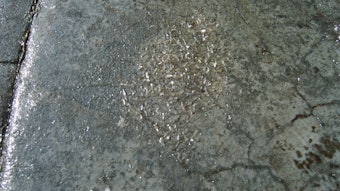
As illustrated in Figure 1, wait for the bleed water to evaporate or physically remove the bleed water before starting the second floating process. Also, the second pass of edging and jointing should not start until most of, if not all of, the bleed water is gone. Mixing or finishing bleed water into the top surface increases the water to cementitious material (w/cm) ratio on the top surface as shown in Image 1. Increasing the w/cm ratio decreases strength and watertightness of the concrete making the surface more prone to premature surface wear and scaling. If the surface has stiffened sufficiently for floating but bleed water has not evaporated, drag a rubber water or compressor hose across the surface to remove the surface water.
Do not trap bleed water and air. More often, premature finishing or improper first (bull floating) or second floating results in trapping rising bleed water and air below the top surface of the concrete (Image 2). When this occurs, the resulting weak or soft zone below the surface causes the top surface of the concrete to flake or scale off. Of course, other factors including exposure conditions, overall quality of concrete (strength, mix proportions, aggregate properties, etc.) and quality of the air-entrainment and curing contribute to the scale resistance of concrete.
However, finishing slabs before bleeding has stopped is a common cause of surface scaling, especially in areas of the country where surface evaporation rates commonly exceed the bleed rates of concrete. When evaporation rates exceed bleed rates, finishers many times mistakenly believe the waiting period is over and start the second floating operation. However, the concrete has not stopped bleeding. The surface has stiffened and appears ready to be floated but stiffening occurred due to drying of the surface and not by the hydration process of the cementitious materials. To offset surface drying, use foggers or spray-on evaporation retarders.
In the early spring and late fall, another similar phenomenon may occur when concrete is placed on cold ground or base materials. Due to warm air temperatures and solar radiation, differential concrete setting occurs or the concrete sets from top down. When this happens, the surface is ready for finishing but the underlying concrete is still plastic and bleeding. This situation presents a finishing challenge. Consider offsetting differential concrete setting by using hot water and chemical accelerators to offset the slower setting concrete below the surface or warming the ground or base materials with electric curing blankets or hydronic (ground thawing) systems.
While bull floating or darbying, do not seal or close the surface by tilting a float or darby so that only the leading or trailing edges are in contact with the concrete. Keep bull floats and darbys as flat as possible to increase the contact area on the fresh concrete. This reduces the pressure applied to the concrete and reduces the potential for densifying and sealing the surface. To check if the floating operation is sealing the surface, do not float a small test section. Cover the test section and an equal floated area with a sheet of clear plastic. If bleed water appears on the test section (non-floated area) but not on the area floated, the floating operation sealed the surface.
As stated in Figure 1, steel troweling is not recommended for exterior slabs exposed to winter conditions and deicing chemicals. Surface sealing is more likely to occur when using steel trowels or fresnos to finish air-entrained concrete. A fresno is a long-handled trowel with a 5-in.-wide and 24- to 48-in.-long blade that looks like a bull float. However, it is a steel finishing trowel and should be used like a trowel. Steel finishing tools both densify and close the surface. Thus, bleed water and air rising to the surface can be trapped below the surface reducing the scale resistance of the concrete. Many finishers commonly use steel trowels and fresnos to finish exterior, air-entrained concrete with success by waiting as late as possible before using these tools. Be cautious if using steel tools to finish exterior concrete exposed to winter conditions and understand there are higher scaling risks associated with their use.
Avoid overworking the surface
Overworking can create excessive mortar at the top surface but primarily overworking the surface can significantly reduce or even destroy the air-entrainment along the surface of the slab as shown in Image 3. The absence of entrained air voids along the top zone makes the surface very susceptible to scaling when exposed to winter conditions and deicing chemicals. Overworking the surface commonly occurs when the concrete is overly wet during the floating operations.
Inadequate curing
Favorable moisture and temperature conditions must be maintained throughout the entire construction process starting with the concrete placing operation and stopping when the specified cure period ends. Curing or concrete protection can be subdivided into two time periods: 1) before texturing and 2) after texturing.
Plastic shrinkage cracking. If the evaporation rate exceeds the bleed rate before texturing or during the finishing process, the water sheen discussed previously does not form and surfaces are prone to early drying resulting in plastic shrinkage cracking and surface crusting. When surface moisture evaporates faster than it can be replaced by rising bleed water, concrete shrinkage at the surface exceeds the shrinkage of the underlying concrete resulting in surface tears or cracks.
Crusting. If excessive moisture loss occurs, a surface crust may form on the top surface. When this occurs the top surface becomes stiff and hard to finish due to surface drying, but the underlying concrete is still plastic. Surface stiffening should occur because of the chemical hydration process of the cementitious materials — not by premature surface drying. Slabs that crust are difficult to finish and typically result in a wavy, cracked surface that is prone to premature surface wear and scaling. As shown in Image 4, the tined surface is highly irregular due to the loss of plasticity during tining and open void spaces occurred because of trapped bleed water and loss of surface plasticity.
Mortar flaking. Mortar flaking over large aggregate particles is a form of surface scaling related to early surface drying. Aggregates with flat surfaces are prone to mortar flaking because these aggregates block bleed water from replenishing the evaporated moisture from the mortar covering the aggregates. This results in a dry-mortar layer of low strength, poor aggregate bond and low durability. Upon exposure to winter conditions and deicing chemicals, these thin layers of weakened mortar flake off. Occasionally mortar flaking precedes wide spread surface scaling but many times it does not.
Premature surface wear and scaling. In addition to improper finishing, failing to maintain favorable moisture and temperature conditions during the finishing process and delaying or improperly curing after texturing increases the potential for premature surface wear and scaling. In order for concrete to develop its full strength and durability potential, it must be properly protected and cured. Image 5 shows surface defects caused by failing to protect freshly placed concrete from freezing. This concrete exhibited extensive scaling and deterioration during its first winter of service.
Use foggers, plastic sheeting and spray-on evaporation retarders to offset early surface drying and resulting defects including plastic shrinkage cracking, crusting, mortar flaking, premature surface wear and scaling. After texturing, start curing immediately and as soon as the surface will not be damaged by the curing method. Use wet burlap, blankets, cotton mats, plastic sheeting or curing compounds. Cure for a minimum of seven days unless otherwise specified.
Late finishing
Of course, waiting too late and allowing concrete to become too stiff before starting the second floating and texturing may result in poorly textured surfaces. However, extending the waiting period as long as possible reduces the potential of prematurely sealing surfaces. The challenge is waiting as long as possible to start floating but not too long. Finishers who understand and overcome this challenge are rewarded with more scale resistant surfaces.
References:
- ACI 302.1R-04 Guide for Concrete Floor and Slab Construction, American Concrete Institute, Farmington Hills, MI, www.concrete.org
- Craftsman Workbook CP-10 (05) ACI Certification Program for Concrete Flatwork Technician and Finisher, American Concrete Institute, Farmington Hills, MI, www.concrete.org