When it comes to being innovative, light tower manufacturers have been very busy indeed. New products introduced this year feature an alternative power source, LED lighting and a second generation of performance and value, among other advances – all destined to bring a host of advantages to end users.
Hydrogen fills a niche
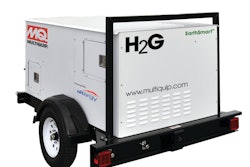
One light tower breaking new ground is the H2LT from Multiquip. Powered by hydrogen fuel cells and featuring plasma lighting, this unit was first introduced to the public last fall, and made its formal debut at this year’s World of Concrete.
“We started to think about developing a light tower that uses an alternative energy source back in 2008,” recalls Torsten Erbel, Multiquip’s vice president product management, engineering and customer support. “The demand for alternative power sources is growing for underground applications, indoor work and use in residential areas where noise and pollution issues are a concern. After looking at more traditional power sources, we asked ourselves, ‘How about hydrogen?’”
After nearly two years of R&D, the company introduced the EarthSmart H2LT. “Hydrogen fuel cells provide a tremendous alternative fuel,” says Erbel. “Hydrogen is abundant and the fuel cells are not only extremely efficient, they are also virtually pollution free. The use of hydrogen fuel cells and plasma lighting allows this unit to provide 68 hours of runtime.”
He points to other benefits, like the cost savings compared to traditional power sources. “There’s a projected 86% cost saving after 10,000 hours of operation vs. diesel power and 21% after 2,000 hours,” he indicates. A large part of these savings comes from reduced maintenance costs and the escalating cost of fuel.
Not to mention the benefits that plasma lighting brings to the table. “Eight plasma lights provide 23,000 Lumens per light,” Erbel explains. “The bulbs have a 50,000-hour lifetime and they are 50% more energy efficient compared to traditional 1,000-watt systems.”
With a price tag that is three to four times that of other light towers, Erbel admits that the H2LT isn’t for everyone. Yet, when you put a pencil to operating cost savings, environmental benefits and certain federal and state tax incentives, the unit can fill an important niche.
“One questions that always comes up is the availability of hydrogen,” Erbel notes. “The hydrogen cylinders feature a nozzle that is identical to the one used on fuel cell vehicles. Currently, there are approximately 200 hydrogen filling stations around the country, along with local fuel supply outlets that offer hydrogen. The number is only going to increase as the use of vehicles and equipment powered by hydrogen fuel cells become more common place.”
Battery-powered performance
Terex Aerial Work Platforms recently introduced two battery-powered light towers also designed for special applications or where pollution can be problematic. The AL 5L and AL 4L feature LED technology that, in combination with batteries, eliminates engine noise and emissions, while lowering operating costs and improving performance.
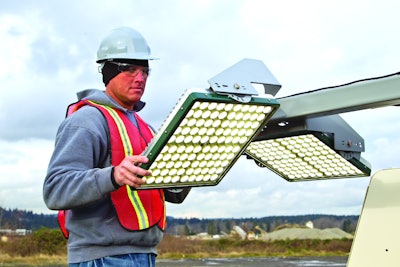
The light towers have four panels, each with 100 individual LED bulbs offering 50,000 hours of runtime. Chad Hislop, Terex associate product manager, asserts, “This not only gives them five times the life of metal-halide bulbs, but LED bulbs also emit a more focused light than metal-halide bulbs. [That] means more light on the jobsite with less glare and light pollution. They also have instant on/off operation. And not having a filament makes LED bulbs less susceptible to vibration and breaking.”
The AL 4L is offered with batteries only, while the AL 5L comes standard with an 8-kW generator for charging onboard batteries. It can also be used to charge up to three battery-operated AL 4L light towers.
“When used this way in collaboration, they actually give users 40 hours of light for eight hours of generator time,” says Hislop. “This presents a considerable fuel savings, something that is especially attractive as the price of diesel fuel continues to rise. If users are on a jobsite where power is available, they can simply charge their light towers by plugging them into a 110V circuit.”
The light towers are built on the same chassis as their AL 4000 and AL 5000 metal halide counterparts, but they are not meant to replace them, says Hislop. “The LED technology is very versatile and can be used in a wide variety of applications, while lowering operating costs and improving job performance,” he explains. “Yet, it is more expensive, too.”
LED light towers cost approximately twice as much as conventional models. As Hislop points out, however, there is a place for both technologies, and when a project calls for special needs, the LED light towers can be an attractive option.
The next generation takes over
Twelve years after introducing its Night-Lite PRO light towers, Allmand has introduced the Night-Lite PROII. Available in V-Series (vertical only) and traditional “laydown” configurations, the new models offer a number of updated features to enhance operation and serviceability.
“Our Night-Lite PRO series has a great reputation for performance and value, and we wanted to build on that,” says Doug Dahlgren, Allmand sales engineer.
He notes that all new domestic PROII models feature the SHO-HD (Super High Output-High Definition) lighting system. “Four 1,250-watt bulbs increase performance over traditional 1,000-watt bulbs,” says Dahlgren. “The 600,000 lumens they produce more closely approximate daylight for a safer and more productive workplace. In fact, three Allmand light towers with our SHO-HD lighting system can replace four light towers with industry standard 1,000-watt bulbs, and provide a higher level of illumination.”
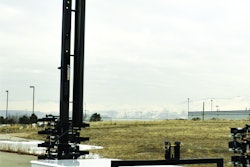
He continues, “Another feature that speaks to performance on the V-Series is the hydraulically-actuated tower that can be fully raised or lowered in only 20 seconds with the flip of a switch. The four light fixtures also have infinite adjustment capability to reduce glare, which makes them ideal for highway repair projects. An optional Saf-T-Visor set can be added to reflect previously wasted light directly onto the worksite.”
When lowered, the lights are contained within the trailer’s footprint, requiring less space for storage and shipping and eliminating the potential for damage from lights hanging over the rear of the trailer.
The “gull-wing” style doors are made from a molded poly material (pDCPD). “This is the first use of this material in light towers,” says Dahlgren. “It doesn’t rust like metal, the paint won’t chip and it is extremely durable. In fact, at this year’s Rental Show in Las Vegas, attendees were given the opportunity to beat one of the new polymer doors with a rubber hammer.” The material, he adds, easily withstood the punishment, just as it will withstand difficult field conditions.
The wide doors are designed to enhance serviceability, as well, by providing full access to all major components in the enclosure. For example, newly designed plug-in ballast assemblies are fully accessible and may be easily removed for service. The ballasts feature replaceable components that can reduce repair costs when compared to one-piece “potted” ballasts.
Delivering added value
More highway traffic in metropolitan areas, along with tighter deadlines for all types of building projects, has required more nighttime work, Dahlgren notes. Along with the growing demand for portable lighting has come a demand for products that enhance performance and provide even more value.
For many users, value means efficiency. “LED and plasma lighting, which lighten the load on generators, and smaller, more efficient engines are part of this equation,” says Todd Howe, product marketing manager for generators and lighting systems, Doosan Infracore Portable Power. “So, too, are compact machines. Really, any product enhancement that reduces the cost of operation without reducing performance is what customers want.
“The Doosan Infracore Portable Power LSC (LightSource Compact) light tower, introduced last year, takes up 20% less space during storage and full operational deployment on a jobsite compared to the industry average,” he relates. Because more units can fit on a single truckload, contractors that transport several light towers to and from jobsites can see fuel savings.
The key, Howe adds, is to reduce the footprint without detracting from other important features, such as runtime, engine size, lighting capability, serviceability and so forth. This was accomplished by making the LSC narrower, while changing the layout of components.
According to Howe, the reduced footprint is innovation grounded in what customers want. “Powered by a 7.8-kW diesel engine and featuring four 1,000-watt metal-halide floodlights, the LSC is designed primarily to provide very efficient jobsite light, although an auxiliary outlet provides an additional power source,” he states. He adds, the company’s other light towers, such as the L20 with a 20-kW generator, will power up an entire jobsite trailer in addition to providing light.
One of the big challenges for manufacturers in all industries is to reduce the cost of owning and operating equipment without sacrificing performance, Howe states. Some of these challenges can be met with new technologies such as LED and plasma lighting or alternative power sources, whereas others can be tackled by creating innovative design.
Looking down the road, he envisions the viability of incorporating hybrid engine/battery technology into light towers to save on fuel costs. An auto start option is already available on most Doosan light towers. Activated by a photocell, the feature starts the generator when night falls, and shuts it off during daylight hours.
As manufactures note, developing and incorporating new technology into light towers comes with a price tag. This must be weighed against the long-term cost of the unit’s operation and performance and, ultimately, the value it can provide on your jobsite.