
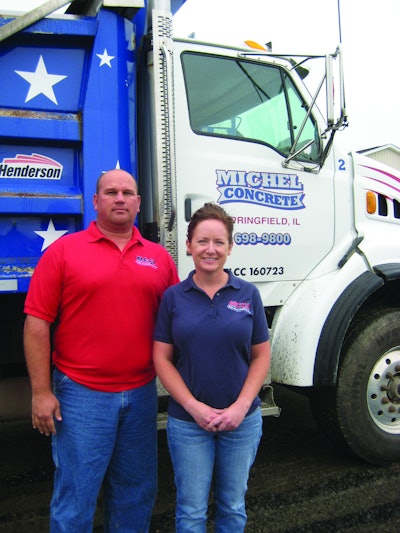
Three years ago, Mary Wilson, CEO and president of Michel Concrete Construction, Inc., Springfield, Ill., bought out her father's concrete foundations firm. The deal happened shortly before the construction economy took a turn for the worse in Central Illinois. Despite a falling economy, the company's sales have increased each year since the buyout. She credits the company's growth and success to diversification and quality products. "One of our company's strongest assets is that we have been well diversified in residential, commercial and agricultural markets for a long time," Mary Wilson says. "When the residential market dropped we didn't have to lower our prices, we just shifted our focus toward the commercial and agricultural work."
In 2010, the company's sales were split 45 percent commercial, 30 percent agriculture and 25 percent residential. Michel Concrete's extensive equipment ownership, field crew expertise and relationships with customers in all three markets allow it to keep those numbers fluid year to year.
A concrete career
Concrete has always been part of Mary's life, but taking over her father's concrete construction business wasn't something she expected to do. For years her father ran his residential foundations company out of his family's home, giving Mary the chance to observe a concrete construction company in action. "As a little girl I remember everything happening at the kitchen counter or the dining room table, from organizing crews in the morning to working on bids at night," she says. "It was exciting to watch his business grow. He revolutionized the way concrete work was done in Central Illinois by making investments in both technology and innovative equipment like boom trucks, telebelts, total stations and pump trucks."
Mary received an Early Childhood Education degree and teaching certificate from the University of Illinois, where she and her husband, Jeff, met. After college, she pursued teaching and then became the director of a child care facility, where she discovered her affinity toward business management. Jeff began working for Mary's parents at their concrete construction business.
In 1994, Mary left her daycare director position to start a family. Shortly after, Mary and Jeff started an exterior flatwork company, subcontracting most of their work from Mary's parents' business.
In 1996, Mary's parents sold their residential foundation business in order to pursue out-of-state agricultural work. When the bottom fell out of the agricultural market in 1999, Mary's father began pursuing commercial work locally. Mary and Jeff closed their exterior flatwork business and Jeff again became a full-time employee of Mary's parents.
When a five-year non-compete on residential work lapsed, Mary's father expanded his business back into residential but also continued the agricultural and commercial work. Having experienced downturns that were independent across markets he understood the need for diversification.
"All this time I was in the background but not working in the business day-to-day," Mary says. That changed in 2005 when Mary was looking for a new career. It took an outsider looking in — a community college career counselor — to get Mary to admit to herself that she wanted a career in concrete. "He saw something in me that I didn't see in myself. I had always maintained a point of contact with my parents' business, but I never realized how much I wanted to be a part of it," she says.
Mary's first job at her father's concrete business was running job costing numbers over all three divisions of the company. That offered her a bird's eye view of every phase of a project, from estimating to punch lists. It also gave her the opportunity to see where every employee and piece of equipment was throughout all phases of a project.
When the company dispatcher left in 2006, Mary found a new position. She realized a lack of communication between the team members running the different divisions often left them fighting over field personnel and equipment, hindering their efficiency. She developed a company-wide scheduling system that greatly increased productivity through efficiency. "I redefined the dispatch position into more of a resource allocation manager. All key resources — personnel, equipment and tools — were scheduled through me. I became the hub and they were the spokes," she says.
The central piece of Mary's scheduling system is a whiteboard that tracks equipment and crew members, something she refers to as the "Call-It Board." "It improves our equipment utilization and allows us to make sure every employee's skill set is being maximized every day," Mary explains.
As Mary's involvement in the company increased, her father's decreased. "As the hub, I knew everything going on in the company at any given moment, so it became easier for my dad to spend time away from the office," she says.
As time went on it became apparent that Mary's role with the company would be successor. "My dad realized I was competent enough to monitor the day-to-day activities in his absence and he began spending a lot less time in the office and more time fishing and farming," she says.
In March 2008, Mary and Jeff purchased the residential and commercial assets of her father's company with Mary listed as the majority shareholder and president of the company. In June 2009, Mary purchased Jeff's ownership stock, making her the sole owner, director and only officer of the corporation. A year later Mary acquired the assets of the remaining agricultural division from her parents. Michel Concrete recently acquired certification as a Woman-Owned Business through the Women's Business Development Center (WBDC) and is currently awaiting Recognition Certification from the State of Illinois.
Today Mary spends 80 percent of her time in the field and runs the company's day-to-day operations. But being a woman in the construction industry is still a challenge. "People are always looking for the man who's really running the show," Mary says. "As time goes on, however, I gain confidence in myself, my role and my abilities, and I feel I've got less to prove. Instead, I let my actions speak for themselves. It doesn't take long, after meeting me, for people to recognize I'm competent and I make my own decisions."
A better foundation
Michel Concrete has built a strong customer base throughout its residential, commercial and agricultural markets. With its commercial and agricultural clients, work comes to them through requested bid proposals. On the residential side, Michel Concrete reaches clients through a marketing plan that educates both homeowners and builders about a quality foundation and why the Michel Concrete foundation package is superior to the competition.
Recently, the company made a change to help its residential foundation customers make better choices, whether they want them or not. Over the last three years, Michel Concrete has dealt with several homeowner callbacks due to wet basement issues. "Whenever a basement has a water problem, the homeowner always assumes it's the fault of the concrete contractor," Jeff Wilson says.
Mary explains that upon further investigation in almost all of these callbacks the problem stemmed from water penetrating through shrinkage cracks above the level where waterproofing spray had been applied — instances where landscapers backfilled too high or set sprinkler heads that hit the foundation.
Initially Mary set out to solve these issues through better education at the homebuilder and homeowner levels and by offering an above-grade waterproofing spray option that was both UV-resistant and cosmetically more attractive than the "black tar stuff" builders and homeowners had been trying to hide. But customers didn't see the value of this $500 option and elected to forego the upgrade.
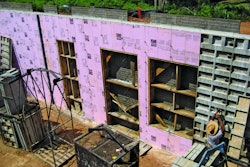
"When Illinois enacted the 2009 energy code, forcing everyone to insulate foundations, the majority of builders in our area elected to insulate inside the foundation wall, which created a visual barrier for finding leaks and a physical barrier for fixing leaks," Mary explains. "I knew a bad situation was about to get much worse and I feared these avoidable, future problems would reflect poorly on Michel Concrete."
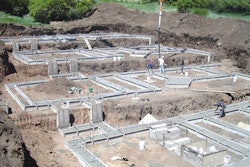
In the fall of 2010, the company made above-grade waterproofing mandatory in its standard foundation package. Today the Michel Concrete foundation package includes Tremco's Tuff-N-Dri H8 on the below-grade portion of the foundation and Tremco Horizon, a paintable, white waterproofing product, on the above-grade portions of the wall. Other features include compaction of garage and porch fill in 8- to 12-inch lifts; installation of vertical steel per code; and installation of solid footing step-ups. "The other guys will provide these things as an option, but at Michel Concrete quality is not an option — it is standard," Mary says. "Sometimes you need to make the right choice for customers. You need to help them spend their dollars the right way to ensure future satisfaction. We are the experts, and we know better."
Michel Concrete promotes its foundation package with its new marketing slogan "All foundations are not created equal." The company uses it in all its brochures, on its website and on t-shirts.
"We work with really good builders who recognize our quality. They know we are not here for just one job but are here for the long haul. Our builders have quite a bit of experience, and they know it only takes one mistake or change order from the competition to make up the bottom-line difference between our bid and theirs. Our builders know we can do the job and we will make them look good while we do it," Mary says.
Future growth
Michel Concrete sees growth in its future, but Mary and Jeff admit there are a few hurdles to overcome before moving the company to the next level. Finding key employees to take the lead and exhibit the same dedication and attention to detail the management team does is one. "As a mom and pop shop, it was easy for my dad to train employees and control quality — he was with his crews on every jobsite. As his company grew and his presence on jobsites became more irregular, it became harder to influence field decisions and attitudes. We struggle with this, too. It is our biggest limiting factor," Mary says.
"Leadership, organization, attention to detail, ability to set the pace — it's hard to find all those skills meshed together in one person. A lot of people have some of those skills, but very few have all of them," Jeff adds.
Building a library of policies and procedures for everything the company does, especially building procedures, is also high on the company's priority list. "A McDonalds hamburger is the same in every restaurant you go to. Defining policies and procedures that create organization, define construction methods and set quality standards will allow us to influence crews, whether we are physically present on the job or not," Mary says. "We want to get procedures down on paper so our employees can consistently provide the same quality foundation every time."
Although Michel Concrete was established just over three years ago, its employees bring years of experience and success to the young construction firm. Its dedication to quality, plans for a well-monitored growth and flexible business model will help the company build upon its roots and prove that all foundations are not created equal.