Telematic systems promise to automate record keeping, providing accurate and timely information that gives contractors the ability to better manage their fleets. “The true ROI with telematics are the efficiencies by having accurate location and utilization information so you are better able to deploy assets, identify under-utilized assets and move them to a location where they are better utilized,” says Pat Crail, fleet information manager, The John R. Jurgensen Companies.
This vertically integrated heavy highway contractor realizes many benefits through telematics. “Prior to telematics, with manual reporting systems, there was often a week lag time. By the time the information is recorded by a foreman in the field and it ends up back in the main office and is entered in the main reporting systems, that information is a week or two old in many cases.”
This makes it hard to determine whether the machine is being utilized or sitting as a backup on the jobsite. “With telematics you can get the information daily or twice daily,” says Crail. It also makes sceduling PM easier and eliminates scenarios where you are sending lowboys to pick up equipment that is no longer there.
Unfortunately, in many cases these telematics systems have not lived up to their potential because the information was difficult to integrate with existing fleet management systems. The challenge has been that systems from various manufacturers and outside vendors use propriety coding, which means the data collected from one manufacturer machine could not easily be transferred into the fleet management software provided from another vendor. Since most contractors run a mixed fleet, this meant the contractor had a challenge to transfer this data onto a single system. “In the past they might have to download the data and then copy it by hand onto another spreadsheet,” notes Stan Orr, president, The Association of Equipment Management Professionals (AEMP). “Of course human error creates all kinds of problems with that approach.”
“This was a big problem for large fleet owners,” says Nick Redd, program manager, Connected Worksite, Caterpillar. “Most machine OEMs already offered their own websites and data feeds of one type or another. Traditional customers had to either work across multiple websites and/or manage the sometimes drastic differences in data feed formats prior to integrating data with their own systems.”
The net result is that many times these systems were simply not being used. So AEMP decided to tackle this issue. “Our members were telling us that was really causing them a lot of hassle,” says Orr.
The genesis of this standard was in the fall of 2007. “A fall conference in 2007 followed an asset management symposium where we had a number of end users,” recalls Crail. OEMs, distributors and end users were in attendance and an exercise was set up where the participants were asked, ‘what do you see as the critical issues for or industry or the biggest issues facing equipment managers and end users today?’”
“We really came away with three topics,” recalls Crail. “One of the top issues was the lack of standardization of telematics data.” The OEMs were quick to pose questions. “[The OEMs] said we built these telematic systems and everybody clammered for them, but the adoption rates have been dramatically lower than what we anticipated. Why aren’t you using it?”
The answer was straight forward. “At the time each manufacturer system, and even third party systems, to view your data and try to manage the fleet using telematics, you had to go to each particular providers website, log in, and use their unique interface – their web portal,” says Crail. “So it was a manual process that a lot of fleet managers referred to as the swivel chair affect. You are logging into five or more different websites just to retrieve data for all your different makes of equipment.”
Prior to the AEMP standard data collection and coordination could be difficult. “This was a huge problem,” notes Steve McGough, chief operating officer, HCSS. “It meant that equipment managers either had to live with tracking data in multiple places or had to have their IT staff find creative (and often expensive) ways to download the data from multiple places and store it on their own servers. While this process worked, you still had a lot of man hours in getting the data matched up so that it could be reported in a comprehensible manner.”
Prior to the AEMP standard, much of the investment in telematic data offered by new machines was not being utilized. “A lot of your newer machines built in the last five years, particularly the higher value machines, are equipped from the factory with a telematics device,” notes Crail. “Typically they come with a complimentary data package where you are not billed the monthly service charge for some number of years. But nobody was able to use this great tool efficiently. “The gist of it was very few people were doing anything with this information.”
There were some options, but none were very attractive. “At that time the big frustration with fleet managers was there wasn’t a convenient way to get all of this timely and accurate telematics information over to the fleet management system to help them use it to manage their fleets,” says Crail.
There were basically three options at that time if you wanted to use this data to help drive your reports. “The first one was to print each web site and manually enter that data into your system, which is a central fleet management software system,” says Crail. The second way was to develop software to import data from each web site. “Most providers did have provisions for importing data into an end-user’s software system or database. But each provider had a different means of doing that, so each one required custom programming. So it was very expensive if you wanted to automate the process. Then every time you brought a new make in, you would go through the process again.” The third option was to disregard the factory-installed boxes and install a third part provider’s box on all of your machines so you can receive data from one source.
A solution emerges
The AEMP Telemetics Standard solves these issues. “The major benefit is that fleet managers can use one software product to retrieve telematics data and manage all of their repairs and preventative maintenance in one place,” says McGough. “This is especially important in mixed fleet environments, but it also means that managers without mixed fleets now have the flexibility to use other software products beyond what their equipment vendor uses.”
The first step in finding a solution was to define the necessary data. “There are hundreds of data points available to each system,” notes Crail, who went on the chair the AEMP sub-committee to develop a telematics standard. “After some conversation we pretty quickly figured out that just a few data points could drive support on 80% of our reporting needs – current location, cumulative operating hours, the distance traveled if it had an odometer that tracks miles and the amount of fuel consumed. Really, those data points combined in different ways along with our accounting information with the histories that we already have in our databases, provide most of the information we need to run management reports. So we concentrated on a standardized approach to deliver the data.”
AEMP asked the manufacturers and third party providers to deliver this data in a standard format so one application could be used to go out and retrieve it from multiple providers and import it in databases. This data could then drive reports without the expense of having to go to a custom software development for each provider.
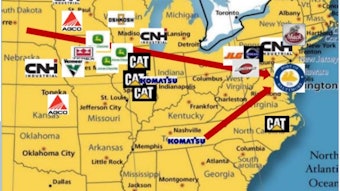
“To their credit, the OEM community, particularly Caterpillar, John Deere, Komatsu and Volvo were very supportive of the idea from the very beginning,” notes Crail. These companies worked together to help develop the standard.
“This was a no-brainer for Caterpillar,” says Redd. “We understood what the customer required and saw the concept of the AEMP Telematics Standard as a reasonable approach to satisfying the requirement.”
Each manufacturer provided its IT experts to work through the complex details and help the fleet managers adopt a common reporting format for the selected criteria. “We basically arrived at the conclusion that XML was an industry standard format that was probably best suited for this type of a project because it is so widely used and virtually any IT personnel can work with it. Developers understand it. It is a universal format.”
AEMP started working on a standard in the spring of ’09. By early 2010 a standard emerged. “At that point we settled on October 1, 2010 as the date when all of the participating providers agreed to start supporting customers with the standard,” recalls Crail.
This makes data the defined data much more user friendly for existing fleet management software. “Contractors will be free to choose a software product that best meets their needs, not the needs of their equipment supplier,” says McGough. “This will give them not only the ability to manage repairs and maintenance in one place, but also look at things like utilization, run time and operating costs across mixed fleets with up to the minute data. The standard also has a real side benefit for software vendors in that going forward, it will simplify the task of maintaining integration with equipment manufacturer’s data.”
It is now easier to manage mixed fleet telematic data with a single fleet management software solution. “As a software vendor focused on the heavy equipment industry, it was a no-brainer,” says McGough. “We wanted to give our customers the opportunity to take advantage of the telematics data provided by all of their manufacturers and use it to help them build a world-class fleet.”
How it works
The way the standard works is each telematics provider retrieves the data from the machine and stores the data on their server. “Each one of them does that in a different way,” notes Crail. “There are a host of differences in the way they get the data from the machine to the telematics provider’s server. Once they get that data on their server, that’s when they are able to provide a common measure. The standard comes into play after the data is transmitted from the machine to the telematics provider server. The telematics provider then stores that on his server and the end user uses an Application Product Interface (API)that is either developed in house or they hire a developer to write one for them. It is a really simple API. It is a couple days programming in most cases.”
The API basically places a call to each telematics provider’s server. “The servers address provides credentials to verify which fleet is asking for its ration,” says Crail. “Once the verification takes place, the telematic provider’s system provides a snapshot of the fleet with the most recent reading for each field in the standard.Where the standard comes into play is the response from the server back to the end users API is an XML document following the scheme that was defined by the standard.” This one API can retrieve the defined data fields from any participating telematics provider. The API is custom software simply because the variety of flett management software being used by the end users. But once the API is written for your specific software, communication issues should become a non-issue.
And there will be no legacy issues to worry about with existing telemetrics hardware. “That is one of the reasons we chose this route,” Crail explains. “There is no affect on the hardware whatsoever. It is at the server level that the provider is going to present the data in the correct format to match the standard. That is a key point, that is why we wanted this approach. It is a pretty expensive proposition to walk out and decide today I am going to equip my entire fleet with telematic devices.” It becomes critical to utilize the investment in telematics that you have already made.
“The AEMP Telematics Standard enables easier, more accurate and quicker flow of machine data into asset-management systems,” says Redd. “The standard allows fleet managers to import key information in a common format using a common process into whatever system(s) they are using to manage their business. This redices, and in some cases eliminates, the inefficiencies of having to work across multiple OEM and third party systems to manage any entire fleet of assets.”
OEM systems necessary for advanced features
“The AEMP Telematics Standard encompasses only the basic subset of information that is common to all vendors,” notes McGough. “There will always be certain aspects of the data that are unique and proprietary to each manufacturer. These may require using specific software or web access to receive this information. However, this new standard makes that the exception rather than the rule. It is definitely a step in the right direction.”
Tying it all together
The AEMP standard allows you to track all your equipment in your feet with your existing fleet management software. This includes equipment with telematics equipment from various manufacturers as well as equipment that is not equipped with telematics devices. “By using the telematics standard to import the data, you are still using the same management reports that you have been using to run your fleet,” says Crail. “You are just adding a more accurate, more timely data input stream for the machines that happen to have the telematics devices. Those can co-exist with the legacy machines where they are still being recorded by pen and paper or fax.”
“All of the same reports that we have been running for years, we are going to keep running them,” says Crail. “We don’t have to go outside of our existing system into a separate world to report on telematics equipment and then go back and report separately on the legacy machines.”