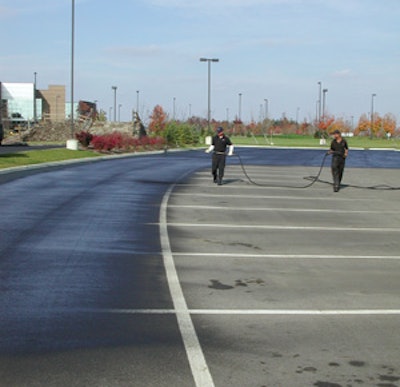
Coverage rates dictate the quantity of sealer applied on the pavement. It is imperative that the right quantity of sealer is applied for contractors and their clients to get its optimum performance.
Sealer manufacturers recommend appropriate coverage rates for their product, but coverage rates also are recommended by local, state, and federal agencies. Any deviation from the coverage rate recommendation will alter the amount of the sealer (refined coal tar or asphalt) applied on the pavement. Too little sealer applied might result in premature wear and failure, while too much will drive the job cost up and might even result in slow drying and tracking.
Coverage rate is most commonly specified in terms of gallons per square yard (gal./sq. yd.), but occasionally it is expressed in terms of square feet per gallon (sq. ft./gal.). In this article we will work through some calculations, so it will help to have a calculator on hand to work through the calculations as you read.
Log in to view the full article
Coverage rates dictate the quantity of sealer applied on the pavement. It is imperative that the right quantity of sealer is applied for contractors and their clients to get its optimum performance.
Sealer manufacturers recommend appropriate coverage rates for their product, but coverage rates also are recommended by local, state, and federal agencies. Any deviation from the coverage rate recommendation will alter the amount of the sealer (refined coal tar or asphalt) applied on the pavement. Too little sealer applied might result in premature wear and failure, while too much will drive the job cost up and might even result in slow drying and tracking.
Coverage rate is most commonly specified in terms of gallons per square yard (gal./sq. yd.), but occasionally it is expressed in terms of square feet per gallon (sq. ft./gal.). In this article we will work through some calculations, so it will help to have a calculator on hand to work through the calculations as you read.
Note the examples and calculations made in this article are for educational purposes only. Actual calculations and figures, such as film thickness, will vary according to mix designs. Also, calculations used in this article apply to both refined coal tar and asphalt-based sealers.
Determining wet and dry film thickness
Sealcoating contractors know that sealer, after it's applied, dries to a tenacious film after full cure. The film thickness of the wet and the dry sealer depends directly on the coverage rate and it is expressed in “mils.” One (1) mil is 1/1000th of an inch. Film thickness is generally referred to in mils simply because it is much easier than referring to hundredths of an inch.
At the nominal application rate of 0.18 gal./sq. yard, the wet film thickness of the film is 32 mils (or 0.032 inch). After full cure (after release of water and other volatiles) the film shrinks to about 13 mils, which is about the same as the thickness of three sheets of 20-pound paper.
Now let's convert the coverage rate in film thicknesses, both wet and dry. To calculate the film thickness, we have to know the coverage rate in terms of sq. ft./gallon.
But before we can start we need to know how many square feet of pavement are covered by one gallon of coating in one (1) mil thickness. The answer is 1,604 square feet; one gallon of sealer will cover 1,604 square feet of pavement with a coating 1 mil thick. If the film thickness is 4 mils, the area covered will be 1,604 ÷ 4, or roughly 400 sq. ft./gallon.
Conversely, if you divide 1,604 by the square foot coverage rate you will get the film thickness in mils (1,604 ÷ 400 = 4 mils). But if the coverage rate is specified in gal./sq. yd., you need to convert it into sq. ft./gal.
To convert, divide 1 by the number of gallons per square yard, then multiply the answer by 9 (the number of feet in a square yard) to reach the number of square feet per gallon.
To illustrate, let's convert 0.18 gallons per square yard to square feet per gallon. First, divide 0.18 into 1 and the answer is 5.55. Multiply 5.55 by 9 and you get 50, which is sq. ft./gal. Wet film thickness, then, is: 1,604 sq. ft. ÷ 50 sq. ft./gal. = 32 mils.
The next step is determining the dry film thickness. To do that multiply the wet film thickness by the solids content (by volume) of the mix.
Click here to view PDF version of Chart 1.
Suppose 1 gallon of sealer mixture (sealer, water, aggregate, etc.) contains 40% by volume of solids. Once sealer has been applied to the pavement, and the water and volatiles have evaporated from the sealer, the sealer film, after full cure, will be reduced to 40% of its original wet film thickness.
Why is it reduced in thickness only, when geometry teaches us that volume is a multiple of the area and thickness? The answer is that the sealer film can shrink only in thickness because the sealer is bonded to the other dimension, which is the area of the pavement. The sealer will not pull away from the pavement edges like oil does when it's dropped on a wet surface.
So now you know all the elements for calculating film thicknesses: factor 1604, coverage rate in sq. ft./gal., wet film thickness, and solids by volume of the sealer mix. So the question that should pop into your mind is, how do you calculate that percentage of solids (by volume)? That brings us to the sealer composition.
You will note later that it is crucial to know whether the recommended coverage rate is based on the concentrated sealer (before water and aggregate are added), or the final sealer mix (which includes the water and aggregate). Huge and costly errors have been made by contractors not knowing these coverage rate details. So please read the job specifications very carefully and your supplier will be delighted to assist you, if you have questions.
Sealer composition
Sealers are stable dispersions of refined coal tar or asphalt in water, with clay or other fillers, and additives, such as emulsifiers and specialty chemicals. Chart 1 shows the typical composition of a contractor-grade sealer (ASTM 5727-00, what in the past had been a P355e type sealer), given both by weight and by volume.
It is important to note that the concentrated sealer contains about 60% water by volume and 50% by weight. After application, the sealer dries and cures releasing the water (and other volatiles). What is left behind as the film is the solids portion (coal tar or asphalt, clay/fillers, and additives), after the sealer is fully cured.
It is the percentage of solids by volume that determines the film thickness, not the solids by weight. So from this point on the article will deal only with volume – not the weight – of the sealer and its components.
Material requirements and mix design
Concentrated sealer is seldom applied as such on the pavement. Virtually all applications require the contractor to mix the concentrate with a specified amount of water, often aggregate (silica sand or boiler slag for coal tar sealers) and sometimes additives. Sealer manufacturers or government agencies also often specify the number of coats and the coverage rate for each coat.
Most of time the manufacturers specify coverage rate in terms of the concentrated sealer and that is strictly to calculate the quantity of the sealer needed for a job. Some governmental specifications (such as the Federal Aviation Administration) denote the coverage rate in terms of the final mixture. So it is imperative that the contractor make sure he is mixing the components in the proper amounts according to the manufacturer's recommended proportions and that he applies the sealer to abide by the coverage rate requirements.
Now let us look at some examples:
JOB A. This is a 10,000-sq. ft. parking lot. The recommended coverage rate is based on the concentrated sealer. The final mixture is applied at the mixture coverage rate, so the cured sealer film will be according to the specification, resulting in optimum performance of the sealer.
Click here to view PDF version of Chart 2.
JOB B. This is also a 10,000 sq.-ft. parking lot, but the contractor misreads the specification and instead of applying sealer at a coverage rate based on the mixture, he applies the final mixture at the rate of the concentrated sealer. The result is the cured sealer film will be much thinner than intended and might result in a job that wears poorly or looks bad.
See Chart 2 for mix components. For both examples we will use a general recommendation of:
- Water for dilution – 30% by volume of the concentrated sealer.
- Aggregate loading – 4 lb./gal. based on the concentrated sealer.
The percentage of sealer in Chart 2 composition is 67.3% (100 gallons of sealer ÷ 148.5 total gallons = 67.3%).
The percentage of solids (by volume) in the above mix is 58.5 (40 sealer solid gallons + 18.5 aggregate gallons) x 100 ÷ 148.5 or 39.4%. The sealer will shrink to 39.4 % of its wet film thickness.
For both Job A and Job B the specified coverage rate is based on concentrated sealer – without water, additives, or aggregate added. Specified material coverage rates, in a two-coat application, are:
- 1st coat @ 0.12 gals. of concentrated sealer/sq. yd.,
- 2nd coat @ 0.08 gals. of concentrated sealer/sq. yd.,
- That's a total of 0.20 gal. of concentrated sealer/sq. yd. for two coats.
So determine the mix design for a two-coat application on each job as follows: Concentrated sealer needed for:
- 1st coat @ 0.12 gal./sq. yd. = 0.12 x 10,000 = 1,200 gals.
- 2nd coat @ 0.08 gal/sq. yd = 0.08 x 10,000 = 800 gals.
- Total = 0.12 + 0.08 = 0.20 gal. concentrated sealer/sq. yd.
- Total concentrated sealer needed = 1,200 + 800 = 2,000 gals.
Mix Design: 30% water dilution and 4 lb. of aggregate/gal. of the concentrated sealer.:
- Sealer = 2000 gals.
- Water = 600 gals. (30% of the sealer)
- Aggregate = 8,000 lbs. (4 lbs./gal. based on sealer concentrate = 8,000 lbs. x .0462 = 370 gal. of sand
Total mix design volume:
2000 gal. sealer concentrate + 600 gal. water + 370 gal. sand = 2,970 gal. total sealer mix
For Job A, the contractor does it right and applies 2,970 gallons of the mixed sealer to 10,000 sq. ft.
For Job B, the contractor misreads the specifications, confusing the concentrated sealer application rate for the mixture and applies only a total of 2000 gallons of the mixture. It does happen and now let's look at what happens and how the film thickness is affected, if you don't realize the basis for the recommended coverage rates.
Job A: The correct result
The contractor on Job A has produced 2,970 gallons of final sealer mix. This means that once all material is added to produce the final mixture of sealer, 0.20 gallons of concentrated sealer produces 0.297 gallons of sealer mixture. So the coverage rate of the sealer mixture is: 2,970 gal. ÷ 10,000 sq. yds. = 0.297 gal./sq. yd.
The job specifies that 0.2 gallon of the concentrated sealer /sq. yd. be applied to the pavement. To put down 0.2 gallon of concentrated sealer, you will have to use 0.297 gallon of the mixture. Now you need to determine a new coverage rate based on the final mixture. To do that you divide the application rate of the mixture by the specified application rate: 0.297 ÷0.20 = 1.49 giving you the ratio between the mixture and concentrated application rates. To determine the new application rates of the mixture, multiply the specified application rate by the ratio (1.49).
- Apply 1st coat of the mixture @ 1.49 x 0.12 = 0.18 gal./sq. yd.
- Apply 2nd coat of the mixture @ 1.49 x 0.08 = 0.120 gal./sq. yd.
- Total of the two coats of the mixture is 0.18 + 0.12 = 0.30 gal./sq. yd.
Film Thickness of the wet film. To determine how thick the wet film will be, 1st Coat: first convert 0.18 gal./sq. yd. to sq. ft./gal. following the formula introduced earlier.
1 ÷ 0.18 = 5.56 sq. yard/gallon, 5.56 x 9 = 50.04 sq. ft/gallon
Wet film thickness of the 1st coat = 0.18 gal./sq. yd. = 50.04 sq. ft./gal. = (1604 ÷ 50.04) or 32.05 mils;
For the second coat, 1 ÷ 0.12 = 8.33; 8.33 x 9 = 74.97 (call it 75) 2nd coat = 0.12 gal/sq. yd. = 75 sq. ft./gal. = (1604 ÷ 75) or 21.39 mils.
Total wet film thickness of two coats = 32.05 + 21.39 = 53.44 mils.
Film thickness of the dry film.
Multiply the wet film thickness by percentage of solids by volume of the mixture (see Chart 2).
- 1st coat = 32.05 mils. x 39.4% = 12.63 mils,
- 2nd coat = 21.39 mils. x 39.4% = 8.43 mils,
- Total wet film thickness of two coats = 12.63 + 8.43 = 21.06 mils.
This (21.06 mils) is essentially the correct film thickness, when the sealer was applied per specifications.
Job B: Too little sealer
Now let's see what will happen to the total film thickness on the same 10,000-sq.-ft. job with the same mix design but the contractor misread and applied the mixture at the coverage rate that was specified for the concentrated sealer. The contractor applies two coats:
- 1st coat of the mixture @ = 0.12 gal./sq. yd.,
- 2nd coat of the mixture @ = 0.08 gal./sq. yd.,
- Total of the two coats of the mixture = 0.12 + 0.08 = 0.20 gal./sq. yd.
Note: Because the contractor has made a mistake in reading the specifications, there is no need to determine the ratio between the concentrated sealer and the final mixture, as we did on Job A. The contractor applies application rates directly to the total sealer volume.
Film thickness of the wet film.
To determine how thick the wet film will be, first convert 0.12 gal./sq. yd. to sq. ft./gal. following the formula.
1 ÷ 0 .12 = 8.33 sq. yd./gal.; 8.33 sq. yd./gal. x 9 = 74.97 (call it 75) sq. ft./gal.
- 1st coat = 0.12 gal./sq. yd. = 75 sq. ft./gal.; 1604 ÷ 75 = 21.39 mils
To determine wet film thickness of the second coat, again convert 0.08 gal./sq. yd. to sq. ft./gal. 1 ÷ 0.08 = 12.5 sq. yd./gal.; 12.5 sq. yd./gal. x 9 = 112.5 sq. ft./gal.
- 2nd coat = 0.08 gal./sq. yd. = 112.5 sq. ft./gal.; 1604 ÷ 112.5 = 14.26 mils.
- Total wet film thickness of two coats = 21.39 + 14.26 = 35.65 mils.
Film thickness of the dry film. Multiply the wet film thickness by percentage of solids by volume (Chart 2).
- 1st coat = 21.39 mils. x 39.4% = 8.43 mils,
- 2nd coat = 14.26 mils. x 39.4% = 5.62 mils,
- Total dry film thickness of two coats = 8.43 + 5.62 = 14.04 mils.
Note that the film thickness of the cured film in Job B is only two-thirds of the correct film thickness and that might cause performance problems, including premature failure. The above examples demonstrate the importance of adhering to mix design recommendations and the specified coverage rates.
- If the coverage rate is specified in terms of concentrated sealer: Use the specified number for calculating the amount of sealer needed for the job. But for actual application of the mixture, multiply the coverage rate by the ratio between the mixture and the concentrated sealer. So if 100 gallons of sealer concentrate makes 150 gallons of total mix, multiply by 1.5 (i.e. 150 ÷ 100).
- If the coverage rate is specified in terms of the final mixture (sealer, water, aggregate, additive, etc.): Calculate the percent of sealer in the mix and use that number for calculating total gallons of sealer, water, sand (measured by the pound), and additives. Then apply per the application rates of the mixture.
Should you have any questions about sealer mix designs, coverage rates, or any other aspect of sealcoating contact your sealer supplier or the manufacturer.
Girish C. Dubey is president of STAR Inc., Columbus, OH, which has affiliate sealer producing operations throughout the U. S. States.