
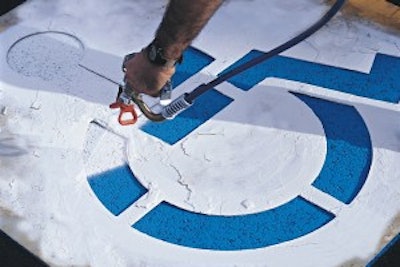
Pavement magazine's February issue outlines most of the U.S. Department of Justice (DOJ) updates to its ADA regulations and new design standards based on guidelines previously issued by the Access Board. What follows here are the changes to some of the more obscure regulations and guidelines that, while rare, still might be encountered by pavement maintenance contractors. Areas include passenger loading zones and bus stops, fishing and boating piers, and golf facilities
The revised regulations take effect in March, and compliance with the 2010 standards will be mandatory in 18 months (beginning March 15, 2012) based on completion of the permit process or, if no permit is required, the start of construction.
As with any government regulations, the ADA standards are complex and can be difficult to follow, but the full text and detailed explanations of all the 2010 standards is available at www.ada.gov.
Passenger Loading Zones and Bus Stops: Sections 209 and 503
Passenger Loading Zones at Medical Care and Long-Term Care Facilities. Sections 6.1 and 6.2 of the 1991 Standards and section 209.3 of the 2010 Standards require medical care and long-term care facilities, where the period of stay exceeds 24 hours, to provide at least one accessible passenger loading zone at an accessible entrance, but the 2010 Standard remove the requirement for a canopy or roof overhang at this passenger loading zone.
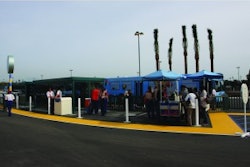
Passenger Loading Zones. Where passenger loading zones are provided, the 1991 Standards, at sections 4.1.2(5) and 4.6.6, require at least one passenger loading zone to be accessible. Sections 209.2.1 and 503 of the 2010 Standards, require facilities such as airport passenger terminals that have long, continuous passenger loading zones to provide one accessible passenger loading zone in every continuous 100 linear feet of loading zone space.
The 1991 Standards and the 2010 Standards both include technical requirements for the vehicle pull-up space (96 in. wide minimum and 20 ft. long minimum). Accessible passenger loading zones must have an access aisle that is 60 in. wide minimum and extends the full length of the vehicle pull-up space. The 1991 Standards permit the access aisle to be on the same level as the vehicle pull-up space, or on the sidewalk. The 2010 Standards require the access aisle to be on the same level as the vehicle pull-up space and to be marked so as to discourage parking in the access aisle.
Valet Parking and Mechanical Access Parking Garages. The 1991 Standards, at sections 4.1.2(5)(a) and (e), and sections 208.2, 209.4, and 209.5 of the 2010 Standards require parking facilities that provide valet parking services to have an accessible passenger loading zone. The 2010 Standards extend this requirement to mechanical access parking garages. The 1991 Standards contained an exception that exempted valet parking facilities from providing accessible parking spaces. The 2010 Standards eliminate this exception. The reason for not retaining the provision is that valet parking is a service, not a facility type.
Transportation Facilities: Sections 218 and 810
Detectable Warnings. Detectable warnings provide a distinctively textured surface of truncated domes. The 1991 Standards at sections 4.1.3(15), 4.7.7, 4.29.2, 4.29.5, 4.29.6, and 10.3.1(8) require detectable warnings at curb ramps, hazardous vehicular areas, reflecting pools, and transit platform edges. The 2010 Standards at sections 218, 810.5, 705.1, and 705.2 only require detectable warnings at transit platform edges. The technical specifications for the diameter and spacing of the truncated domes have also been changed. The 2010 Standards also delete the requirement for the material used to contrast in resiliency or sound-on-cane contact from adjoining walking surfaces at interior locations.
The 2010 Standards apply to detectable warnings on developed sites. They do not apply to the public right-of-way.
Recreational Boating Facilities: Sections 235 and 1003
These sections require that accessible boat slips and boarding piers be provided.
Accessible Route. Sections 206.2.10 and 1003.2 of the 2010 Standards require an accessible route to all accessible boating facilities, including boat slips and boarding piers at boat launch ramps. Section 1003.2.1 provides a list of exceptions applicable to structures such as gangways, transition plates, floating piers, and structures containing combinations of these elements that are affected by water level changes.
The list of exceptions specifies alternate design requirements applicable to these structures which, because of water level variables, cannot comply with the slope, cross slope, and handrail requirements for fixed ramps contained in sections 403.3, 405.2, 405.3, 405.6, and 405.7 of the 2010 Standards. Exceptions 3 and 4 in Section 1003.2.1, which permit a slope greater than that specified in Section 405.2, are available for structures that meet specified length requirements. Section 206.7.10 permits the use of platform lifts as an alternative to gangways that are part of accessible routes.
Accessible Boarding Piers. Where boarding piers are provided at boat launch ramps, sections 235.3 and 1003.3.2 of the 2010 Standards require that at least 5% of boarding piers, but at least one, must be accessible.
Accessible Boat Slips. Sections 235.2 and 1003.3.1 of the 2010 Standards require that a specified number of boat slips in each recreational boating facility meet specified accessibility standards. The number of accessible boat slips required by the 2010 Standards is set out in a chart in section 235.2. One accessible boat slip is required for facilities containing 25 or fewer total slips. The number of required accessible boat slips increases with the total number of slips at the facility. Facilities containing more than one thousand (1000) boat slips are required to provide twelve (12) accessible boat slips plus one for each additional one hundred slips at the facility.
The 2010 Standards do not require the dispersion of the physical location of accessible boat slips. Rather, the dispersion must be among the various types of boat slips offered by the facility. Section 235.2.1 of the 2010 Standards specifies that if the required number has been met, no further dispersion is required. For example, if a facility offers five different ´types´ of boat slips but is only required to provide three according to the table in Section 235.2, that facility is not required to provide more than three accessible boat slips, but the three must be varied among the five ´types´ of boat slips available at the facility.
Fishing Piers and Platforms: Sections 237 and 1005
Accessible Route. Sections 206.2.14 and 1005.1 of the 2010 Standards require an accessible route to each accessible fishing pier and platform. The exceptions described under Recreational Boating also apply to gangways and floating piers.
Accessible Fishing Piers and Platforms. Sections 237 and 1005 of the 2010 Standards require at least 25% of railings, guards, or handrails (if provided) to be at a 34-in.maximum height (so that a person seated in a wheelchair can cast a fishing line over the railing) and to be located in a variety of locations on the fishing pier or platform to give people a variety of locations to fish. If railings, guards, or handrails are provided, accessible edge protection and clear floor or ground space at accessible railings are required. Additionally, at least one turning space complying with section 304.3 of the 2010 Standards is required to be provided on fishing piers and platforms.
Golf Facilities: Sections 238 and 1006
Accessible Route. Sections 206.2.15, 1006.2, and 1006.3 of the 2010 Standards require an accessible route to connect all accessible elements within the boundary of the golf course and, in addition, to connect golf car rental areas, bag drop areas, teeing grounds, putting greens, and weather shelters. An accessible route also is required to connect any practice putting greens, practice teeing grounds, and teeing stations at driving ranges that are required to be accessible. An exception permits the accessible route requirements to be met, within the boundaries of the golf course, by providing a "golf car passage" (the path typically used by golf cars) if specifications for width and curb cuts are met.
Accessible Teeing Grounds, Putting Greens, and Weather Shelters. Sections 238.2 and 1006.4 of the 2010 Standards require that golf cars be able to enter and exit each putting green and weather shelter. Where two teeing grounds are provided, the forward teeing ground is required to be accessible (golf car can enter and exit). Where three or more teeing grounds are provided, at least two, including the forward teeing ground, must be accessible.
The 2010 Standards provide an exception for existing golf courses with three or more teeing grounds not to provide golf car passage to the forward teeing ground where terrain makes such passage infeasible.
Section 1006.3.2 of the 2010 Standards requires that where curbs or other constructed barriers prevent golf cars from entering a fairway, openings 60 in. wide minimum shall be provided at intervals not to exceed 75 yds.
Accessible Practice Putting Greens, Practice Teeing Grounds, and Teeing Stations at Driving Ranges. Section 238.3 of the 2010 Standards requires that 5% but at least one of each of practice putting greens, practice teeing grounds, and teeing stations at driving ranges must permit golf cars to enter and exit.
Miniature Golf Facilities: Sections 239 and 1007
Accessible Route to Miniature Golf Course Holes. Sections 206.2.16, 239.3, and 1007.2 of the 2010 Standards require an accessible route to connect accessible miniature golf course holes and the last accessible hole on the course directly to the course entrance or exit. Accessible holes are required to be consecutive with an exception permitting one break in the sequence of consecutive holes provided that the last hole on the miniature golf course is the last hole in the sequence.
Accessible Miniature Golf Course Holes. Sections 239.2 and 1007.3 of the 2010 Standards require at least 50% of golf holes on miniature golf courses to be accessible, including providing a clear floor or ground space that is 48 in. minimum by 60 in. minimum with slopes not steeper than 1:48 at the start of play.