One of the issues I see in the concrete polishing industry is contractors not allowing an abrasive to fully refine the floor to its maximum potential before moving to the next grit in the processing sequence. The result is a floor that lacks overhead reflective clarity and durability.
So how does a contractor know when an abrasive has refined the surface to its fullest potential? How does an owner, architect and general contractor bid a job and receive apples-to-apples bids where finished results will be the same regardless if they choose contractor A or B?
I often wonder why the concrete polishing industry tries to reinvent the wheel. Materials have been processed with abrasives for more than 100 years. For example, optical lenses - eye glasses - are polished with abrasives. I believe we should look to other industries already processing material to a specified finish to help improve our industry. What you will find is the challenges they deal with are the same issues the concrete polishing industry is dealing with.
Customers often request a specific polished concrete finish such as honed, semi-polished, highly polished or mirrored polished. These terms are based on visual aesthetics and may have different meanings from one person to another. In other words, these definitions are subjective. If a customer requests a highly polished concrete floor, that finish will range in reflective appearances depending on the contractor and to what degree he allowed the abrasives to fully refine the floor throughout the grit sequence.
The concrete polishing industry attempted to combat this subjectivity by utilizing gloss meters. The industry quickly found gloss readings could be improved by applying chemicals, and at times higher readings were often a result of resin transfer from resin-bonded abrasives.
What if we could remove some of the human element of subjectivity with an instrument that could provide a scratch profile reading that would tell the contractor and owner the floor has been refined by the diamond abrasives to a specified degree from one grit to the next? This could allow for the creation of refinement categories which would allow for different qualities of polish through a scientific approach. Each category would inherently have its own degree of reflective clarity and durability.
For example, if working on a top tier project like a school floor, what I will call a refinement category Class A finish, you would want a measurable degree of refinement from one grit to the next. A Class A floor would require a reading that shows a high level of refinement. Let's say we are working in a warehouse where the owner may only want a low-grade polished concrete finish, what I will call a refinement category Class C finish. This would mean each grit would require a lower degree of refinement. The result would be less reflective clarity and lower durability but would fit the owner's needs and budget. Both examples could be produced using scientific means.
Scientific data could be used to show increase in abrasion resistance between refinement categories. The concrete being worked on will be a determining factor in overall abrasion resistance, but the process itself creates its own percentage level of increased or decreased abrasion resistance. For example, the abrasion level of any unprocessed material is going to be X; after the polishing process is performed the new abrasion level is Y. The increase in abrasion resistance is going to be the difference between X and Y expressed as a percentage.
Slip coefficient? This data will also provide end users assurance that when the floor is installed to meet specific surface roughness criteria they will have a floor that meets specific slip coefficient requirements.
A means of measurement
Surface Metrology is defined by Wikipedia as "the measurement of small scale features on surfaces, and is a branch of metrology. ... Surface metrology is the study of surface geometry, also called surface texture or surface roughness. The approach is to measure and analyze the surface texture in order to be able to understand how the texture is influenced by its history, (e.g., manufacture, wear, fracture) and how it influences its behavior (e.g., adhesion, gloss friction)."
Wikipedia also says Surface Roughness "plays an important role in determining how a real object will interact with its environment. Rough surfaces usually wear more quickly and have higher friction coefficients than smooth surfaces (see Tribology)."
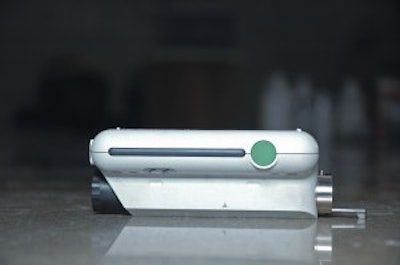
There are portable instruments called surface profilers used in other industries such as aerospace, ship building, mechanical engineering, automotive and healthcare to measure surface profiles that have been processed with abrasives. These instruments have the ability to record data and print reports. In the concrete polishing industry, these reports could be submitted to a GC, architect or owner as proof of testing.
There are more than 25 different measurements used in various industries. Focusing on Ra for now would best fit the concrete polishing industry. Ra is the Arithmetic Mean Roughness of a surface. It measures from a mean line that lies between the highest and lowest point on a sample length. Ra measures the average length between a scratch pattern's peaks and valleys and the deviation from the mean line. The measurement is expressed either in micro inches or meters. ISO standards express Ra as CLA, or Center Line Average.

The top graph shows a microscopic view of a scratch profile created with abrasives with a Ra reading of 109.6. As you move up in grit designations the profile becomes smaller and more consistent as shown in the bottom graph.
My research
I have completed some initial tests based on the information I have presented above. This concept will need to be put through additional testing on polished concrete to see exactly how it can be applied to the concrete polishing industry. My raw data is presented in Chart 1.
The floor was an old warehouse space once used as a machine shop. The concrete was ground to sand aggregate and no densifiers were used. The planetary machine I used for grinding had a main head and satellite heads that all rotated in the same direction. The equipment weighed 600 pounds and had 18 3-inch round abrasives underneath it. For the surface profile testing I used a Mahr Federal profile meter. Also, keep in mind my testing was focused on a mechanical process, not chemical.
I ground the entire 20-foot by 25-foot test area using a 70-grit metal bond abrasive with two passes at a slow rate of speed making sure the floor was fully refined and creating an equal base scratch pattern. An approximately 3-foot-wide by 20-foot-long area was left at the 70 grit metal grind. I then divided the remaining test area into two sections equaling two 10-foot by 25-foot areas. One side received one pass of subsequent abrasive grits and the other side received two passes of subsequent abrasive grits. I then proceeded across a second section of the test area with a 120-grit metal bond abrasive. Leaving a section refined to the 120-grit metal bond abrasive, I proceeded in the sequence with a 3-foot-wide section with a 50-grit resin bond abrasive. I repeated this for 100-, 200-, 400- and 1500-grit resin bond abrasives. See Chart 1 for results.

Chart 1: Raw data results from Jim Cuviello's initial concrete polishing surface profile testing.
The following are first impressions of the readings:
- Random readings within the same grit produce a wide range of readings.
- The areas that received two passes have a lower reading than one pass except at 50 resin which could be an anomaly.
- As the process is performed, generally speaking, the higher the grit the lower the reading showing a decrease in surface roughness.
- The areas that received one pass compared to two passes showed a greater inconsistency of results.
What could cause the wide range of readings?
- Pits
- Pores
- Micro fissures
- Aggregates
- Degree of concrete consolidation around aggregates
My proposal
It would have to be determined how to best use this raw data in the concrete polishing industry. Here is a proposed method, and of course, numbers would have to be refined after further testing. At this point it is assumed fine aggregate, sand aggregate and exposed aggregate standards would be individually produced. To keep this example simple it shows resin bond abrasives only. Metal and hybrid bond abrasive readings would also be incorporated into the overall formula:
- Measurements taken after fully refined base grit
- Take X number of readings per X square feet
- Throw out the highest and the lowest readings
- Two readings per grit must fall within the Required Range
- No reading may exceed the Max. Reading
| Class A Refinement | ||
| Resin Grit | Required Range | Max. Reading |
| 50 | 95-120 | 165 |
| 100 | 50-75 | 100 |
| 200 | 25-35 | 80 |
| 400 | 10-15 | 40 |
| 800 | 9-13 | 30 |
| 1500 | 5-9 | 20 |
| Class C Refinement | ||
| Resin Grit | Required Range | Max. Reading |
| 50 | 120-145 | 215 |
| 100 | 75-100 | 130 |
| 200 | 35-45 | 130 |
| 400 | 15-20 | 90 |
| 800 | 13-18 | 90 |
| 1500 | 9-13 | 80 |
A colleague has suggested another way to use this data would be to determine base readings and each consecutive grit must show an improvement of X percentage.
More testing needs to be performed to determine if the profile meter is a viable instrument for the concrete polishing industry. It is mind boggling to sit back and think of all the variables that would have to be tested to determine their effects on the data, but do not be negative and simply say there are too many variables to consider. Now is the time to embrace our industry and new ideas and elevate the concrete polishing industry to the next level within the flooring industry.
Being able to deliver quantifiable results would not only elevate the status of polished concrete within the flooring industry but also put polishing contractors on a level playing field when bidding and provide more consistent results from one polishing contractor to the next. Quantifiable results in the concrete polishing industry will also push abrasive manufacturers to produce abrasives that deliver measurable results in a shorter amount of time and push equipment manufacturers to develop equipment that most efficiently moves abrasives so they work at their peak performance. Furthermore, I believe a detailed understanding of scratch patterns will lead us to see that slip coefficient can be changed through scratch pattern manipulation. How much is yet to be seen, but this testing research is next on my agenda.
A Word about Abrasives
Abrasives work through abrasion, where a harder material cuts a softer material. When abrasives are used under equipment with consistent movement the abrasive will cut a uniform pattern. This cut pattern is made of peaks and valleys. The dimension of these peaks and valleys is determined by the particle distribution size of the abrasive grain, called grit. Other factors such as the grains' shape and quality also affect these dimensions. ANSI B74.20 is the American standard for abrasive sizing.
The longer an abrasive abrades a surface the more consistent and refined the cut pattern, or scratch pattern, becomes. Duration variables that affect the amount and degree of abrasion when processing materials (in our case concrete) with abrasives are equipment rpm and the rate at which the equipment is being moved over the surface in a forward linear motion. Other variables that affect abrasion are the size and number of abrasives being run under a machine, weight, abrasive bonding, whether the process is being performed wet or dry, and the physical movement of how the equipment moves the abrasives.
Mechanical abrasion of a surface can be complex, and understanding the complexity will allow a better finished product. Specifying a finishing grit often leads to mixed results because of these variables from one contractor to the next. - J.C.