
Renting your customer the right generator for his or her job is not as simple as pointing to the nearest model. You need to understand a little bit about electricity to adequately understand the parameters of your customer's job and ensure you provide the right equipment for his or her needs.
According to experts at Kohler Rental Power, the most important factors when choosing a generator are volts, amps and phase. By understanding the relationship between these three electrical values, you can help ensure your customer gets the right equipment for the job.
Volts vs. amps
Voltage is a measure of the strength of an electrical current. Household electrical current is 110 volts, while construction sites typically run on 208- or 480-volt current.
Amps, on the other hand, measure the volume of the electrical current. It makes sense if you think of electricity as though it were a bag of M&Ms. There's the small bag of M&Ms you get at the checkout line at the grocery store. That's your 110-volt current. Then there's the big bag of M&Ms you put in the candy dish at Christmas. That's your 480-volt current. The number of M&Ms you take out of either bag is your amps.
Another way of looking at it is this: Voltage is how much electricity there is, while amperage is how fast that electricity is moving (if at all).
Single- or Three-Phase
Whether your customer needs a single- or three-phase generator depends on the size of the machinery they plan to run. Single-phase distribution is used when loads are mostly lighting and heating, with few large electric motors. A single-phase supply connected to an alternating-current (AC) electric motor does not produce a revolving magnetic field; single-phase motors need additional circuits for starting, and such motors are uncommon above 10 or 20 kW in rating.
High-power systems (hundreds of kVA or larger) are nearly always three phase. Single-phase motors use one set of windings to start, while three-phase motors use three sets. If you have a large motor to start, you need very large windings. With a three-phase motor, you can make it smaller by connecting three sets of windings.
Size is everything
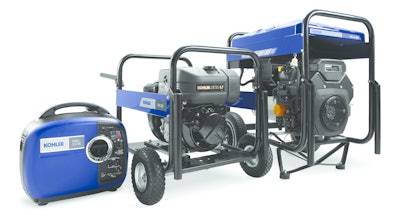
As you know, generators are available in a wide range of sizes. Generators with power supply capacities of 5kW to 50kW are readily available in the personal and home use markets, while industrial generators run anywhere from 50kW to over 3 Megawatts. Many people believe smaller generators can be used for standby electric power because they are not running all the time. Unfortunately, generator under sizing is one of the most common mistakes when renting or buying a generator. Not only does it pose a potential risk to the generator, it can also damage other assets connected to it, create hazardous situations and limit overall productivity of the unit and/or the business relying on it.
If a generator is too small, it could fail catastrophically, experts say. At the very least, it will shut down, leaving your customer without power.
One way to avoid under sizing your generator is to be aware of the inrush current. Inrush current or input surge current refers to the maximum, instantaneous input current drawn by an electrical device when first turned on. Pumps, for example, typically require high inrush current. Alternating current electric motors and transformers might draw several times their normal full-load current when first energized. For this reason, it's important to factor in the anticipated inrush current when sizing a generator for a job. The amount of inrush current is affected by the number and type of tools being powered. Contractors can minimize inrush current by "sequencing" the electrical load by turning equipment on in stages.
Generators that are larger than necessary for the load won't do immediate damage to equipment, but they can be detrimental in the long run by causing wet-stacking in the engine. More importantly, oversized generators are costly and wasteful.
Many generators on construction jobsites are oversized. The reason is that naturally, contractors and rental sources want to err on the side of caution when sizing a generator to a load. By using a generator that's too large, however, significant amounts of fuel are wasted, which adds to the cost of a project over time and has negative consequences to the environment.
Additional considerations
There are several additional factors to think about when renting your customer a generator. One important thing to consider is fuel capacity. How often will your customer need to refuel? Can a fuel truck come to the site or will [they] need an auxiliary day tank?
It's a good idea to supply generators with environmental containment systems. To remediate a spill of diesel fuel on a 4- by 4-ft. piece of land costs $10,000. Contractors are required to ensure the equipment they use is environmentally compliant.
Lastly, ask your customer if he or she needs any auxiliary equipment. This could include additional cable, extra distribution panels or an automatic transfer switch.