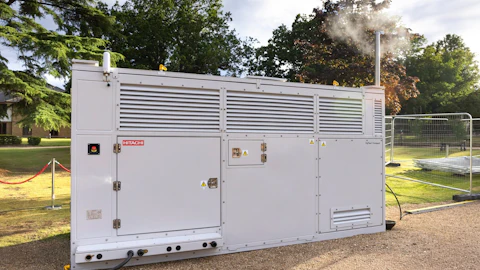

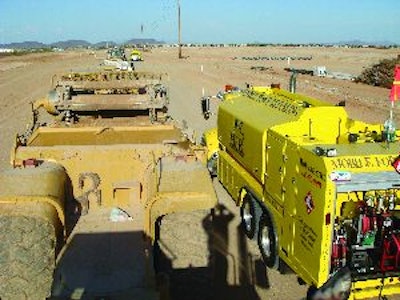
Many options exist to keep your fleet topped off every morning, including outsourcing an on-site refueling service, running your own fuel/lube trucks, on-site tanks and even fuel tanks in the back of pickups.
Phoenix, AZ-based Markham Construction is a large commercial contractor with 200+ pieces of equipment. The company has in an-house maintenance and service coordinator, as well as journeymen mechanics and service people on the payroll. "We do all of the major repairs here in our shop," says Hollis Loper, vice president, equipment operations.
The company's equipment ranges from large Caterpillar motor scrapers to motor graders and skip loaders. It also owns its own lube trucks. "These trucks have 2,000-gal. tanks and they all have around 12 or 13 reels on them for product," says Loper.
Markham uses a diversified approach to match its refueling strategy to the jobsite. The company contracts its fuel and has a 12,000-gal. fuel tank in its yard. It uses a combination of fuel storage and purchasing on demand to best meet its needs.
Its own fuel trucks are used for on-site fueling when it makes sense, and outsourcing is used when it doesn't. Jobsite tanks are also occasionally used. "We do put portable tanks on sites when consumption is greater than the fuel trucks hold," says Loper.
Efficiency is a must when refueling a larger fleet, and Markham has developed a few best practices. "We line the machines up where all fuel tanks are on the same side," says Loper. "We only fuel between shifts to prevent interruptions."
Horsepower vs. fuel consumption
Paul R. Lipp & Son, Rogers, OH, is an excavation contractor that runs excavators, bulldozers, track loaders, wheel loaders and scrapers. "We purchase fuel in bulk and store it at our equipment yard for convenience and consistent, traceable quality," says Greg Lipp, president. "Buying fuel on the road can be risky sometimes."
The company has mostly small- to mid-sized equipment. "The average horsepower is around 100 hp, with the larger machines at 175 hp," says Lipp.
"Our jobs typically last two to three days with some larger jobs that may last four to six weeks. We have been fortunate to find work within a 20-mile radius of our equipment yard, so we always return to our yard at the end of each day," he notes. "We have not experienced the need to have portable fuel tanks on our jobsites."
Jobsite fuel tanks can pose many problems. "The portable on-site fuel tanks raise questions about theft, vandalism and environmental liabilities," Lipp notes. "Our operators drive pickup trucks that carry the usual hand tools, plus lasers, chop saws, safety equipment, etc. These trucks are also equipped with auxiliary fuel tanks that mount in the bed of the truck and carry about 90 gal. of off-road diesel. They have 12-volt electric transfer pumps."
Horsepower does make a difference in determining fueling requirements."I like to think of fuel usage as having a direct relationship with the horsepower of a machine," says Lipp. "Unless the machine is idling most of the time or doing light-duty work, the fuel consumption is going to be fairly easy to predict. Our 175-hp elevating scrapers will burn between 5 and 6 gal. per hour (gph) when working. The 100-hp excavators and dozers will use 3.50 to 3.75 gph when working and the smaller excavators (5- to 8-metric ton class) will use 2.0 to 2.5 gph.
"From the above usage rates, you can see we average about two machine refuelings per 90-gal. transfer tank for an 8- to 10-hour shift," he notes. "A different approach to refueling would be required if we had multiple machines at 150 hp and over and operators that did not or could not carry their own fuel. This might be an on-site portable tank or a fuel supplier that brings a fuel delivery truck to the jobsite each day."
Always on the move
Mt. Carmel Stabilization Group, Mt. Carmel, IL, has much different requirements. The company has large, high-horsepower equipment that is highly mobile and only stays on a given site for a short time.
"Our jobs normally last one to two days and we move on to the next job or state," says Kelly Crowder, equipment and maintenance manager. "Mt. Carmel's refueling strategy is to find fuel wherever they can. The crew supervisor generally relies on the local fuel supplier to fuel the equipment." Fuel is purchased on demand.
The company has to remain flexible based on jobsite requirements. "We do own a couple of fuel trucks, but they are rarely used," says Crowder. "The times they are used are because of job security, like airports or a large project where doing our own fueling makes sense."
Typically, Mt. Carmel has local vendors come on site to fuel equipment. "Occasionally, job size might make us look into our fueling practices," Crowder admits. But the company never resorts to job fuel tanks; these stay back at the shop to top off equipment before leaving for a job.
An outsourced solution
Phoenix, AZ-based Mobile Force Refueling (MFR) specializes in on-site refueling and lubrication of construction equipment. It charges an hourly rate that varies by the level of service, from daily full-service maintenance to on-site fueling only. "We are literally a turnkey equipment service company," says Brad Davis, owner. "We do the full daily maintenance, along with 250-hour, 1,000-hour or 2,000-hour PM services."
According to Davis, on-site refueling services offer many benefits over alternative methods. For example, he believes jobsite fuel tanks can create a false sense of economy.
"Some contractors claim that with a jobsite tank they don't need to pay for fuel delivery services on a daily basis," Davis comments. But there are labor costs to consider. "Let's assume they have an employee grease their equipment [and] it takes 10 minutes to service a machine. Let's figure on 10 machines. You have an hour and 40 minutes wrapped up there. Then the guy has to fuel it. Let's say another 10 minutes to fuel each machine because the jobsite tanks only pump 6 gpm. Now you have another hour and 40 minutes. You have three hours and 20 minutes just tied up into fueling and greasing."
Likewise, running your own fuel trucks adds expense. "The truck obviously is a cost," says Davis. "It is a fixed asset. It is an operational liability with the fuel and the insurance." And what if you don't work 12 months a year? "As our client, you have no fixed truck costs. You have no insurance. You have no employee. Finances are tough; getting capital is tougher. Would you rather put $150,000 into a motor grader that generates revenue or $150,000 into a fuel truck that costs you money?"
Contractors often simply compare labor rates. For example, MFR charges $88 an hour (for full service) and an internal employee may be making $18 an hour. "Granted, you are paying $18 an hour, but there is a burden cost," Davis points out. "So it is really $26 an hour.
"When you are driving a truck down a road at today's fuel price, it costs you $30 an hour just in fuel," he continues. "A typical heavy-duty truck is getting 6 mpg. If it is travelling 60 mph, it is burning 10 gph of fuel at $3/gal." This assumes the vehicle speed doesn't exceed 60 mph.
Once you add the $26 an hour for the employee to the $30 for fuel, you are already at $60 an hour. "Then, there are truck payments and insurance," says Davis. "There is wear and tear on the truck, which I calculate right around $9 an hour. And you have double time - there is windshield time to get wherever you are going and back. We eliminate the windshield time all together."
Let's say you have two jobsites located 30 miles apart, each with five machines. "Your oiler is going to spend an eight- or 10-hour day traveling to and from both of those jobsites," says Davis. "We would travel to the site and fuel the five machines. You are probably looking at a two-hour bill, so $176 plus fuel." To service the second site would also be $176, for a total of $352.
"By the time you take your truck driver to the rack and load a 1,000-gal. truck, you have an hour into it," he notes. "If your internal burden rate happens to be $65 an hour, which is low, it just cost you 6.5¢ [per gal.] to get fuel into your truck."
Now say your driver has to drive eight to 10 hours round trip to and from those jobsites. In this scenario, you would have $650 in labor to fuel the machines at those sites vs. the $352 MFR would have charged. "Most contractors' internal costs to operate their own lube trucks are well into the $95 range with all costs calculated," Davis points out.
MFR is also able to sell fuel at a lower price due to volume pricing. "Let's just assume we would sell it to you for 10¢/gal. cheaper than you purchased it," says Davis. "We saved you $50 in fuel and $298 in labor.
"The only time, in my opinion, when having your own fuel/lube truck really makes sense," he states, "is if you are on one big project where the truck is going to stay and run all day long there."
MFR helps contractors set up a customized plan to fuel equipment. "We generate the majority of our revenue dispensing fuel," says Davis. "At an $88 hourly rate, there is not a lot of money in that. We will help them improvise a plan that saves on cost and creates efficiencies, which is clearly in both of our best interests."
No contractor is too small to use on-site refueling services. MFR continually goes to jobsites where it services one machine. The alternative to the contractor is to get into a truck and go to a service station to get fuel. Usually, this is on-road diesel, which is 50¢/gal. more expensive than off-road diesel due to the tax.
Plus, many of the tanks at service stations only pump 6 gpm. So not only does it take time to drive there and back, it can take another 20 minutes to fill a 120-gal. tank. "We are dispensing at 40 gpm," says Davis. "We can fill that tank in three minutes." Once you add up all the costs, the small contractor could actually save money with a refueling service.
Beyond cost, liability is also a serious concern when you run your own refueling fleet. "Most contractors don't have the right insurance. They don't have the proper licensing," says Davis. "We have extraordinary coverage and insurance that are typically required for fuel vendors.
"Most contractors don't assume they're a fuel vendor, but they really are. They should have the same license requirements and permits that we have. A lot of them have huge exposure by not having these," he cautions. "Many contractors call their insurance company and say we have a service truck. It is written on their policy as a service truck. They do not indicate that it is a fuel truck that has hazardous materials."
On-site fuel tanks are also getting more onerous. In the past, you put a tank on the ground. "It wasn't a big issue," Davis notes. "Now you have to file for a permit. You have to get a site plan. You have to actually construct a pad and use explosion-proof wiring and a panel box to do it literally by code." All of this takes time and adds to your costs.