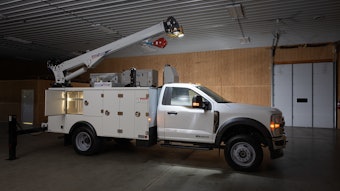
Beyond the obvious criteria - the ability of a truck to perform the intended tasks - other key considerations can impact performance, such as life-cycle cost, fuel economy, safety features, operator comfort and resale value. The 2011 chassis cabs were designed to address these issues.
Life-cycle cost is a primary consideration with any work truck. All of the manufacturers have managed to reduce costs through better fuel economy, exhaust brakes that save on wear and tear, extended service intervals and increased capability.
"Don't just look at the purchase price," says Dan Tigges, product manager, General Motors. "Look at what it is going to cost you in fuel, insurance and maintenance and repairs, and try to factor all of those into the decision. This is why a commercial dealer network is huge. If the truck is not up and running, nobody makes money."
"Small contractors will tell you that the first consideration is purchase price, when in fact it is really about fifth," says Todd Kaufman, F-Series chassis cab marketing manager, Ford. The reality is that the first consideration is the proper truck for the job. "We find that people will try to under-specify the truck, then they have a problem because they are misapplying it - maintenance cost goes up, etc. First, and probably the most important thing, is to make sure you are purchasing the right truck for the application."
Work with the dealer to get the right truck; they are trained to ask the right questions. "The end result is you apply the correct vehicle for the application," notes Kaufman. "Everybody is happy because the vehicle lasts a very long time and it has very low maintenance costs. It gets the job done and it doesn't break down. It provides the lowest cost of ownership."
Reduce operating costs
When it comes to life-cycle cost, fuel economy is a major factor. "Because of the large scale of the jobs heavy-duty trucks do, they tend to consume a lot of fuel," says Tigges.
Most major suppliers claim fuel economy improvements for the 2011 model year. The Chevrolet and GMC diesel-powered chassis cabs boast an 11% improvement in fuel economy on the highway, even with increased horsepower and torque ratings. The selective catalytic reduction (SCR) system used to meet 2010 EPA emissions limits helps achieve this goal. "That is one of the reasons we went to SCR as opposed to a lean NOx trap," explains Tigges. "We also have better aerodynamics, and made improvements in the Allison transmission electronic fan clutch. There is less drag on the engine. So there is really a combination of things that helped us get to those numbers."
Ford claims up to 22% improvement in fuel economy for its 2011 chassis cab models equipped with the 6.7-liter Power Stroke vs. 2010 models. "What is really interesting is that we don't sacrifice any performance. The torque and horsepower are improved; so is the towing and payload," says Kaufman. This is due to a combination of changes, including improved aerodynamics, the new diesel engine with SCR system, a totally new transmission, new axles and improved tires.
The largest share of the savings is due to the new double overdrive six-speed transmission. "The internal components on the transmission reduce parasitic loss," says Kaufman. "The efficiencies that the transmission added make up almost 60% of the 22% improvement in fuel economy."
Ford also asserts that the SCR system has been beneficial. The previous generation trucks relied on exhaust gas recirculation (EGR) and particulate traps to meet emissions requirements. "It puts a bunch of heat inside the engine," says Kaufman. The result is a huge loss of performance. "By adding SCR into the aftertreatment, there are two main benefits. One, you certainly get the reduction of NOx, virtually eliminating it and turning it into hydrogen and water. Two, the engineers are able to reduce the amount of EGR that goes into the engine initially, which then allows for a cleaner burn and a lot more efficient use of fuel."
Some customers have expressed concern about adding another fluid. "You need to buy an extra tank of product - diesel exhaust fluid," says Kaufman. "Based on a 100,000 mile a year application, you are talking less than $300 a year in consumption. If you take a conservative 3% improvement in fuel economy at today's fuel prices, the return is pretty easy to see. Diesel today is at an average $3.09. Do you really think it is going to stay there? Over the life of the vehicle, it certainly makes sense to me that this is the right solution."
Despite being relatively new to the U.S., Europe and Japan have a proven track record with SCR technology.
Ford has also reduced maintenance costs by extending transmission fluid drain intervals to 150,000 miles. A dual filter provides fine filtration and large capacity in a single package, and eliminates the need for an external spin-on filter.
Ram Trucks chassis cabs also use SCR. "The Cummins turbo diesel engine uses a commercial-grade SCR system to reduce oxides of nitrogen (NOx) by as much as 83% in order to meet the new, more stringent 2010 diesel emissions requirements," says Dave Elshoff, head of Ram Truck brand communications, Chrysler Group. In addition, the company offers savings on maintenance with 7,500-mile standard oil change intervals.
Many of the diesel-equipped chassis cabs offer an exhaust brake, including the Ram 3500, 4500 and 5500 chassis cab vehicles, on which it's standard. "This feature reduces brake fade, prolongs brake life and provides confidence and safety when hauling heavy loads," notes Elshoff.
Compare features
Pay attention to which features come standard and which are options. For instance, according to Elshoff, Ram has added a number of no-cost standard content to the all-new chassis cab, including power windows, locks and mirrors.
Also look at features unique to each vehicle make. Take Ford's live-drive PTO on its TorqShift transmission. The PTO output gear is linked through the torque converter to the engine crankshaft. This allows the transmission to power auxiliary equipment with up to 50 hp and 250 lb.-ft. of torque output. The power is available any time the engine is running.
Previously, if you wanted a live-drive PTO, you had to install a clutch pump that would operate hydraulics off the front of the engine. "It was very expensive," says Kaufman. "It required a significant amount of time and labor to install it. Now, with the live-drive PTO, it is real simple. It is relatively low cost compared to a clutch pump. It is easy to service and install.
General Motors chose to use an independent front suspension in its Chevrolet and GMC chassis cabs vs. a solid front axle like its competitors. "But we beefed it up significantly," says Tigges. "We have a 6,000-lb. maximum gross axle weight rating. And by going with that independent front suspension, we are able to provide better ride and handling than with the solid axle. There is a lot less unsprung weight, a lot less weight that is not riding on the springs. You don't have to control all of that weight going up and down. You keep more tire on the road."
All of the chassis cabs are available with automatic transmissions that can manually limit the highest available transmission gear, and allow manual upshifts and downshifts based on road speed and engine speed for improved towing. "However, the Ram chassis cab is the only vehicle in its segment to offer a manual six-speed transmission, standard on all diesel models," Elshoff asserts.
In addition, there are unique features offered by each manufacturer that increase upfitter friendliness. For example, Ram Truck chassis cabs feature four upfitter switches integrated on the instrument panel. "Each of these four upfitter switches are linked to an auxiliary Power Distribution Center (PDC) located under the hood, which includes one fused 20-amp battery feed and one fused relay-controlled 20-amp ignition," says Elshoff. "In addition to these feeds, the PDC supports four new customizable switches. Two switches are ignition fed and the remaining two are either battery or ignition."
Another upfitter feature is the ability to handle auxiliary-fueled equipment. "A special capped auxiliary fuel line on the fuel tank makes upfitting even easier, facilitating the use of auxiliary equipment running on fuel," Elshoff states.
Powertrains built for work
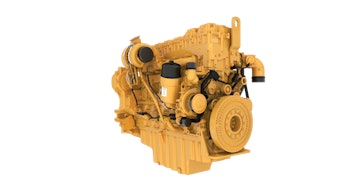
For 2011, the powertrains under the 2011 chassis cabs have been beefed up with more capability.
"Ram increased the chassis cab's capability by increasing axle ratings and GVW, yet retained the same proven chassis and powertrain," notes Elshoff. The 5.7-liter HEMI V-8 gasoline engine delivers 383 hp at 5,600 rpm and 400 lb.-ft. of torque at 4,000 rpm. The 6.7-liter Cummins Turbo diesel engine is rated at 305 hp at 3,000 rpm and 610 lb.-ft. of torque at only 1,600 rpm.
The powertrains and frame design allow the Ram Trucks to provide impressive capability. The Ram Chassis Cab 3500 features a 26,000-lb. gross combined weight rating (GCWR) and 19,000-lb. trailer tow capability. The Ram Chassis Cab 5500 features a gross vehicle weight rating (GVWR) of 19,500 lbs.
For 2011, General Motors pumped up performance of its Chevrolet Silverado and GMC Sierra chassis cabs with a more powerful 6.6-liter Duramax diesel that delivers 335 hp at 3,100 rpm and 685 lb.-ft. of torque at 1,600 rpm. GVWRs have increased up to 13,200 lbs., with a GCWR of up to 27,500 lbs. on dual rear-wheel models. The front axle weight rating has increased to 6,000 lbs. and the rear axle weight rating has increased to 9,750 lbs.
GM has also introduced new frames. "All of these frames are significantly stronger than their predecessors, and allow us to carry a lot more payload than we have in the past," says Tigges. Maximum payload has been increased to 7,293 lbs.
Longer wheelbases - ranging from 133.6 to 167.7 in. - and wider front/rear tracks enhance the ride and handling characteristics, giving them a greater feeling of smoothness and control. Larger engine and transmission mounts, coupled with a 125% stiffer front frame structure, also provide greater vibration control, while hydraulic body mounts are incorporated under the cab section on extended and crew cab models for a more isolated feel inside.
There are more configurations to consider, as well. GM has increased its range of 2WD regular cab offerings. "It used to be that all we offered was a box delete on the 2WD regular cab," notes Tigges. "It had to be single rear wheels and only the gas engine was offered. For 2011, we will offer that 2WD regular cab with single rear wheels or dual rear wheels. We will offer it with the gas or the diesel engine."
Ford introduced a 6.2-liter gas engine to replace its previous generation 5.4-liter gas engine in the F-250 and F-350 trucks. But the big news from Ford is the 6.7-liter Power Stroke diesel that pumps out 735 lb.-ft. of torque and 390 hp, along with the six-speed TorqShift transmission. "We had a radical redesign of the diesel powertrain in the Super Duty," says Kaufman. This allows the F-550 to tow up to 26,400 lbs. The 2011 Super Duty also has a payload capacity of 6,520 lbs.
Looking at the numbers and options available, it becomes clear that the 2011 trucks will offer an advantage in terms of total cost of ownership and capability. With improved fuel economy and increased horsepower and torque, these trucks are a win-win scenario. The trick is to get the truck that most closely matches your application.
GM ROLLS OUT CREW CAB
Despite the fact that the regular cabs dominate this market by a significant margin, there is a growing interest in crew cabs. "It's a growing piece of the market," says Dan Tigges, General Motors.
To address this, General Motors made some changes to its lineup. "We dropped our extended cab chassis cab and added a crew cab chassis cab in its place," says Tigges. "If you are using the vehicle to haul people, the crew cab is going to give you a much more comfortable ride. You can sell someone the advantages of a crew cab chassis, but it is pretty hard to move them down."