By Mark Buncher, Ph.D., P.E.
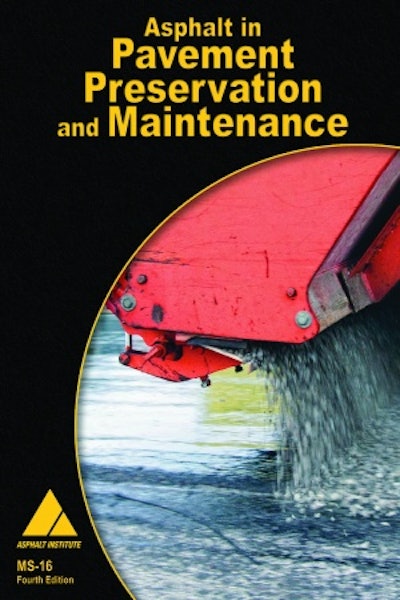
The Asphalt Institute recently released their 4th edition of the MS-16 Manual, Asphalt in Pavement Preservation and Maintenance. This new edition is 170 pages, more than twice that of the previous edition, and now includes the topics of pavement management and preservation. Discussions on all the maintenance and preservation methods have been expanded, including the latest technologies on current surface seal options, infrared patching, specialized patching procedures and expanded crack sealing and filling procedures.
This 4th edition of the manual maintains its field-friendly size, and was prepared with the hands-on practitioner in mind. It provides useful guidance on materials, designs, techniques, equipment, mixing and placement, best practices, precautions, etc. A brief description of each chapter is as follows:
- Chapter 1 discusses pavement management systems and their role in a preservation program.
- Chapter 2 provides information about methods and terminology that apply to the use of asphalt in pavement maintenance.
- Chapter 3 covers pavement evaluations along with the identification and causes of various asphalt distress types.
- Chapter 4 describes the asphalt materials, aggregates and mixes used for pavement maintenance and preservation activities.
- Chapter 5 covers crack sealing/filling and patching methods, procedures and terminology.
- Chapter 6 provides details on 11 surface treatment types, ranging from fog seals to chip seals to microsurfacing.
- Chapter 7 discusses the uses of asphalt in repairing Portland cement concrete (PCC) Pavements.
Ordering information can be found on www.asphaltinstitute.org or calling (859)-288-4960.
Surface Treatments
Asphalt surface treatments are versatile, widely used preventative maintenance techniques that are applied to the entire surface of the pavement. When properly designed, they are economical, easy to place, and cost-effective. They seal and add life to the existing underlying structure. There is a wide range of surface treatment types, with each type distinctly different and for various uses. The 11 types of surface treatments that are covered in the 37 page Chapter 6 of MS-16 and are briefly described below.
- Dust Palliative: Application of a diluted asphalt emulsion applied with an asphalt distributor to an unpaved surface for dust control. The diluted material is sprayed in repeated small applications as required to penetrate and seal the surface.
- Fog Seal: A light spray application of diluted emulsion applied to the surface of a chip seal, or weathered hot mix to seal cracks, reduce raveling, or rejuvenate surfaces.
- Rejuvenator: Fog seals using specially formulated emulsions to not only seal, but to penetrate and restore oxidized asphalt surfaces by replacing lost components of old age hardened asphalt.
- Sand Seal: A light spray application of asphalt covered with sand size aggregate (basically, a chip seal using sand) to improve skid resistance, seal cracks, reduce raveling, or rejuvenate surfaces.
- Chip Seal: Sprayed application of asphalt immediately covered by a single layer of uniform-size aggregate used as a wearing and waterproo?ng course that improves skid resistance. Also known as a bituminous surface treatment. Repeated applications result in increased thickness.
- Sandwich Seal: Variation of chip seal where a larger aggregate is spread first on an existing chip seal without an asphalt binder applied, followed immediately by a chip seal using thicker asphalt rate and smaller aggregate. This is used to address an existing bleeding surface.
- Scrub Seal: A variation of a chip seal using scrub brooms towed behind the distributor of chip seal forcing emulsion into pavement cracks. Emulsions are specially formulated to give adequate time and stability to enable scrubbing of the emulsion into the existing surface. Improves crack sealing and waterproofing.
- Slurry Seal: A mixture of fine aggregate, mineral filler, emulsified asphalt, and water to correct oxidation, seal non-working cracks, stop raveling, improve skid resistance and appearance. A squeegee strike-off and burlap drag is used to spread and finish.
- Cape Seal: A single-layer chip seal followed by a slurry seal results in a smoother, quieter surface with a better seal than a chip seal alone. A minimum cure time of three days between placement of the chip seal and slurry seal application is recommended.
- Thin Overlays:Thin overlay of conventional dense graded mix used to extend the life of a pavement, improve ride quality, and correct surface defects such as low skid resistance.
- Ultrathin Bonded Wearing Course: A thin overlay placed by a specially modified paver that simultaneously applies a heavy tack/bond coat of a polymer-modified emulsion and then a thin layer of gap graded hot mix. The hot mix is dropped directly onto the unbroken emulsion. The water in the emulsion flashes to steam drawing the residual asphalt into the hot mix to form a strong cohesive bond with the pavement. The result is a very smooth and open-textured surface that can significantly reduce the generation of tire/pavement noise and improve skid resistance.
Chip Seal Best Practices
There are 16 pages dedicated to chip seals, covering everything from materials, design, equipment, construction, joints, seasonal limitations, precautions, distress types, etc. The following simple safeguards will greatly increase the chance of success when a chip seal is constructed:
- Assure the existing pavement structure is strong enough to support expected traffic.
- Perform the mix design with materials representative of those to be used on the job.
- Use aggregate which is free from dust and slightly damp for the best results.
- Inspect and calibrate the equipment to ensure proper operation.
- Select the proper type and weight of rollers.
- Follow proper construction techniques.
- Provide proper traffic control.
- Perform the work in weather conditions suitable for the type and grade of asphalt selected.
Adhering to these simple safeguards will help prevent problems such as streaking, bleeding and loss of cover aggregate; the three most common distress types for chip seals. Yes, MS-16 provides descriptions of these distresses and lists the causes for each.
Getting back to sound fundamentals of pavement maintenance and preservation is critical in these funding challenging times. AI's new MS-16 Manual provides critical information based on the latest technologies to do just that.
Dr. Mark Buncher is Director of Engineering for the Asphalt Institute