![Tony Groat Edited 5b57430ec070e[1] Headshot](https://img.forconstructionpros.com/files/base/acbm/fcp/image/2024/06/Tony_Groat_edited.5b57430ec070e_1_.667c30792412c.png?auto=format%2Ccompress&crop=faces&fit=crop&h=48&q=70&w=48)
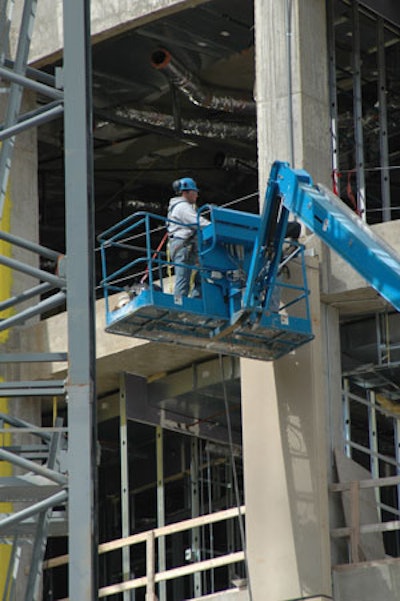
Aerial work platforms (AWPs) have become a tool of choice to place workers at heights to perform tasks. As their use continues to grow, their diversity in size and available options also expands. Small-profile vertical lifts and scissor lifts allow users to pass through standard doorways; articulated booms provide access up and over structures; and boom jibs offer additional access into hard to reach areas. Users are placing these highly productive machines in all types of environments and conditions.
From a simplistic point of view, many operators see one aerial lift as pretty much the same as the next; one may be able to reach higher or have a larger platform, but they are viewed as basically alike. While much can be said to correct this myth, the one truth to this perspective is that most of the risks associated with their use are the same.
AWPs are the safest means to place workers at height, provided the equipment operator is properly trained and the work platform is inspected, maintained and serviced as recommended by the manufacturer. Failure to do so can result in serious injury or death.
A required element of proper lift equipment training is the recognition of hazards associated with their use. It is reported that over 80% of aerial lift accidents are the result of operator error. An examination of fatalities involving aerial lifts in the construction industry points to the following causes: electrocutions, falls, collapses or tipovers, caught in/between and struck by/against.
Confined space and overhead risks
While AWP manufacturers are always researching means to mitigate risk when using their products, it is unlikely that all risk will ever be completely eliminated. So it's important to stress the need and responsibility for managers and operators to be adequately trained; site risk assessments to take place prior to operation; proper AWP selection be made for the job; and safe operating procedures to be defined, implemented and supervised once hazards and risks are identified.
According to the Center to Protect Worker Rights, between 1992 to 1999, one of the top five causes of deaths involving aerial lifts used in construction was crushing hazards, where the operator was caught in/between the lift and an overhead obstruction. This risk continues to be a leading cause of fatalities with AWP use today.
Confined work spaces can present just such a risk. When thinking of confined spaces, you may think in terms of an enclosed work environment, such as inside a vessel or industrial plant. Yet, AWPs can face a confined space in a large open warehouse or outside a plant, as well. The confined space is the work area around the relatively small platform from which the operator is working.
It is not uncommon to see a lift driving through extremely tight quarters, such as a standard size doorway, to maneuver to the actual work site. An operator can pay too much attention to maneuvering the machine when there is limited clearance. Incidents have occurred when the operator bent low over the guardrail while driving through the opening, only to get his body caught between the top of the door frame and the platform guardrail.
It is also common to see a boom platform maneuvering through a maze of overhead steel, trusses or obstructions to reach the work area above it. The lift operator is focusing on maneuvering the platform; his or her hands are on the controls, with eyes shifting constantly to see where the platform is in relation to the obstacles. In these situations, operators have been known to have their body pushed against the controls by overhead obstructions. The pressure of their bodies on the controls leads to the machine continuing to move forward, trapping the operator.
Such risks are potentially fatal, so the primary attention of the operator must be on personal safety over moving the platform into position.
Hazard identification and training
When employers direct personnel to operate an AWP, they have a responsibility to warn the operators of potential hazards, provide the means to protect against the hazard and explain the potential consequences of not following proper operating guidelines. A proper risk assessment should always be conducted to recognize the safest means to perform a task and the procedures to be used.
A risk assessment can allow an AWP to be used safely in a work site that has a confined overhead area or obstructions. This will require site managers to become aware of the specific precautions and procedures needed when planning and supervising work in these areas.
It is also critical that operators are adequately trained to recognize the risk associated with AWP use. The mobility and flexibility of today's AWPs make it hard for an operator to foresee the danger in manipulating these machines into place.
In Europe, the International Powered Access Federation is working jointly with the Construction Plant-hire Association to call on AWP users to take extra care when planning and using lifts where confined overhead areas or obstructions are present. Their goal is to produce a best practices guide for such applications that will be applicable wherever AWPs are in operation. For more information about their efforts, visit www.ipaf.org or www.awpt.org.