Street and parking lot sweeping received another boost as an effective pollution-control effort following a one-year study conducted by Seattle Public Utilities (SPU).
"We had very high expectations and the 'big picture' message is street sweeping exceeded our expectations for pollution removal and cost effectiveness," says Terry Martin, acting division director for asset management of SPU.
Results of the 2006-2007 study were published in April, and among the recommendations was that Seattle "begin pursuing an expanded street sweeping program to reduce the amount of pollutants discharged to area-receiving water bodies from city streets."
"The Street Sweeping Pilot Study provided valuable data for understanding the effect of sweeping streets every two weeks with a regenerative air sweeper on the amount and characteristics of dirt present on the streets, sediment accumulation in catch basins, and materials removed by the Sweeper," the report notes. "Data collected for this study clearly show that sweeping each side of the street every other week is very effective in reducing the amount of sediment and associated pollutants discharged from city streets."
Study details are reported in the "Impact Sweeping" article published in the October/November issue of Pavement Maintenance & Reconstruction.
Study Background
Early research pointed a direction the study should take.
"I was surprised at how little literature there was and how little study had actually been done on street sweeping so we decided to go the extra mile and set up a pretty comprehensive study," Martin says.
He says their research into previous sweeping and stormwater studies indicated the approach the Seattle study should take. SPU decided to measure the amount (by weight) of sediments and the quality of sediments, as opposed to the quality of stormwater runoff. In this study SPU used what's termed a "mass balance" method which measures the amount of sediment and associated pollutants present on the street, removed by sweeping, and accumulated in catch basins. Swept and unswept sites were compared in light industrial, local residential and arterial streets.
"Because many previous studies have had difficulty demonstrating a significant difference in stormwater quality between swept and unswept sites, focusing on sediment mass/chemistry was considered to be the most cost-effective way to evaluate street sweeping performance," the report notes. "It also provides the information necessary to estimate a sediment mass balance between swept and unswept study areas by measuring the mass of sediment that is removed by the sweeper and catch basins versus what remains on the street."
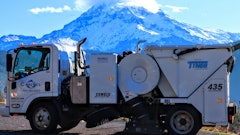
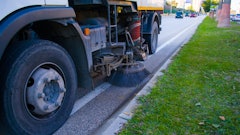
Test sites were selected in two residential areas and one light industrial area. In the test sites each side of the street was swept on alternating weeks, for an overall sweeping frequency of once every two weeks. SPU contracted with SDOT to perform the sweeping required of the study and SDOT crews subsequently swept the streets using a Schwarze Industries Model A8000 regenerative air sweeper. Each side of the street was swept from the curb to a width equal to the street sweeper. A single pass covered nearly all of a traffic lane in the two residential areas, and approximately 50% of a traffic lane on the industrial streets. The street sweeper was operated at a rate of approximately 5 to 7 mph.
The volume of street dirt, sweeper waste, and catch basin sediment was measured approximately every four weeks. Street dirt samples were collected using an industrial vacuum and weighed from both the swept and unswept sites on one to two days prior to sweeping. Samples were collected from alternate sides of the street on each consecutive sampling event to coincide with street sweeping events.
Sweeper waste was stored in separate dumpsters assigned to each test site. Each dumpster was weighed on an industrial scale after excess water was removed with a trash pump. Material greater than 2 centimeters in diameter was removed by hand and weighed separately to determine the proportion of debris in the waste material. Sediment accumulation in the catch basins was determined by measuring down from the rim of the maintenance hole to the surface of the sediment. A total of 12 catch basins were sampled at each test/control site.
In addition to collecting the amount of sediment from the streets, street dirt, sweeper waste, and catch basin sediment samples were collected for chemical analysis every four weeks and archived. At the end of each quarter, a single composite sample of each media type was prepared from the archived samples and submitted to the laboratory for analysis. Samples were analyzed for total suspended solids, metals, organic content (total volatile solids and total organic carbon), semi-volatile organic compounds, and PCBs.
Seattle to expand sweeping
Based on the results of the pilot study, Seattle is beginning to pursue an expanded street sweeping program. The study recommended that as the city expands its sweeping efforts that it:
- Prioritize areas within the city where water/sediment quality improvements are most needed and where street sweeping has the greatest potential to improve water and sediment quality. The study identified areas where sweeping could have the greatest impact as arterials and curbed roads.
- Establish a sweeping frequency of once every two weeks, which was the frequency shown to be effective in the study. The report also recommends that the sweeping frequency should be increased to once every two weeks in areas that are currently swept less frequently.
While the study did answer a number of questions, it also provided reason for additional study. The report suggests the city:
- Evaluate whether street sweeping can also be cost effective in areas without curbs. Many of the streets in the industrial sections of Seattle are not curbed and the study suggests additional research to develop a cost-effective strategy for dealing with these roadways.
- Continue to evaluate street sweeping performance by monitoring the volume of sweeper waste removed and tracking how removal rates vary with the type of streets swept (e.g., land use, traffic volume, number of parked cars, and the absence of curbs).
- Continue to evaluate the effectiveness of street sweeping at reducing drainage system maintenance costs. The study notes that though results indicate "that sweeping had a negligible effect on reducing catch basin sediment buildup, this result is counterintuitive and should continue to be studied as it has the potential to save the city considerable money if justified by further analysis."
Additional Resources that Build on the Topics of this Article
Seattle Sweeping SPU 2009 - Read the full study report.
Podcast interview with Terry Martin - The audio interview with Martin, one of the project specifiers, can be found at the end of the page.