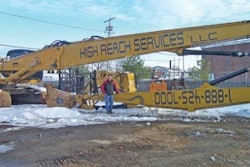
It started out as a simple job: remove an ATM machine from the side of the supermarket and rebuild the wall. It should have been quick, clean and over with. But even the simplest construction jobs are rarely simple.
The problems began innocently enough. During the construction process, the supermarket owners wanted a minor change. No problem. The builder brought the architect back into the loop, the plans were updated, construction restarted...and builder and architect withdrew a small amount from the construction fund to cover the costs of the change.
Everything was fine, until the next work stoppage the following week. Another quick meeting of the minds, another quick update, and another quick withdrawal from the construction fund.
By the time the construction was over, the builder was looking at a six-figure cost overrun. "Looking back," builder Paul Singh says, "We should have been much more rigorous in our planning and our communications. We jumped into construction too early, and none of us did a good job of managing the back-and-forth between the architect, the bank, the supermarket, and our own crew."
Paul's experience is, alas, all too common. And before you chalk up Paul's problems to inexperience and mismanagement, you should know the other half of the story: Paul and his family own one of the leading construction companies in the Washington, D.C. metro area.
Tensions have always existed between designers and builders, and between architects and contractors. Rather than blending their disparate skills in a yin-and-yang harmony, they're more likely to fight like cats and dogs when a project goes awry...and every project goes awry, even ones where the customer is an industry veteran.
The eternal frustration of the designer is that he has to rely on the builder to transform his ideas into reality, and that somehow the perfection of the drawing board doesn't translate on the job site.
There's an old joke that's illustrative.
An architect tells his contractor, "I was an atheist, but you've made me a believer." "Why?," asks the contractor, "Because the beauty of my work makes you think of Heaven?" "No," says the architect, "Because I didn't believe in the Devil and Hell until now."
Yet designers have no monopoly on frustration. Too often, they find themselves trying to translate abstract plans into concrete reality with insufficient guidance, forcing them to make difficult choices.
Have you heard this old contractor's saw?
"What's the difference between God and an architect? God knows he's a great architect. An architect knows he's greater than God."
It's hard to avoid these tensions. In a typical project, the customer hires the designer and builder separately. Once the architect finishes the plans, the customer then hires the lowest bidder to handle the buildout. Small wonder the relationship often turns adversarial.
But this battle has no winners, only losers. Designers don't get to see their plans fully realized. Builders have to scramble against tight deadlines and even tighter budgets. And the customers sit on the sideline, getting madder and madder as they see their overruns growing and their pocketbooks shrinking.
In these difficult economic times, with commercial construction in historic doldrums, designers and builders can't afford the costs and hassle of poor coordination. That's why when it comes to design and construction, collaboration is the future.
All too often, we've seen the effects of designs that are "thrown over the wall" to construction: Delays, overruns, and dissatisfaction with an imperfectly realized vision. Many times, the industry has tried to build bridges to better relationships between designers and builders. The number of seminars, roundtables, and articles is endless.
For example, more than a decade ago, The Boston Society of Architects and the Associated General Contractors of Massachusetts teamed up to publish "The Client Advisor" as a way to explain the roles and responsibilities of architect and contractor in the context of a project.
Yet all these attempts to bring together design and construction inevitably ran into basic physical limitations - construction teams didn't have the time to visit the design team studios as the design took shape, and designers rarely had the ability to follow the progress on the construction site.
Even in today's high tech world, most communications still take place in person or on the phone, and the main record for discussions and change orders remains pen and paper. The general manager at the construction site acts as a project manager, coordinating information and activity with the architect, the structural engineer, and the customer. Information flows are tightly controlled, and usually bottlenecked. Even e-mail simply adds to the problems, generating a blizzard of old messages and out of date file attachments - the electronic equivalent of the overstuffed briefcase in the cab of the general manager's truck.
But a new breed of high-tech collaboration tools are breaking down the boundaries, physical and mental, between design and construction. For example, PBworks, a "SaaS" (Software-as-a-Service) provider of hosted collaboration tools, offers architects, designers, engineers, and construction teams a shared online environment where they can work together from the design phase through final construction, managing tasks and milestones in an online environment, with e-mail and RSS (really simple syndication) notifications to keep everyone informed. By providing organization and transparency to designer, builder, and customer, these tools can alleviate the disconnect between the three parties and improve the efficiency of the design/build transition.
Wikis are simple web sites that allow multiple people to edit their content. They can be public (a la the Wikipedia online encyclopedia) or private. Wiki collaboration has several characteristics that make it ideal for allowing designers and builders to work together.
First, wiki collaboration tools are extremely simple to use. The Wikipedia famously includes contributions from millions of different authors, none of whom ever needed to attend a training class or read a manual in order to know how to use that Web site. PBworks hosts several times as many pages of content as the English-language edition of the Wikipedia. And even though PBworks is secure enough to be trusted by organizations such as the Mayo Clinic, FedEx, and the Department of Homeland Security, it's also easy enough to be used by thousands of grade school classrooms. Architects and contractors are busy; they already spend enough time dealing with complex 3-D software; the last thing they need is to have to learn a complex new tool.
Second, hosted collaboration provides a permanent record of interactions. Each and every change and edit is time stamped, and the identity of the person making the change is stored for audit trail purposes. This can put an end to the endless "he said, she said" arguments that can result from informal verbal agreements and discussions.
Third, online collaboration solutions are searchable. Rather than being forced to search through mountains or e-mail or reams of forms (or through the dreaded overstuffed briefcase), a general manager or architect can simply type in the words he or she is looking for and see the best matches in less than a second.
Fourth, collaboration keeps everyone up to date. The general manager, architect, and customer can all subscribe to notifications that alert them whenever a change has been made. This provides a very simple way to make sure that changes and issues are distributed to all the relevant parties in near real-time, rather than relying on weekly or even monthly face to face meetings to surface important issues.
Fifth, some collaboration solutions incorporate actual project management tools, such as tasks and milestones. These tools allow project managers to see the status of the project at a glance, and help all the parties involve collaborate on specific tasks, rather than trying to untangle long e-mail chains or unwritten conversations.
Finally, hosted collaboration tools are accessible to any of the interested parties as long as they have an Internet connection. This means the system does not require designers or builders to download any software or operate any servers. They can even be accessed via mobile phones such as Blackberries and iPhones.
Let's return to the example of the bank ATM job, and see how things might have gone differently had his architect and contractor been using a hosted collaboration solution.
"The problem," says Paul, "Is the lack of coordination. It might be more than a week between meetings with the architect and the bank, and during that time, if the construction crew has erected a wall or poured concrete, mistakes can become very expensive. One of the costlier mistakes involved just such a delay. By the time we caught the problem in our next meeting, we had to undo a week's worth of work. That adds up."
If instead, the site manager and his crews were able to update a project management workspace on a daily basis with the latest work and potential issues, posting digital photos or even embedding short videos of the job site, the architect and customer would become aware of problems before correcting them became prohibitively expensive, and could provide clear feedback via the same medium.
At the same time, this ability to provide progress reports and gather feedback would allow the builder and his crew to work with greater confidence, less paperwork, and without having to resort to gut-wrenching guesswork to keep the work moving while waiting for the next scheduled meeting.
PBworks even allows users to "comment" on pages and tasks; these comments are also time-stamped and tied to particular users, allowing designer, builder, and customer to keep a clear and permanent record of which changes were approved and by whom.
We're still at the very beginning of the collaboration revolution. The tools are still evolving at a frantic pace. Yet if they continue their rapid progress, the day may yet come when jokes about architects and contractors will be as outdated as using a handsaw to cut two-by-fours.