"We started getting calls about porous asphalt pavements," recalls Dave Vogt, a Bend, OR-based contractor. "So in 2008 we decided to take the lead in central Oregon and show this market how porous asphalt could solve the stormwater management problems we're facing."
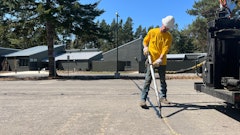
Vogt succeeded. Last year his firm, Hooker Creek Companies, placed two test sections of porous asphalt pavement. They handle stormwater well, so Hooker Creek upped the ante by constructing the first full-size porous asphalt parking lot in that part of the state at the firm's new equipment rental store in Redmond.
Today, the firm gets calls to present the technology to various forums of contractors and engineers. With that, porous asphalt is a new market for Hooker Creek.
Just as Hooker Creek's business model worked well for them, so it can work well for other asphalt contractors. It's a good idea to start by building a successful project or two. Then you have a demonstration project to showcase to others. Word spreads, you make some presentations, engineers and environmental authorities like what they hear, and you're up and running.
"The best promotional tool for porous asphalt is the product itself," says Jim Huddleston, executive director of the Asphalt Pavement Association of Oregon.
How it works
Porous asphalt pavement is not new, but it's new to many asphalt contractors. Asphalt has a successful track record of porous pavements dating back to the late 1970s. Cahill Associates, an engineering firm, has been involved in the design and construction of more than 200 porous asphalt pavements since the 1980s.
Cahill has reported no failures on pavements for which proper design and construction procedures were followed, according to Kent Hansen, P.E., Director of Engineering, National Asphalt Pavement Association (NAPA).
Porous asphalt pavements are designed for dual duty. They provide pavements for parking and roads and serve as stormwater storage and infiltration systems.
What's more, the demand for porous asphalt pavements is growing because they offer site planners and public works officials the opportunity to manage stormwater in an environmentally friendly way, says Hansen.
From the bottom up, the standard porous pavement structure consists of:
- An uncompacted subgrade to maximize the infiltration rate of the soil.
- A geotextile fabric that allows water to pass through, but prevents the migration of fine material from the subgrade into the stone recharge bed.
- A stone recharge bed consisting of clean single-sized crushed large stone with about 40 percent voids. The stone chamber serves as a structural layer and temporarily stores stormwater as it infiltrates into the soil below.
- An optional stabilizing course or "choker course" consisting of clean single-sized crushed stone smaller than the bed's larger stone. That stabilizes the surface for the paving equipment.
- An open-graded asphalt surface with interconnected voids that allow stormwater to flow through the pavement into the stone recharge bed.
Reaching the specifiers
Grimes Asphalt and Paving Corp., of Grimes, IA, has become a leading marketer and builder of porous asphalt pavements in their state. The firm built its first porous asphalt pavement - a nature trail in suburban Des Moines - in 2004. Since then, Grimes Asphalt has installed seven porous asphalt projects, says Stephen Moyna, a project manager at the firm.
Customers for porous asphalt are both public agencies and private businesses. Grimes Asphalt's first project was built for the Metro Waste Authority's Regional Collection Center in Bondurant, IA. The next was a parking lot for Luther Park Center, an assisted care center in Des Moines. The customer was a private developer.
"We had done other standard paving projects for this developer," says Moyna. "They had heard that Grimes was doing porous asphalt, and they wanted to be environmentally friendly. So we assisted with the design and construction of the parking facility. Then we put up a sign at Luther Park that graphically illustrates how porous pavement works."
Other Grimes customers are the Polk County Conservation Board, a high school, the Central Iowa Expo (an agricultural trade fair), a manufacturing firm, and a new townhome developer.
The townhome project is noteworthy because the porous asphalt drive, through the center of the development, allowed the developer to build one or two more townhomes instead of taking the space for a storm water retention facility. "That made it feasible for the developer to build the project," says Moyna.
Moyna is Grimes Asphalt's lead marketer of porous asphalt pavements. Last year alone, he made 56 presentations explaining porous asphalt to:
Both Moyna and Jill Thomas, the associate director of the Minnesota Asphalt Pavement Association (MAPA), host "Lunch and Learn" sessions that seek to educate specifiers about porous asphalt.
Consultants typically work on a billable-hours basis, says Thomas, but they're expected to take lunch, which is non-billable. So the state asphalt association buys the engineers a box lunch, which they can eat while Thomas talks to them about porous asphalt. Thomas estimates that she has done some 70 to 75 "Lunch and Learn" sessions for various design firms and agencies.
When Moyna is planning a presentation, he gives his contact flyers to distribute that explain porous asphalt.In a "where", "when" and "why" format, the simple one-page flyer elaborates on how porous asphalt systems temporarily store runoff and eliminate the need for retention basins. Plus, the flyer directs readers to Grimes' website, which features a video clip of porous asphalt in action (www.grimesasphalt.com).
Thomas says MAPA created an 11-page draft specification for porous asphalt. "An agency can put that spec right into a contract," says Thomas. "It covers everything from the geotextile to the mix design to the stone recharge bed."
Porous asphalt is catching on in Minnesota - with 15 to 20 projects constructed since 2005 - in part because groundwater infiltration is being promoted by environmental agencies.
Thomas says watershed districts limit the impervious area that a new building can create. But if, for example, a new Target store can build a porous parking lot, it helps offset the amount of impervious area that would have been included in the project. Plus, the porous parking lot eliminates the need for a retention basin - and the space it would occupy.
Not difficult
"Paving with porous asphalt is no different from paving dense-graded asphalt," says Huddleston. "You mix it in the same plant, haul it with the same trucks, and pave it with the same pavers. There are some minor differences, but they're not huge. I tell our members to develop good porous mix designs, and to make sure they avoid poorly designed jobs.
"Don't skimp on quality in any way," adds Huddleston. "Porous pavement is like going to a new restaurant. You'll try it once, and if the food is bad, you won't go back. You have to make sure the project works so that the technology will promote itself."
Education of internal contractor personnel is a key to success. "You need to make sure your dispatchers, your estimators, your plant people understand what porous asphalt is," Huddleston says. "So when the call comes from somebody who wants a porous pavement, your people know how to answer."
And it's critical for a contractor to know how to dispel the common myths about porous asphalt, Huddleston says. Myth number one is that the water will seep through the pavement, saturate the subgrade, and wreak havoc with the asphalt. It's not so. Water passes through the asphalt and into the stone recharge bed where it is stored until the uncompacted subgrade can absorb it. The stone recharge beds make outstanding structural bases and perform equally well whether dry, wet or saturated.
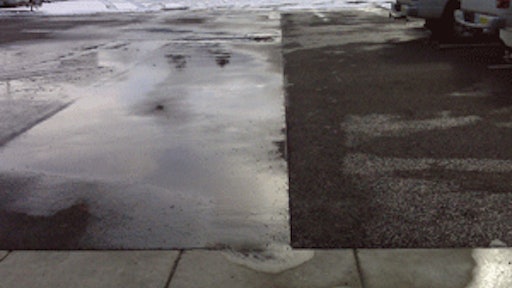
Secondly, freeze-thaw cycles are no problem for porous asphalt. That's because snow and ice form, then melt on the surface, and the water passes completely through the asphalt. Snow and ice don't build up the way they do with dense-graded asphalt.
It's best to keep porous asphalt surfaces clean of sand and dirt, because you don't want to plug the pores. "You should vacuum-sweep them once a year," says Huddleston. "But not everyone does that, and no problems seem to have developed."
Another myth is that porous asphalt won't hold up to heavy loads. It will, and a porous asphalt street project called Pringle Creek in Oregon proves that, says Huddleston. There, construction trucks traveled over the porous asphalt streets and caused no problems.
Some people think the hydrocarbons will leach out of asphalt and into the groundwater. Not true, says Huddleston; asphalt does not leach hydrocarbons. In fact, porous asphalt pavements, with stone recharge beds, have been found to be very effective at removing hydrocarbons and other pollutants that are deposited or washed onto the pavement.
No added cost
On a yard-by-yard basis, the cost of the open-graded asphalt mix is little more than conventional dense-graded asphalt. The underlying stone bed is usually more expensive than a dense-graded aggregate base, but that difference in cost is offset by the significant reduction in stormwater pipes and inlets.
Because porous pavement is designed to fit into the topography of a site, there is generally less earthwork and there are no deep excavations. Hansen says Cahill has compared the cost of porous pavements to other stormwater management options - and generally the porous pavement turns out to be the less expensive option.
"What we're promoting is that porous pavements are beneficial, and asphalt is the best way to build a porous pavement," says Huddleston. "When properly designed and built, porous asphalt pavements will out perform the competition in all areas. Asphalt is faster to construct, it is lower cost, and it has a proven performance history with jobs that are over 30 years old still performing well today."
Resources
The definitive technical guidance document is NAPA's Porous Asphalt Pavements for Stormwater Management (order number IS-131). New last fall, the publication is lavishly illustrated in full color. An accompanying executive summary brochure, Porous Asphalt Pavements (PS-33), is useful as a trade-show or seminar giveaway. Both are available from the NAPA online store at http://store.hotmix.org.
Also, check www.hotmix.org for information about NAPA's porous asphalt webinar series.