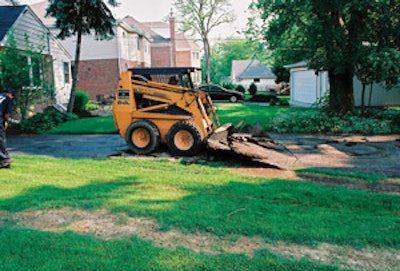
Homeowners are justifiably finicky when it comes to their property, so appearance and neatness count when paving residential driveways. Unlike commercial work with long pulls and road work with even longer pulls, paving residential driveways requires patience, attention to detail, and awareness of surroundings. But just like all paving jobs, good technique as well as proper planning, execution, and teamwork will lead to quality jobs, enhanced reputation, and significant profits. Top Quality Paving's John Ball uses these photos to work through a driveway paving project, offering insights and tips along the way.
Removing the old pavement
First things first when replacing a driveway, and that usually means removing the old pavement. Skid steers are ideal for this type of work, and bring your truck to haul it all away. Before you start make note of surrounding structures, including patios, gardens, and houses, and even though you're not digging deeply it's a good idea to call your local "one-call" center (or the new 811 phone number which will connect to most local centers) to learn the location of any buried lines.
Teamwork prepares the base
Use stone or in this case processed gravel to level the base. Note the skid steer in the background, which moved the gravel throughout the driveway; the lute man, who is leveling the gravel by hand; and the roller, which is compacting prior to paving. When adding processed material make sure to compact it. Sometimes the material can dry out, and processed material especially will move beneath the roller. Dampening the material with a light mist of water will help keep the material in place, help take the voids out, and improve compaction.
Constructing starting pad, pavement edge
Because the paver needs a platform from which to start, and because the operator doesn't want to start from the concrete apron, which has a slight downward slant, the paver worms out hot mix for laborers to construct a pad of asphalt. The pad is the width of the paver, in this case 8 feet, and 3 feet deep to support the weight of the screed. Note none of the laborers work from the concrete so they don't track asphalt on it. Also note how the lute man (right) positions his lute at an angle; the other laborers shovel mix toward the lute, creating a nice, smooth edge to the driveway.
Starting to pave
After the pad is constructed the paver is ready to start the first pass. The screed is out and has taken off from the pad, the laborer is fine tuning the pad where it might have been marked by the weight of the screed. Note the hopper is up so the mix slides easier into the conveyor, which helps reduce segregation.
Paving and working the paving plan
As the first pull moves out the driveway you can see where the job will require two passes. This approach was discussed and planned for before any mix was placed. As the lute man fine tunes and levels the surface, the shovel man is doing two important things: first, he is removing excess mix from the edge of the screed before it is actually placed; second, as the line on the right edge of the pass shows, he is "cutting" the mat to make room for the next pass, which will overlap the right side of the first pass. Without cutting the mat before the overlap there will be to much material at the joint, and there's a good chance it won't roll down, leaving a slight ridge in the mat the length of the overlap in the driveway.
Shovel tips to fill low spots
As the paver pulls its first pass the crew works to fine tune the mat. The operator gets a shovel of mix from the paver and places it on a low spot. Note that he dumps the mix where it's needed and does not broadcast it over the surface. Broadcasting the mix results in segregation. The shovel of mix will then be smoothed over by the lute man, who also will fine tune the edge of the mat, readying it for the second pass. Do not place a shovel full of mix onto the mat without having it worked by the lute man. The two work in tandem, as a team, and both most work effectively to get the best result.
Hand roll to seal edge
Once the first pass is down and the paver is out of the way, the crew uses a hand roller to seal the edge of the mat, both against the concrete apron and against the lawn. Sealing the edge by hand enables the operator of the power roller, in this case a 1 ½ ton static roller, to compact the pavement without having to work right at the edge, which might push the mix either onto the concrete or break the nice line on the edge and push it onto the lawn. This seals up the handwork the lute man did making the edge straight. It's important when handwork is done that it be sealed as quickly as possible. If you wait too long it won't look as good and could segregate before you get the roller on it. Note that the operator placed a piece of plywood over the concrete so as to not damage or stain it when moving the roller from the garage to the mat.
Working the mat for second pass
The lute man cuts away an edge with the lute, cutting into the material and raking it back toward himself so the paver operator will have something to match onto in the second pass. Cutting the edge and thinning it out ensures there aren't any humps in the mat, enabling the paver to level the mat with the next pass. Also, note the proper position of the roller handle, which should always be on the side nearest the operator so he can walk on the grass and not the mat when rolling and so he doesn't have to stretch over to push it.
Starting the second pass
The paver has backed to the garage and is accepting new hot mix from the dump truck. The operator watches the material flow into the hopper, all the while keeping his hand on the throttle to make sure the paver takes the correct amount of mix from the truck. The operator wants to make sure the mix does not overflow the sides or the front of the paver. If he sees that too much mix is flowing into the paver he can immediately push forward, and engage the machine to start paving.
First pass of the roller
The first paving pass has been made as far as the plan dictates, and the roller operator has started compacting. For the best compaction job work from the edge of the mat, which has been sealed by the hand roller, toward the paver. The paver has received its new load of hot mix and has positioned itself to start its next pass.
Dealing with too much mix
Sometimes too much mix will be dumped into the hopper - or the truck will pull away too quickly - leaving a pile of mix in front of the paver. It is essential that this excess mix be shoveled out of the way and deposited evenly across the base or even back into the hopper. If this material were left and paved over the driveway would have a permanent hump in the middle that could not be compacted away.
Why a two-man screed?
Any work on residential property requires neatness and exactness, as homeowners are spending their own hard-earned money on this investment. So when paving a driveway you will get the best result by operating with two operators on the screed. Each operator has control of the extensions and each can keep the paving pass up tight with the grass area on either side. In this case an 8-foot screed is used with extensions of a foot or so on each side. Also, operators on each side can adjust the thickness of the mat as necessary to make sure it matches the main screed across the width of the driveway.
Tipping and 2 x 4s
A few things to notice in this photo. First, the operator lifted the box of the paver up, tipping the mix down toward the conveyor so the mix slides more easily from the paver into the auger area. By tipping the hopper in this manner the material moves as a mass, sliding all at once, which reduces segregation. Note the 2 x 4s that are lined up with the tracks of the paver to provide a smooth transition from the driveway to the sidewalk. They also protect the edges of the sidewalk from chipping or breaking. Also note the guide bar (chain) hanging down on the front edge of the paver, which makes it easier for the operator to pave in a straight line. The operator is looking at the edge, lining up the tracks to make sure he hits those two pieces of wood.
Dealing with the sidewalk
it! The main drive is paved and the paver has reached the sidewalk. Notice the front of the endgate flush with the edge of the sidewalk. A very nice balancing act as they came right level into the sidewalk. Not as easy as it looks because as the paver reaches the sidewalk it angles upward slightly on the front end, and doesn't flatten out until the paver is on the sidewalk. Note again the 2 x 4 pieces of lumber on the opposite side of the sidewalk (and you can see them peeking out from beneath the paver as well). These 2 x 4s ease the transition from the driveway to the sidewalk and protect the edges of the sidewalk from damage caused by the weight of the paver.
Pave to sidewalk
The paver has come and gone, leaving the mix flush against the concrete. Laborers are working to make sure the mix is high enough so it will be even with the sidewalk after compaction. A second laborer is sweeping fine particles away from the mat and the sidewalk. If left in place these particles will be crushed into the sidewalk or mat by the roller, leaving a messy appearance.
Ready to pave apron
With the paver across the sidewalk, the 2 x 4s are removed and laborers dribble hot mix next to the concrete, creating a pad (similar to the wider mat constructed at the garage) to support the screed and make sure there's enough mix adjacent to the sidewalk. Note the laborer cleaning the lute.
Paving the apron
The paver has backed to the small pad, lowered the screed, and pulled forward toward the street, placing the remainder of the driveway and completing the apron…almost. The lute man is fine tuning the edge, making sure it's the correct height so it will be level with the concrete when rolled.
Saw edge for a finishing touch
The step most contractors don't make time for: using a pavement saw to cut a nice straight line at the end of the driveway between the asphalt street and the end of the driveway. This not only enables the asphalt to seal up properly because it's compacted against a straight face, but it also makes the edge of the driveway look uniform, providing a very nice cosmetic touch to finish off the job. Depending on how much is cut out, a skid steer can be used to pick up the debris, or as in this case a shovel and broom will work fine.
For best compaction: follow the water!
If you want a good job, roll straight. If you want to mess up a driveway, roll crooked! Operators who can follow water marks will make sure the finished job is rolled in sequence and that no area is left without proper compaction. Here it's easy to see how the operator followed the triangle left after the first paving pass.
Nice curved edge
Successful driveway paving results not only in well-placed, properly compacted mix. Good driveways also have nice straight edges - even if the edge is on a curve - that are paved tight to the grass.
| RELATED ARTICLES |
| More images and insights on demanding driveways in the equipment gallery. |
Information for this article was provided by John S. Ball III, Top Quality Paving, Manchester, NH (www.tqpaving.com). Photos by Allan Heydorn; paving by S&H Paving, Schaumburg, IL. John Ball will present a variety of paving seminars at National Pavement Expo West, Nov. 15-17, Las Vegas; and National Pavement Expo, Jan. 30-Feb. 2, 2008 in Nashville. For more information visit www.nationalpavementexpo.com..
|
S&H Paving: "Driveways Are Our Bread and Butter" Joined in business by sons Ozzy and Fernando, cousin Abel Hernandez, and Noel and Efrain Espinal, the paving operation relies on a systematic approach to generating as much work as possible, at as high a quality as possible, ensuring that word of mouth helps market the company throughout the Chicagoland area. "Driveways are our bread and butter. That's what we live off of," says Ozzy Hernandez, who has worked with his father for more than 15 years. "We've got a few people working with us and they all have families, so it's important we do a good job and take care of the job. That's how my father has kept this business growing." Ozzy says one of the first steps S&H takes when arriving on any jobsite is to take a good look around so everyone on the crew is aware of the surroundings. While some of the six-person crew begins unhitching the equipment, father and son walk the jobsite, getting the lay of the land and looking for any problem areas they will need to deal with. Can they pull the truck back to the beginning of the driveway? Are there any wires in the way? How close are the houses or other buildings? Is there a patio that might come into play? "We're very careful around the property we're doing," Ozzy says. He says that unlike commercial jobs, where the crew works in a large space with few obstacles and no one looking over their shoulder, paving residential driveways requires patience and a little more care. "Most homeowners are very observant about the work we're doing," he says. "They want to make sure we don't damage their lawn, or their flowers, or the side of their house. That's important to them so we make ourselves aware of it." He says S&H usually prepares three driveways a day, which includes ripping out old pavement, adding gravel, leveling it and compacting it. Once the prepared driveways receive approval from local inspectors, S&H can pave several in a day. "That approach enables us to keep ahead, and we can have plenty to do and can really keep the paving going over the summer," he says. He says that in addition to experienced workers, good equipment is the key to their success. S&H uses several trucks, a Leeboy 1000 paver, a Wacker 1 ½-ton roller, an Edco pavement saw, a Case 1845C skid steer, a 500-gal. and 1,000-gal. Able sealcoating rigs, and miscellaneous hand tools. "We might take our time around a house, but it's important that we take care," Hernandez says. "We don't rush anything, we don't force anything, and we make sure the homeowner is happy with the way the finished driveway looks." |

![Lee Boy Facility 2025 17 Use[16]](https://img.forconstructionpros.com/mindful/acbm/workspaces/default/uploads/2025/09/leeboy-facility-2025-17-use16.AbONDzEzbV.jpg?auto=format%2Ccompress&fit=crop&h=100&q=70&w=100)




![Lee Boy Facility 2025 17 Use[16]](https://img.forconstructionpros.com/mindful/acbm/workspaces/default/uploads/2025/09/leeboy-facility-2025-17-use16.AbONDzEzbV.jpg?ar=16%3A9&auto=format%2Ccompress&dpr=2&fit=crop&h=135&q=70&w=240)


