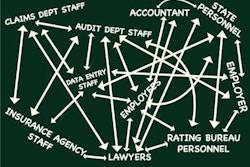
It's hard to fathom, but when first instituted a century ago, the workers' compensation system was devised as a cost-saving mechanism. Job safety was deteriorating, leading to an increase in accidents and injuries. Employers increasingly found themselves in court, defending civil suits.
Workers' compensation was seen as a way out of the problem by spreading the risk, while providing compensation to employees who were disabled from working.
Today, the system is a monster. Workers' compensation accounts for the fastest growing labor cost in the country. Studies show that costs in this area are doubling every four years, with insurance premium levels rising at an annual rate of 10%.
Employers spend tens of billions of dollars each year to insure their work-injury risk. Most costs result from the payment of increased benefits when it comes time to determine an employee's eligibility to return to work. The most common injuries are typically caused by lower back strains, slips and falls, and incidents in which employees are struck by various objects.
Increased utilization of attorneys on a contingent fee basis has fueled the cost increase. When these attorneys are involved, studies indicate cases become fifteen times more expensive for employers. Over-treatment by physicians contributes to the problem. Medical costs are approaching half of total benefit costs. Backlogged administrative systems drive up costs by creating obstacles to the rapid settlement of claims.
Dozens of states have turned to legal reform in an effort to control spiraling costs. Caps on recovery awards and contingency fee limits have been passed in many states, with limited success. Other states have passed laws that provide incentives to employers who implement drug-free workplace programs.
Federal laws such as the Americans with Disabilities Act ("ADA") and the Family and Medical Leave Act ("FMLA") have added confusion by imposing seemingly conflicting employer obligations.
Workers' compensation costs have had an enormous impact on the bottom line. By focusing on long-term objectives, however, these expenses can be effectively managed and contained. Here is a checklist that can help keep your costs down:
Establish a Comprehensive Cost Reduction Program: The program should be tailored to suit individual needs, but there are common elements to the most effective programs:
- A legal, but thorough pre-employment screening program.
- Administration of agility tests to job applicants.
- Conducting post-offer medical exams and inquiries.
- A focus on safety training at orientation.
- Utilization of accurate, updated job descriptions.
- Strict enforcement of a substance abuse policy.
- Consistent adherence to a temporary light duty policy.
- Coordination with FMLA, STD and other leave programs.
Train Employees to be Safety-Conscious: Implement a comprehensive safety program that provides for regular meetings, dissemination of written materials, and hazard communication. Consider creating a safety committee, consistent with the requirements of the National Labor Relations Act.
Evaluate Your Organization's Claim History: Study your history of workers' compensation claims over a minimum five-year period, and look for patterns in injury type and frequency. Determine the most common types of injuries, and look for a repeat use of the same doctors, chiropractors and lawyers.
Compare Your Costs to Those of Other Companies: Contact other contractors to compare your cost figures with those of "benchmark" companies with excellent claims records. Find out what they do differently, and try to determine what makes the difference. National, state and local industry associations represent valuable sources of information that may lead to additional cost savings.
Periodically Audit Claims Reserves: Hire a qualified person to evaluate whether reserve computations are reasonable or excessive for the types of injuries incurred at your facility. This person should report directly to you, not the insurance company.
Familiarize Yourself with Basic State Procedures: Try to become more involved in deciding whether a claim is settled or litigated. If you operate in more than one state, be aware that state laws vary, particularly as they pertain to items such as commencement of the benefits period, retaliation, notice periods, attorney fees, and the availability of a subsequent injury trust fund.
Evaluate the Legal Knowledge of Cost Control Managers: Determine whether those persons presently responsible for cost control are trained on applicable provisions of state and federal law, including the ADA, FMLA, and the OSHAct.
Train Managers and Supervisors on Cost Containment: Instruct supervisors on proper techniques for compiling information and background evidence from the employee and other witnesses. Train them on proper safety procedure and first-aid, accident reporting, and physician referral procedures. Instruct supervisors to show personal concern for their employees while on leave.
Retain Aggressive Attorneys and Adjusters: When available, consider exercising your right to choose your own attorneys and adjusters. If your insurance policy does not allow this, consider renegotiating the policy, and insist on prompt communication with insurance representatives.
Know Your Insurance Policy Inside and Out: Understand the correlation between current experience and future premiums. Identify the parties responsible for attorneys' fees, and determine whether those fees are reflected in your experience ratings. Determine who pays for surveillance and medical exams, and whether you have input in selecting the attorney.
Handle Every Claim Individually and Aggressively: Consider possible courses of action for each file as you review it, including such options as surveillance, medical exams, termination of benefits and light duty. Move quickly when a course of action is determined.
Establish a Good Working Relationship with Company Physicians: Look for an honest and conservative doctor who, in addition to providing excellent medical care, understands your point of view. Cultivate a trusting relationship with that physician over time.
Identify and Deter Fraudulent Claims: Warn employees of the consequences of filing fraudulent claims, and aggressively investigate suspicious cases. When fraud is discovered, consider criminal prosecution and civil actions for damages, especially when evidence points to a conspiracy between unscrupulous lawyers and medical providers.
Obtain a Full, Universal Release of all Claims Before Settling: Retain full and final authority to approve any and all settlements. Make an effort to obtain a full release of all claims whenever a settlement of a workers' compensation claim is reached.
Coordinate Workers' Compensation Claims with Pending Litigation: When litigation is pending with the employee, a qualified person (usually labor counsel) should compare the facts contained in the workers' compensation file to the other litigation.
Do Not Overlook Subsequent Injury Trust Funds: The manager charged with responsibility for cost containment should become familiar with the procedures for obtaining reimbursement from the state subsequent injury trust fund, if applicable.
Bring Employees Back to Work as Soon as Possible: Consider implementing temporary light duty policies or "work hardening" programs designed to return employees to work as soon as possible. Designate a coordinator to work with injured employees while on leave, and to encourage them to return to duty as soon as possible.
Analyze the Advantages of Self-insurance: Under "self-funding" plans, the employer is directly liable for workers compensation benefits. In states that permit it, self-funding may provide significant cost-saving advantages, particularly when insurance premiums exceed the amounts paid to employees by the carrier.
Manage Workplace Injuries - Don't let Them Manage You: Audit your policies and procedures to ensure a proactive approach to cost containment. Computerize workers' compensation data to spot injury patterns. Emphasize early treatment and return to work. Refer your employees to trusted physicians. Follow up with and monitor injured workers by telephone.
Conclusion
Controlling workers' compensation costs is no longer merely a desirable goal. For many employers competing with other companies which have successfully lowered their costs, it is a necessity for business survival.
Steve Bernstein is a partner in the Atlanta office of Fisher & Phillips LLP. His practice includes representing construction companies and other employers throughout the United States in both state and federal courts, as well as before the NLRB, the U.S. Department of Labor, the EEOC, and other state and federal agencies. A significant portion of his practice is devoted to the implementation of preventive employee relations programs that include supervisory training as well as the development and administration of effective human resources policies and practices. He can be reached at 404-231-1400, [email protected] or www.laborlawyers.com.