Boston, MA, is one of the largest metropolitan areas in the United States. The city itself contains over 600,000 people; but with all of the surrounding cities taken into account, the population of the area exceeds 4 million. The city also attracts more than 12 million visitors each year. Given these numbers, there's no wonder transportation is a large concern.
The Massachusetts Bay Transportation Authority (MBTA) operates the oldest and fourth largest transportation system in the country.
"The T", as it's known locally, was created in 1964 to run the already functioning transit system. Today, it provides transportation to the entire greater Boston area by means of subways, buses, ferries and commuter rail lines.
The commuter rail offers train service to out-lying points west, north and south of Boston, including Providence, RI. It is owned by the MBTA, but managed and operated by the Massachusetts Bay Commuter Railroad Co.
When the MBTA decided to extend the existing commuter rail line down the south shore, from Braintree all the way to Scituate, it became evident it would involve far more than simply laying down 18 miles of new track. The $250 million "Greenbush project" faced a variety of challenges almost immediately.
Bypass crucial to completion
One of many concerns was a decision regarding the functionality of a stretch of 48-in. pipe that belonged to the Massachusetts Water Resource Authority. The stretch of pipe was part of a combined sewer line - a system that allows general public and industrial waste to combine with ground water runoff when conventional sewer systems are at capacity during periods of heavy rainfall.
As it turned out, the pipe was positioned at the exact point where a portion of the extended rail line was planned. In order to complete the rail extension, the sewer line would have to be bypassed and rebuilt at a lower elevation without disturbing the local population of the area or causing environmental impact.
A large volume of water would have to be re-routed before reconstruction of the pipe could begin. Cashman/Balfour-Beatty (CBB), the company entrusted with completing this undertaking, contacted Baker Pumps to coordinate the bypass operation.
There was little margin for error. "With a bypass, what we do is interrupt the line," explains Carroll Hunnewell, a regional manager with Baker Pumps. "We plug it off and it has no place to go. If we can't pump it, it backs up. Then there is a chance that it can come out in the street or back up into homes."
There could also be financial repercussions. "Any problem would have been a big mess to clean up. And with the environmental issues at stake, we could have faced fines for any violation," says Julie Power, a project engineer who worked on the Greenbush project for CBB. "Once the pumps were installed, we needed to ensure they would remain reliably operating to their maximum capacity so the construction team would be able to go in and complete their work in a timely fashion."
Pumping in all kinds of weather
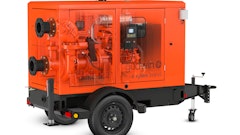
While pumps from several different manufacturers were considered, the project team ultimately settled on The Gorman-Rupp Co.'s Prime Aire pumps. These pumps operate with a patented priming system engineered to eliminate weepage. They also feature a dual-suction side capability, a compressor-over-pump and an abrasive-handling seal.
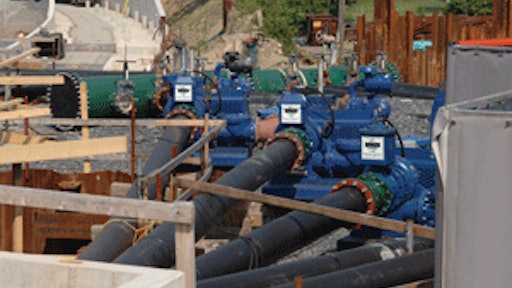
To execute the pumping operation, Baker Pumps designed a siphon to direct the water down, then back up a 5-ft. elevation. The operation implemented seven 12-in. pumps (six primaries and one backup) that attached directly to seven 14-in. suction lines, with water being discharged 750 ft. away into the siphon chamber. The company also had to deal with a 22-ft. lift in elevation from the water level to the pump centerline at its highest point.
The presence of homes and shops in the area also made noise a primary concern. To address this, Baker Pumps developed a soundproof barrier around the project using sound-absorbing curtains, which cut noise level by more than 30% at a distance of 30 ft.
Extreme weather proved the biggest obstacle during the pumping stage. "When we were getting ready to start pumping, we were in the midst of a pretty dry time," says Power. "Then once we started pumping, we hit a period of several back-to-back storms."
In fact, the Boston area was experiencing back-to-back 100-year storms - periods of rainfall that have just a 1% chance, in any given year, of being equaled or exceeded.
Fortunately, the pumps were able to handle the increased volume. "We were aware that flows could be considerably greater than we were asked to design around," says Hunnewell. "By building a safety factor into the design of the pumping system, we were assured that the operation would continue to run smoothly during the times of heavy rainfall."
The pumps were able to keep going even when the flow exceeded expected levels by upwards of 10 MGD, Hunnewell adds.
Once the rainfall had passed, the pumps continued to operate effectively even in periods of extreme dryness. "When you're doing a bypass, your flows vary dramatically. They are all over the place," Hunnewell comments. For this reason, it was vital that the Prime Aire pumps came equipped with dry run capability. This allowed them to continue to run completely dry without any damage to the mechanical seal.
Lower than expected costs
Operating costs for the bypass project were difficult to pinpoint. "We weren't quite certain what to expect in terms of the amount of fuel we would burn running the pumps," Power admits.
Based on past experience, Baker Pumps and Gorman-Rupp anticipated the operation would burn 3 gph per pump. This proved pessimistic. "Our fuel costs were dramatically less than calculated," says Power.
According to Hunnewell's calculations, the bypass actually used 1.5 gph per pump, a 50% reduction in fuel cost. This amounted to a nearly $15,000 savings in project costs.
The savings went right to the project's bottom line. "Before the job, there was a significant level of anxiety over the potential problems," Power states. "But everything ran very smoothly. We couldn't have asked for anything better."








![Woc 2021 Banner 2 Hires[33]](https://img.forconstructionpros.com/files/base/acbm/fcp/image/2021/06/woc_2021_banner_2_hires_33_.60b943bc31158.png?auto=format%2Ccompress&fit=crop&h=135&q=70&rect=84%2C0%2C1749%2C984&w=240)