Years ago, when many contractors started striping pavements, maybe the only value they could offer was clean bright lines. But today pavement marking contractors can offer more. And the more they can offer the more value they add to their service - and the more revenue they can generate from each parking lot they stripe. So here are a few services you can add to your company. If you’re already offering them, good for you. If you’re not, it’s time to consider broadening the scope of your business so you can become a more valued problem-solver for your customers while adding revenue to your business.
Install lightweight car stops
A combination of the drive to recycle and the need for lightweight parking stops has created an industry of plastic or rubberized car stops, speed bumps, and speed humps.
"These are a better solution for property managers and for contractors," says Steve Engels, vice president of sales for GNR Technologies. "Contractors really have to look at it as selling ‘value added’. These offer an opportunity for the contractor to break into accounts he hasn’t been able to before and offer additional revenue-generating services to existing customers."
GNR’s car stops weigh about 32 lbs., compared to 300 lbs. for a single concrete car stop. They are black and feature white and yellow reflective markings or blue reflective markings for use in handicap stalls. The stops can be installed using an adhesive, but Engels recommends installing them in asphalt with two 14-in. rebar spikes or in concrete using two shorter lag bolts. In asphalt the holes can be drilled and the spikes driven in with a sledge hammer; a pneumatic jackhammer can install each spike in 7 seconds.
"It’s a 10-minute process start-to finish," Engels says.
He says the lightweight stops have advantages for the property owner over concrete stops, namely they last long, are easy to replace when damaged, and will remain in place.
"Concrete stops aren’t spiked, they’re pinned only an inch or so into the pavement because people think the weight of the concrete will keep them in place," Engels says. "But you often see concrete stops sitting out of line or out of position and the parking lot doesn’t look very good."
He says the recycled rubber stops take about the same mount of time to install as the concrete stops but require less equipment - no flatbed truck and no lift to move the stops off the truck or position them in place. Plus there’s less risk to crews who won’t have to lift and position the 300-lb. concrete stops.
Engels says contractors can generate a margin of 20% to 35% on each car stop, speed bump, or speed hump installed. He estimates that depending on the market a contractor installing 200 of these car stops on a small parking lot could generate $2,500 to $5,000 on the job.
"For contractors in pavement maintenance who want to enhance their business this is a great opportunity," Engels says. "The market for these is very young and unpenetrated and we know from experience that contractors in the striping business are often asked to put these in."
Maintain those metal posts
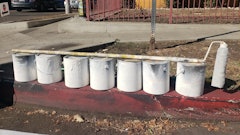
Bollards are the steel posts positioned throughout most parking lots. They are installed to protect buildings from cars and trucks, protect dumpsters from vehicles, prevent vehicles from driving up on sidewalks or into doors, protect outdoor utilities, and many other situations.
But bollards get nicked and dinged so they need to be maintained, mainly repainted, and usually about once a year. Some pavement marking contractors offer this service, and if you don’t you should consider it. You have the paint, you’re already bidding the job, just add an offer to paint the bollards. But painting bollards has its own problems. Paint can be sprayed on, but overspray on surrounding sidewalks and buildings is a real concern. Or it can be done by hand, which is time consuming. Plus, if you check out any bollard you come across there’s usually paint splatters on the pavement around it. (If there aren’t, the painter took some extra time to cover the pavement - again expanding time on the job and possibly eating into profits.)
But another solution is to install bollard sleeves, which are available from a number of companies including Ideal Shield and Post Guard from Encore. Made of molded plastic, the sleeves simply slip over existing bollards to improve their appearance. Ideal Shield’s bollard sleeves are available in yellow, red, blue, black, and custom colors; Post Guard’s sleeves are available in 12 colors, 5 diameters, and 2 square sizes. Sleeves withstand a broad range of temperatures and generally can be cleaned using any nonabrasive cleaner.
"It’s a great door opener for a salesperson," says Bruce Liebowitz, president of Post Guard. "It’s a product many property or facility managers have never even thought of, and even if they have thought of it it’s not a priority for them and they don’t know where to buy them. You get a lot of attention when you walk into an office carrying a 60-in. red bollard cover under your arm. It’s a great way to prospect."
Ideal Shield’s sleeves are made of 1/4-in.-thick one-piece polyethylene plastic that is secured to the bollard with neoprene tape. Dennis Knittel, Ideal Shield national sales manager, says the tape creates an air vacuum and suction keeps the sleeve in place.
"They just lock down," Knittel says. "When put on properly you just can’t pull them off."
Where Ideal Shield uses strips of neoprene tape placed around the bollard, one strip near the top and one at the bottom, Post Guard by Encore uses two expansion foam strips draped over the top of the bollard. Liebowitz says the properties of the foam make it expand, holding the sleeve in place.
"While offering a contractor a new avenue of revenue you are also providing the end user a value-added product" Knittel says. "When you put these sleeves on they make the lot look nice for years to come. Even if a contractor typically paints bollards these save time, last longer, look better, and avoid the problem of spilling or splattering paint on the sidewalk or asphalt around the bollard."
He says once a contractor gets the hang of installing sleeves, they take only two minutes to install and mark-up ranges from 15% to 50% per sleeve.
Liebowitz agrees.
"The finished look the contractor leaves on the facility will get noticed by others. It adds a nice professional finish to the job," Liebowitz says. "Plus, you can generate some nice cash. It’s hard to put an exact dollar amount on it but if a parking lot has 45 bollards on it a good guess is a contractor can make another $500 in an hour or so once you know how to install them."
"Pavement marketing"
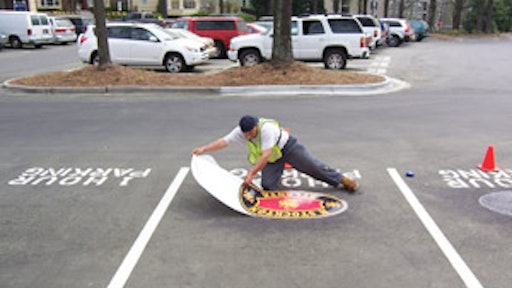
Still another addition to the striping contractor’s arsenal of services is also the newest pavement addition: applying custom digital images to asphalt or concrete pavement. Steve Johnson, president of U.S. Striping/Digimark, can turn a parking lot or parking garage in an advertising medium.
"It’s the last bastion for advertising," Johnson says. "When you’re standing on a parking lot you are literally standing in a field of gold because parking lot managers can now become revenue generators. Their parking lots can be more than just places to park."
Johnson says the Digimark product, which can be used on both concrete and asphalt, can be used for traditional arrows, turn lanes, and Americans with Disabilities Act compliance, but it’s designed to have a much bigger impact.
"We can reproduce anything a store or restaurant might want on their parking lot or a school might want on its playground, from employee-of-the-month name and photo, to company logos, to childrens’ games. One city has actually used it to put walking directions onto the sidewalk," Johnson says. "So contractors can now improve the condition of the parking lot, restripe it so it looks sharp, plus offer their customers an opportunity to market themselves or generate additional revenue by pavement marketing."
Digimark is a licensed operation in which contractors pay a fee for the right to sell and install the digital image products. The contractor can market the Digimark service to its customers or can offer it to property managers to sell to their tenants. In either case the purchase is made through the contractor and the contractor provides installation.
Under the Digimark process each contractor is provided with a template and knows what material he needs for the artwork to get the pavement digital image produced by Digimark. The contractor collects all the material and sends it to Digimark, which produces the image and sends it back to the contractor who then installs it.
While the image applied to the pavement appears to be vinyl, it is actually manufactured from a printable form of PVC - the same material used for plastic plumbing but in a different formulation. Johnson says the material is immune to traffic, won’t oxidize, and won’t come off the pavement until the contractor removes it.
Johnson says the installation process is easy, with no heat required. First sweep or broom the area, then apply an aerosol primer to assure a clean surface for installation. Next position the PVC image in place, peel the backing from it, and stick the image to the pavement. And removing it is easy too. Simply heat the image using radiant or steam heat and the image peels up, leaving behind no residue and it doesn’t damage the pavement.
| RELATED CONTENT |
| What value added striping services do you provide? Share what you do and learn from other contractors. |
"So not only is it simple but it is something that can be changed regularly. Employee of the month is a perfect example, but stores could market seasonal sales," Johnson says.
He says contractor should use the service to enhance the services they already provide.
"They can sell it themselves or they can pitch it to the facility or property manager and rely on him to sell it to his tenants," Johnson says. "If the property manager sells it then the parking lot can also be a revenue source for him."
He says contractors can generate profit in the area of 50% per square foot that each image covers.
Longer-lasting markings
While contractors often generate revenue from regular visits to paint parking lots, they can maximize results while minimizing maintenance time spent on return visits and increase their revenue by offering preformed thermoplastic markings, including stop bars, arrows, wording, handicap stencils, and even decorative crosswalks.
"Preformed thermoplastic is a durable pavement marking material that should complement a contractor’s current pavement marking program; it is not intended as a replacement," says Zina Hedrick, Flint Trading Inc., manufacturer of PreMark, HotTape, DecoMark, and TopMark preformed thermoplastic. "A contractor may choose to paint all of the parking stalls in a parking lot and use preformed thermoplastic for handicap symbols, directional arrows, and word markings because it is precut and ready to use without the need for templates."
She says that while up-front material costs are higher than paint, the overall value of preformed thermoplastic is realized when the following factors are considered:
- Maintains retroreflectivity (nighttime visibility) because glass beads are uniformly distributed throughout the material so that as the marking wears new beads are exposed. Plus, the material offers enhanced skid resistance, wears well, and generally lasts 6 to 8 times longer than paint.
- Increases sales and profit, enabling the contractor to make more money per job and making it easy for him to start doing work he had previously subbed out. The process has a low start-up and mobilization cost (only equipment needed is a propane heat torch, propane, and standard tools such as chisel and chalk line) and application is easy so expensive, skilled labor is unnecessary.
- Differentiates them from the competition by helping expand into new markets (custom logos, decorative walkways, specialty markings), offering a variety of colors and shapes of material, providing products that reduce potential tort liability exposure, and providing the benefits of a durable product.
Plus, Hedrick says adding performed thermoplastic enables contractors to expand their work season. "Our PreMark preformed thermoplastic, for example, has no minimum air or road temperature requirements for application," she says. "So the marking season can be extended so new work can be gained and deadlines can be met easily without worrying about application temperature restrictions."
She says the performed thermoplastic installation process is fast and easy, making it even easier for contractors to add the service to their business. First clean the surface (removing debris with a blower) and ensure no moisture is present. Then position the preformed thermoplastic material, heat the material with a propane heat torch, and "chisel test" to ensure a proper bond. Hedrick estimates that it takes 15-20 minutes to install a handicap symbol or an FHWA standard arrow.
"Often contractors simply see the fact that preformed thermoplastic costs more per square footage of material when compared to paint and they are ‘discouraged’ because they want the repeat business of painting again and again. They can become stagnant in their services because they are repeating the same work for same customers and not ever expanding their market or product offering," Hedrick says. "By using performed thermoplastic they will make money up front by providing a longer-lasting product, rather than making fewer dollars each year from repainting."
Enhancing interest in preformed thermoplastic is a recent Federal Highway Administration rule, effective Jan. 16, 2007, that clarifies the language "open to public travel" to include roads within shopping centers, parking lots, airports, sports arenas and other similar facilities. Under the new guidelines private roads open to public travel are subject to the same traffic control standards as public streets and highways.
"At the most recent National Pavement Expo shows, I had several contractors interested in preformed thermoplastic because of this guideline clarification," Hedrick says. "Contractors are looking for more durable materials based on guidelines from the MUTCD for private parking lots, especially at the entrances/exits that lead to public roads. This is typically directional arrows and word messages, stop bars, and handicap symbols."
Detectable warnings
Since 2001 the Federal Highway Administration has required detectable warnings on all new public sidewalk ramps. Warnings also are required under the ADA on private construction as well (due to upcoming changes in the ADAAG design standards, many states are not enforcing the private side mandate until that section of ADAAG has received final clarification).
Jon Julnes, president of Vanguard ADA, which markets detectable warnings that are constructed on site, says the Americans with Disabilities Act (ADA) has specific requirements for detectable warnings, but the essence of them is the warnings need to extend two feet front to back and across the entire width of the sidewalk opening. Plus, where overlays are involved, if the overlay abuts a sidewalk ramp detectable warnings must be installed.
"Some people place them in the center of the ramp, leaving as much as 1 foot space on either side, but because a blind person could easily walk through that opening, those constructions are noncompliant," Julnes says. "Eventually all public sidewalk ramps must have detectable warnings on them."
He says that providing that information to a client is a value-added service contractors can offer.
"Many of them are aware ADA requirements exist but they don’t have the time or the inclination to find out exactly what they are," he says. "If you can also install the detectable warnings for them you become a problem solver."
Detectable warnings products vary widely. Vanguard’s, for example, is a liquid-applied epoxy-based system that the contractor manufactures on site. Contractors must license the product and process from Vanguard, which trains and ships product to them. Currently there are 11 licensed installers covering 38 states, but the company is looking for more.
| RELATED ARTICLES |
| Looking for companies that produce detectable pavement warnings? View a list of detectable warning manufacturers. |
He says some products use raised nubs to provide skid resistance, but Vanguard uses glass beads that are integral to the product.
"So even if the product wears down it retains its skid resistance and also retains its retroreflectivity," Julnes says.
"It’s a great value-added service," Julnes says. "There is some debate about whether or not it’s going to be maintained for the private side, but it’s still in the building codes in a lot of states and a lot of state and local governments require it, so contractors can really help their customers comply, at the same time making the world a safer place for blind people, while generating additional revenue from each job they’re on."
He says by installing the product on smaller properties such as fast-food restaurants and convenience stores contractors can generate as much as 35% net after expenses, taxes, and overhead. Plus he says demand for detectable warnings is growing nationwide at a rate of 40% to 50% a year.
"And we see no reason why that won’t continue," he says.