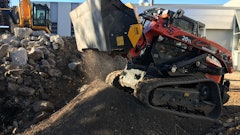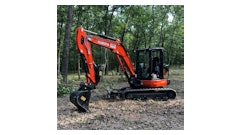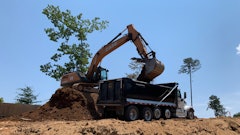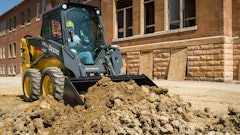
While buying a bucket for your skid steer may not require the same kind of investment in time and money as selecting its host, choosing and using the right bucket can go a long way toward getting the best possible performance from the pair.
Bucket choices offered by skid-steer manufacturers are numerous. There are also a large number of will-fit suppliers specializing solely in attachments, including buckets. Given all these choices, you may either become thoroughly confused, or find a bucket - or possibly two or three - that best accommodates your needs.
To ensure the latter happens, start the selection process by evaluating your application for the bucket. Will you be using it mostly for loading, spreading, digging, handling loose material - or maybe a combination of them all?
Buckets tend to generally fall into four categories: general purpose, light material, multipurpose and specialty. Specific terminology for buckets varies between manufacturers, so ask your representative about the characteristics of each one to ensure you're getting the right fit.
Material density and weight
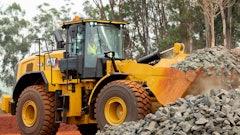
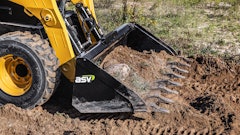
For the bulk of applications, a traditional dirt bucket - a.k.a., construction, industrial or general-purpose bucket, depending on whom you talk to - is likely the best choice. It is by far the most commonly used type. But even here you need to make decisions. Do you need extra strength and durability? How about teeth? What size do you need?
Dirt buckets generically are good choices for digging and moving dirt and rocks. But the material's density and ground conditions will dictate if you need to upgrade to a heavy-duty dirt bucket. Constructed from a greater thickness or higher grade of steel, this bucket type is designed for harsh applications that need added durability.
"It's made for more severe, rugged use such as on a track loader or a larger skid-steer loader with more power, traction and force," says Kelly Moore, product manager for skid-steer loaders and compact track loaders, Gehl.
Of course, when you add strength to a bucket, you also add weight. This in turn reduces the weight of material you will be able to carry.
For example, CEAttachment's heavy-duty 48-cu.-ft. dirt bucket weighs about 950 lbs., which is about 400 lbs. more than a comparatively sized standard-duty bucket. "You wouldn't want this heavy-duty version on an 1,800- or 2,000-lb. lift capacity machine," says Ron Grimstad, product manager, CEAttachments. "You've used up almost half of your lift capacity in the weight of the bucket. So unless you're handling packing peanuts, you can quickly overload the machine."
The limiting factor in buying any bucket is the weight and density of the materials you're lifting. "Are you hauling rocks or mulch?" asks Doug Laufenberg, product marketing manager for attachments, John Deere.
Look for the cubic foot rating on the bucket to make sure you don't overload the machine capacity, which can stress the engine and drivetrain. Depending on the carrier, overloading may also eliminate your ability to roll back the bucket.
"But even worse, it compromises safety," notes Moore. "Carrying more load than intended for a given size loader can cause the back end of the loader to lift off the ground and operate in a very unsafe mode."
When it comes to capacity, Grimstad realizes it may be tempting to opt for more than what is actually needed in an attempt to get work done faster. "But that may hurt the performance of the machine," he says. "Sometimes it's a balance between capacity and cycle times. It may be possible to do more work with a smaller bucket because you aren't constantly overloading your machine."
More capacity vs. breakout force
When capacity is an issue, you may want to consider a low-profile dirt bucket. Low-profile buckets have a longer lip, which in some cases offers more capacity. Some contractors also like these buckets because they have a lower back, which enhances visibility.
"These types of buckets are becoming more common," says Moore. "Depending on the manufacturer, they can have slightly more capacity. And they lend better visibility to the cutting edge, so the operator can see it as he drives close to curbs, gutters and buildings."
While a low-profile bucket may enhance capacity, smaller buckets with a shorter lip and shorter bottom offer more breakout force than larger buckets with longer lips and deeper bottoms. "Think of it as a lever effort," says Laufenberg. "A shorter lever lets you put more force on the bucket to break through the dirt."
If you move to a smaller bucket to gain breakout force, make sure your bucket is slightly wider than the tires or tracks on the machine. "If you go too small, you will be operating within the track of the machine, so you won't be operating on a flat plane," Moore explains. "Also, if you overfill the bucket, the excess will spill over the edge and the tires will run over it, which changes the level of the machine."
Ideally, the bucket should be about an inch or two wider than the tires. "If you go too much wider, you can run into problems with machine overload because it will be easier to carry more than the machine is intended to," Moore points out. "It's best to consult with your dealer and the operator's manual to determine capacity. Then size the bucket accordingly."
Teeth and edges
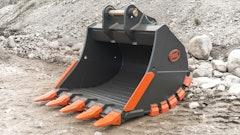
Accessories such as weld-on or bolt-on teeth and bolt-on edges can also affect breakout force. "If the material to be moved is highly compacted with rocks, a bucket with teeth and a shorter floor length will increase the breakout force and make the skid steer more productive," says Jeff Freiburer, sales application specialist, Paladin.
"Teeth can also be a benefit in summer months when it's dry because they can break through the hardpan," adds Moore.
If teeth are not needed (or wanted), a bolt-on edge can save wear and tear on the bucket edge.
"The surface the bucket will be used on is important to determine if a bolt-on edge is necessary," says Freiburer. "The bolt-on edge is the leading cutting edge on the bucket. It can be replaced if worn out, and will not affect the edge welded in the bucket."
The corrosive nature of the material the bucket will encounter is also a consideration. "Thicker steel will mean longer bucket life in a corrosive environment," Freiburer states.
Beyond dirt
While dirt buckets are by far the most popular choice for skid steers, there are situations that dictate a different option.
"If the material to be moved is considered light material, you may want to consider a bucket with a higher capacity rating to move a higher volume of material in a shorter time frame," says Freiburer.
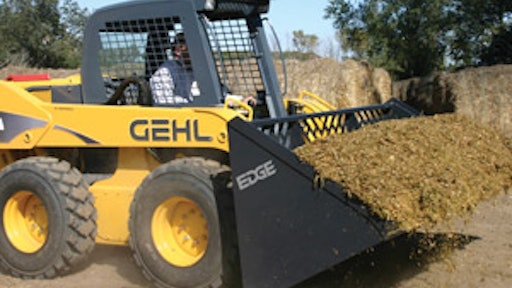
Light material buckets are deep with a high back to carry larger volumes of lighter material, such as mulch, wood chips, sawdust, bark, etc. In some cases, they do double duty as snow buckets, although dedicated snow buckets are available from some suppliers. Utility buckets can also be grouped into this category.
"These buckets are not intended for digging, but rather for moving lighter weight material," says Grimstad. "They typically have more capacity than a dirt bucket, but they don't have the strength. They are for loose materials or for backfilling around foundations."
Many manufacturers also offer specialty buckets, such as skeleton, brush and scrap grapple buckets. "A specialty bucket can be more cost-effective in the long run due to the fact the bucket is more efficient for the application," says Freiburer. "In some cases, a standard dirt bucket will not work for the job."
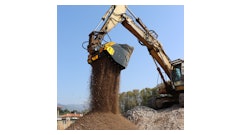
Skeleton and brush grapple buckets are essentially sifting buckets. They are a good choice for demolition or any task requiring you to separate dirt from the base material. "They let dirt fall out of the base material," says Grimstad. "It could be separating stone from dirt, brush from dirt, etc. - anything that is large enough to not fall through the cracks."
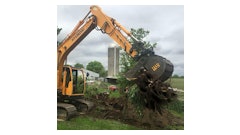
These buckets are also available with a grapple for handling and ripping out brush, small trees and shrubs.
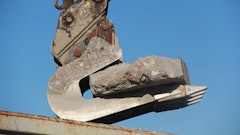
Scrap grapple buckets are essentially buckets with open sides - they have a bottom lip and back with sides cut out, plus a pair of grapples. For construction applications, they are often used to handle brush. They may also be needed in a demolition-type application with grapples mounted to the top of the bucket, says Freiburer.
Multipurpose buckets
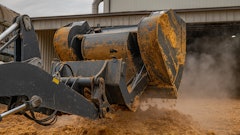
Multipurpose or 4-in-1 buckets have commonly been used in the Southeast, but are beginning to make more numerous appearances in other regions. As their name implies, these buckets can perform multiple functions because the bottom and sides can separate from the back.
"The combination bucket enables operators to do much more than dig," says Justin Odegaard, Bobcat attachment product representative. "Operators can dig, load, carry and dump material like a construction bucket, plus grip debris like a grapple, or grade and level dirt. Serrated grapple edges are good for moving logs, beams, concrete chunks or other bulky materials."
When closed, they operate like a standard bucket, but with an added advantage for dumping at maximum height. "You can roll it out like you would any other bucket. Dirt or other material will spill over the cutting edge of the bucket, which works 99% of the time," says Grimstad. "But if you're trying to reach into a dump truck that's at the limit of the lifting height capacity of your machine, you can't roll out a bucket enough to dump it because you will hit the sides of the truck. With the
4-in-1 bucket, you can simply open up the bottom of the bucket and spill out the material."
When open, the back of the bucket can serve as a dozer or box blade. "If you're doing trench work, having the straight-edge dozer blade is nice for backfilling," Grimstad notes. "Plus, you can reach across the trench with the bucket open and use the backside of the bucket part to pull material in."
Because of their clam-style design, these buckets can also operate like a grapple to pick up materials that can't be handled with a standard bucket.
Although these buckets definitely offer advantages, there are some drawbacks to consider. Because of the mechanics required to open and close the bucket, you do lose some volume. Cutting edges and hydraulics also add to the weight. For example, CEAttachments' 72-in. heavy-duty dirt bucket weighs 700 lbs., whereas its 72-in. standard-duty 4-in-1 bucket weighs 900 lbs. The added weight, in turn, reduces the weight of material the bucket can carry.
In addition, 4-in-1 buckets can cost up to three times as much, or more, compared to similar-sized dirt buckets. "You will need to evaluate if you need the extra features," advises Grimstad.
Yet, according to Odegaard, many contractors who have made the investment find they don't go back to a standard bucket. "They can do so many things with the combination bucket," he says. "They find they need to leave the seat much less frequently because the machine can now pick up things that the operator used to have to get out of the machine to do." "All specialty buckets have several different applications and each has pros and cons depending on the job," adds Freiburer. "It is very important that the right bucket is used for the given application for both the skid steer and bucket to be cost effective."
|
Quick Bucket Changes "Operators can quickly connect loader attachments to the mounting plate, lock two levers and be ready to work," says Justin Odegaard, Bobcat. The optional Power Bob-Tach system (shown) is approved for use on G-Series and newer loader models. Activating the Power Bob-Tach switch on the dash panel will engage the Bob-Tach wedges into the attachment. The system will then provide a continual charge pressure to keep the attachment secure and hold the levers in the locked position. With non-hydraulic attachments, operators can change attachments in a matter of minutes. "Operators are more likely to use the right size of bucket when attachment changes are simple," Odegaard notes. "And this can help the operator finish a job sooner thanks to attachment and loader versatility." Hydraulic-driven attachments require you to shut off the loader and exit the cab to unhook/hook up the hydraulics. "But for standard attachments, the factory- or field-installed Power Bob-Tach system is really a time - and hassle - saver," says Odegaard. |