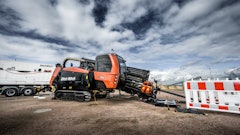
When Jon Ersland purchased his first horizontal directional drill about 10 years ago, he figured he would use it only occasionally - likely just once or twice a week. But today, he finds he uses it much more often. "It goes out with us on just about every job," he notes. "With the changes we've been seeing [in this industry], it seems that we drill more and more. Now we tend to use the drill more than our trencher."
Ersland, his wife, Lori, and his son, Aaron, own/operate K & L Trenching, based in Huxley, IA.
K & L focuses on placing power, gas and phone lines. Tools in its underground equipment cache include a Ditch Witch JT921 horizontal directional drill and a 5110 combination trencher/plow. A Ditch Witch XT1600 excavator-tool carrier was also added last Fall.
One reason Ersland is drilling more frequently is economics. The significant difference in per-foot cost that previously existed between open-cut trenching and horizontal directional drilling (HDD) has begun to evaporate. Initial purchase price and maintenance costs associated with HDD equipment have come down, while restoration costs for open-cut trenching have gone up. In other cases, HDD may be the only option available to navigate the ever-increasing underground congestion of cables, lines and pipes.
Nonetheless, Ersland still finds plenty of applications for both equipment alternatives. For him, as well as many other contractors, trenching isn't going away, and is still a cost-effective approach for many jobs.
Evaluate the cost restoration
Determining whether open-cut trenching or HDD is more cost-effective on a particular job often boils down to your knowledge of the local area and its working conditions, and the affect they might have on machine and crew costs.
"We've been doing this a long time," Ersland says. "But every job is different, so coming up with an exact cost formula is difficult."
For many contractors, determining which method is the most cost-effective begins with evaluating the level of restoration required.
"When I started in this industry 18 years ago, restoration wasn't a big issue," says Richard Levings with the Ditch Witch organization. "You just trenched it, and it was what it was. But that has all changed. The cost per foot to trench is higher than it used to be. You might not get paid much more, but the cost is higher because people are more particular about their lawns and the restoration part of it."
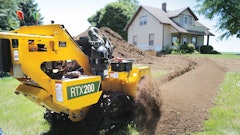
Open-cut trenching is a fast, economical way to place utilities in undeveloped, rural areas. There is no added cost wrapped up in time and tools to identify existing utilities, and there is no chance of cutting through or damaging underground lines, pipes, cables, etc., which can cause additional downtime. Plus, machine setup time and operation are faster compared to HDD. You can also take advantage of a common trench for multiple utilities, further reducing installation costs.
Open-cut trenching may be your only option in states with specific requirements. "Some states require that you lay sand in the bottom of the trench when placing natural gas lines," says Bob Wren, training manager, Astec Underground. "It cushions the pipe to prevent damage. You aren't able to do this process with a drill."
But even in a rural setting, there will likely be some level of restoration required. You may be able to accomplish adequate restoration using the trencher itself. However, some jobs may require bringing in compaction tools, such as vibratory plates or rammers. If you are required to restore the ground to grade for gravity sewers, water drain lines, etc., you may also need to invest in a laser level system.
In addition, you need to factor in the time to restore the trench. "The costs and time constraints associated with restoration can become very expensive, especially when you consider the difficulty in finding laborers," says Levings. "If you go into an existing area with a trencher, you may have to restore it two to three times to get it back to its natural state. It might be less expensive to open-cut that trench initially, but it's more expensive to maintain it."
Restoration costs will further increase when open cutting across established lawns and landscape, or across paved asphalt or concrete surfaces, because you have to replace more than just dirt.
"Restoration is hard work," adds Ersland. "The drill has made our job easier. In some cases, we can drill for trench price, particularly in backyards. When you're in an area with sod, you have to compact the dirt and re-sod or seed it, then keep it wet if it's summertime. It's time-consuming, and time is money and manpower. That's important for us since we're a small company."
Working around existing utilities
HDD eliminates much of the restoration requirements, and therefore costs, since there is only an entry and exit pit to restore. This makes this method attractive in urban areas.
"In urban settings, there can be a lot of damage to yards and driveways by open cutting," says Ed Savage, trenchless segment manager, Vermeer. "But with a drill, you can bore under yards, driveways and streets without hampering residents from getting in and out of their homes."
HDD is also a good choice - and sometimes the only choice - for areas where a lot of underground utilities have already been installed.
"In the last 20 years, there have been a lot of utilities put in the ground," says Levings. "Everything from fiber optic systems to phone systems to gas networks have been installed underground. There has also been a lot of sewer and water systems redone, and electrical systems have been taken from overhead to underground. There's just a lot more in the ground today, and placing more product in those areas requires something more minimally invasive. You can surgically install utilities using a drill to steer, guide and place them where you want. A drill allows you to work better around existing utilities."
A drill is also typically the method of choice when it comes to placing utilities under rivers, streams, etc.
However, you need to consider any extra costs incurred if you are required to carry off the spoils and bring in new dirt. Plus, you have the added cost of a fluid mixing system. And while costs are coming down, drill tooling (drill heads, backreamers, etc.) and pipe are still typically higher than tooling (chains, teeth, etc.) associated with a trencher.
"It's not as expensive as it used to be," notes Levings. "Tools are more wear resistant. They last longer and they're able to work in a wider variety of soils. But if you're putting a lot of footage in the ground, you will wear components with either machine."
HDD is also not an option for shallow trenches less than 2 ft. deep. "It's hard to keep the drill head in the ground because there isn't enough pressure from the top of the ground," says Levings. "It wants to follow the path of least resistance. So most of the time, if a trench is shallower than 2 ft., a contractor will open-cut it. Fortunately, restoration isn't quite that expensive at these shallow depths."
Training required
Manufacturers have designed directional drills to be more operator friendly, with anchoring systems and pipe loading systems that are easier to operate and handle. Still, training and operator costs can be higher with a drill.
"A directional drill will take an operator with a little higher skill set because you have electronics that locate the drill head," says Savage. "With a trencher, you don't have the learning curve of rod loader operation or locator operation."
Yet, training for either machine is critical, says Levings. "Training is necessary if you're going to be successful with any piece of equipment," he states. "Both machines take a certain level of training. Operating a trencher in rural areas takes less training. But in challenging areas, you have to have a higher level of expertise. If you're rock trenching, you don't want an untrained operator on the machine.
"Learning the underground industry is also important," he continues. "Operators need to be able to recognize color codes for the underground marks. They also need to understand the area and approximately at what depths different utilities are placed. It might be gas at 30 in., water at 48 in. and power at 24 in. Every area is different, so operators of any equipment need to be trained on what they're dealing with in their area for underground installations."
In the end, a mix of HDD equipment and trenchers often ends up being the most cost-effective solution, since it enables you to take advantage of each machine's strengths.
According to Wren, this is already happening in many areas of Tennessee, where rural water (city water routed to rural residents) is a growing trend. "Contractors will use trenchers to open cut alongside the road, then use a drill to cross under it," he points out.
"There isn't any job that is cut and dried," he adds. "Every one is different, and every state and county will have different requirements. It really depends on who your customer is. It isn't black and white. It's gray all over."
|
Double-check Before You Dig However, it's also a good idea to perform your own checks for buried utilities. While you might not be at fault for cutting a utility that a One-Call service didn't locate, it will still lead to downtime - or worse - if a strike occurs. This is why many contractors conduct secondary utility locates prior to trenching or drilling. "One-Call services have some latitude on each side of the mark," says Richard Levings, Ditch Witch. "We highly recommend that each crew have a locating device to double check the locate. Then, we also recommend that contractors do some type of soft excavation to expose existing utilities before they start work." There are several types of low-cost, simple locating systems available in the marketplace. For example, Ditch Witch offers a new locator line that makes it more feasible for every crew to have one. "These systems allow you to do a better job of planning before you work," says Levings. "You should pre-plan either the trench or the bore and double check everything, even if you're using a plow or a backhoe." Ditch Witch's hand-held pipe and cable locators are designed to detect buried utilities, such as telephone, cable, etc., that are conductive and emit an electromagnetic signal. Its ground penetrating radar can detect both metallic and non-metallic pipes and cables. "Locating instruments are very, very important to our industry because they can prevent damage to existing utilities," Levings emphasizes. "Most contractors will have one or two sets, but we recommend that each crew has its own." |