
Do your counter employees know the difference between cohesive and granular soils? Do they understand what impact force is? Or vibratory force? If the answer is no, they need to read this article.
Basic knowledge of soil types and what machines are best suited for compacting them is important to effectively serve customers looking to rent light compaction equipment. To ensure your customers are getting the service they need, start by educating your employees on the science of compaction.
Particle physics
Different types of soils are made up of different types of particles. These particles each possess their own properties and behave in their own unique ways.
Cohesive soils, for example, include clays and silts. The particles in these soils are smaller and are held together by magnetic attraction. They can be recognized by the fact that they will form a ball when squeezed in the palm of your hand.
"If you could analyze the particles that make up a ball of clay, you would see that the particles are shaped like a flat pancake," says Peter Price, manager of product & training at Bomag Americas Inc. "They need to be compressed with impact force."
Granular soils, on the other hand, include gravel and sand and are held together only by gravity. If you hold them in the palm of your open hand, the particles will freely slip through your fingers. These particles are larger than cohesive soil particles and they have rough surfaces which can be agitated to minimize the air voids between them, Price explains.
Because cohesive soils require impact force to achieve compaction, the best equipment for the job is a rammer. The rammer's up and down motion, or amplitude, pounds the particles into each other until a stable mass is created. Granular soils, however, require vibratory frequency to excite the particles so they settle into a dense material.
Tools of the trade
The world of light compaction equipment is generally thought to include rammers, plate compactors, trench compactors and walk-behind rollers.
"Vibratory rammers are the most universal type of compactor," says Mark Conrardy, sales engineering manager at Wacker Corp. "They work in any soil type with the exception of sand. They are ideal for very confined spaces such as narrow trenches and along footings, foundations or walls. Rammers work the best in cohesive soils where the shearing action of the shoe can work the soil and break the bonds of the clay where vibration alone will not."
For their part, vibratory plates are ideal in granular-type soils such as sand and gravel. "They're the most efficient type of compactor due to the large contact area of the plate and the high number of vibrations that they send into the soil," says Conrardy. "The limitation of a plate is when the soil contains approximately 30 percent cohesive material. At this percentage, the clay and silt will act like glue and make the sand and gravel stick together, not allowing the vibration impulses to move them into a denser configuration."
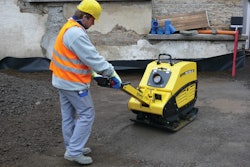
Reversible plates work the same as forward vibratory plates but are larger. "They use the same concept as forward plates, but the weight goes up and so does the cost," says Fabian Salinas, product manager for concrete and light compaction products at Dynapac. "If you need more output and higher compaction rates, you need a reversible plate."
Reversible plates also offer increased versatility because they can switch directions easily, making them a snap to get in and out of tight spaces. "It's an issue of ROI," says Salinas. "In some cases, a reversible would be overkill."
Trench compactors are typically used in cohesive soils. They are used in deep trenches and are effective at covering areas larger than what a rammer can handle but yet aren't large enough to warrant the use of a ride-on roller. With a padfoot drum, a trench compactor concentrates its static weight on the pads, while the vibratory frequency works to compact just about any material, except asphalt.
When your customer is working in asphalt and has an area to cover that exceeds what a plate can handle, they can use a walk-behind roller. According to Salinas, the walk-behind roller is to asphalt what the trench compactor is to soil.
"Sometimes they're used in heavily unionized areas where a guy is paid differently if he's sitting vs. standing," notes Salinas.
How do you know when a job calls for one of these machines over a rammer or a plate? "The economy of scale needs to fit the application," says Salinas. "It's dictated by the size of the contractor and the size of the job. A rental rate is less than $100 per day for a rammer and several hundred for a trench roller."
Good questions
The only way to ensure customers get the best machine for their job is to ask the right questions. The first, most important question for rental personnel to ask their customer is what type of material they are working in, soil or asphalt. If the answer is soil, you need to find out if it's cohesive or granular. Price at Bomag says it's a good idea to also ask if they're working in native backfill or engineered fill. Native backfill is more likely to contain a combination of soils with pebbles and gravel mixed in throughout. "Engineered fill is screened and well-graded material that is very compactible," he says.
The next question to ask is what size job they are doing. You need to know in order to suggest a machine with the right capacity.
"Also ask if it's a confined area, such as a trench or a large open area, such as a slab," says Conrardy. "This will determine whether a plate or roller would be used on a gravel material, for example."
Price notes that you should also find out from your customers if they prefer equipment powered by gas or diesel.
Features to note
Some of the most important features to note on today's light compaction equipment include those that minimize hand-arm vibration. Europe has already implemented HAV (hand-arm vibration) ratings for equipment which regulate how long an operator can use the equipment before a break is required. While sources agree it will be years before the United States adopts such regulations, everyone believes they are inevitable. With that in mind, manufacturers are working to reduce hand-arm vibrations through innovations such as low-vibration handles. Ingersoll Rand, for example, offers an exclusive padded handle on its rammers to help reduce such vibration, says Russ Warner, product marketing manager for light compaction equipment.
Other new features aim to assist operators in achieving optimum compaction. Bomag, for example, recently introduced its Economizer, an option on its model BPR 65/70 reversible plate. The Economizer measures how compact the soil is as the operator works, helping him or her to avoid overcompaction. While the option increases the cost of the machine by eight to 10 percent, Price says the cost is justifiable by looking at the increase in productivity that results from avoiding overcompaction.
Price points out that overcompaction is a big problem on jobsites when the operator is unaware that soil can become too compact and thus, less stable, after too many passes with a plate, rammer or roller. When this occurs, excess energy breaks down the soil particles, introducing more air voids. What's more is the excess energy, once it is no longer being effectively absorbed by the soil, bounces back up into the machine, causing wear and tear on the machine and undue fatigue for the operator.
Tell your customers
Aside from the features worth pointing out to customers for their convenience, there are also things to note regarding safety. "Safety precautions are always highlighted with operational warning labels, as well as in the operator's manual," says Conrardy at Wacker. "Anyone renting any type of equipment should make sure they are familiar with these instructions and warnings before operating a machine."
Warner at Ingersoll Rand recommends practicing the start procedure with employees so they can properly convey the information to customers before they leave your yard. "They need to be comfortable explaining the choke or throttle procedures to customers," he says.
In general, your employees need to know the ins and outs of your light compaction equipment so they can be a source of information to your customers. Be sure to educate your staff on the basics of compaction science, as well as the specific features your fleet has to offer the operator. You will be compensated for your efforts by the positive impression your employees leave with your customers.