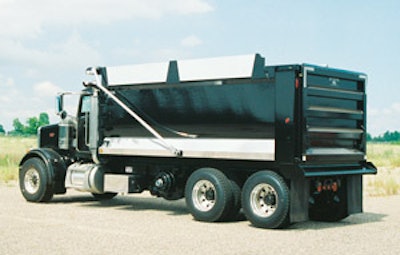
Not all dump bodies are created equal. "A good coat of paint and some fancy striping can make any body look good," says Bill Pick, product applications and inside sales manager, Monroe Truck Equipment. It is what you can't see that really makes a difference - the type of metals used in the construction process.
"The first thing you need to do is get a spec sheet on it. In any type of dump body application, the metal is going to be what makes it or breaks it for you," says Pick. "If you have comparison quotes from some other places, then make sure you are comparing apples to apples." One of the key criteria is the tensile strengths of the metals used.
Joe Paulsen, vice president of sales and marketing, Crysteel Mfg. Inc., a Truck Body and Equipment International (TBEI) Inc. company, agrees, adding, "Our number one objective in dealing with contractors is to educate them on the right steel to use for their application."
It is safer to spec a body that is a little too heavy than one that is too light. But there is a penalty for over-spec'ing. "You are adding weight that you don't need and you are going to add cost," says Paulsen. "Crysteel really tries to help people design their bodies so they are not putting in extra just because it was safe."
There are many types of steels in many different gauges. "The best way for a contractor to gauge which type of steel is best for him is to discuss his particular application with a reputable dump body supplier," says Bob Miller, vice president of sales and marketing, Ox Bodies, a Truck Body and Equipment International (TBEI) Inc. company. "TBEI companies offer a broad variety of steels in their bodies, ranging from a mild steel that has a 36,000-psi yield to the higher abrasion-resistant (AR) types of steel that approach 200,000-psi yield."
Each steel has its unique strengths. Consider a severe demolition application. "You want to make sure that the dump body is made out of good wear-resistant plate," says Paul Gettis, JMH Trailers. "We offer one kind of steel, Hardox 450. It's really strong."
Selection can be further complicated by the fact that several different steels can be used in any given body to tailor it for your application. "There are several different options for sides, ends and floor," says Pick. "Ninety nine times out of 100, the floor will be heavier than the sides or the ends."
For contractors who haul lighter, non-abrasive materials, aluminum may offer an alternative to steel. "Aluminum body users are usually looking for a combination of three basic things," says Miller. "[This includes] looks or appearance, greater payload capacity and protection from highly corrosive loads that would destroy a steel body."
But there are downsides to aluminum when it is not used in the right applications. "Aluminum body users are usually very protective of the loads they haul because aluminum is softer than steel and will crack more easily than steel if abused," says Miller. "It is also more expensive to repair than steel."
The expense of aluminum is offset by increased payload. "If you are hauling a lot of non-abrasive materials, like finer gravel or dirt, where money is a factor as far as maximizing the amount of aggregate in that load, then aluminum is a good choice," says Pick.
In addition to the material used, note the way the dump box was constructed. "The fewer welds that you see on a body, the more of a premium dump body," says Paulsen.
Larger companies generally have tools to form the steel so they can minimize the amount of shearing and welding. Low-budget operations may not be able to invest in this technology. "They are going to be more apt to shear everything," says Paulsen. They will shear the piece of steel and start welding the corners.
The integration of the hoist to the body can also be an indication of the quality. Paulsen asks, "Was it an afterthought or do the two actually belong together?"
Get the right body style
Dump bodies basically come in three different types: half round, semi-elliptical and the traditional rectangle.
The traditional rectangle dump box is still an attractive alternative in select applications. "You do have that full floor. You are going to get maximum spread with it," says Paulsen.
Miller adds that a traditional rectangular dump box offers a lower center of gravity and shorter side heights for the same capacity compared to half-round of semi-elliptical bodies.
Traditional rectangular bodies also allow the use of double-wall construction. "In situations where the application is extreme and they are concerned with the outside appearance of the body, a double-sided body keeps visible damage to the body on the inside," says Miller.
But most rectangular bodies require additional bracing. "On a typical square body, either vertical or horizontal side braces are used to support the sides," says Miller. "In severe applications, both are used to add strength." This adds weight. The flat floor of the traditional dump body is also more susceptible to dents and dings from direct impacts.
And the shape and construction may result in an opportunity for corrosion. "On the traditional, there are more corners, more welds, more opportunities for corrosion to start," says Paulsen.
With the half-round body, the steel is actually formed into a semi-circular shape. The curved floor of the half-round body stands up to impacts better than the flat floor of a traditional rectangular dump body. "It is a strong body," says Gettis.
The curved shape means that the force generated by the material is deflected when it is dropped into the body, as opposed to a flat floor that takes a direct impact. This design doesn't require crossmembers, which translates into a lighter body that can handle more payload.
Clean-out is enhanced, as well. "It also promotes a cleaner dump cycle, meaning that material is less likely to stick in the body when dumping," says Miller.
In addition, the shape of the half-round body affects loading and dumping. "The half round puts the load in the center of the body," says Gettis. When you dump the material, it remains in a concentrated pile. "It comes out in the center if you want to keep it in little piles."
However, the half round has limitations if you plan to haul equipment or pallets in the bed. "If you ever want to put anything in your dump bed, you don't have a flat floor," says Paulsen.
Like the half round, the semi-elliptical dump body does not use crossmembers. "The semi-elliptical body has the ability to absorb a pounding and an impact throughout the whole body," says Pick. "The elliptical curve provides memory for the body itself."
Impact forces are deflected in a similar fashion as the half-round body. "If you put a rock in there, it is never going to hit anything square, so the material is not going to take the full blow of the hit," says Paulsen.
The shape of the semi-elliptical also strikes a balance between the traditional rectangular and half-round dump bodies. "You are still going to have flat floors," says Paulsen. "You are still going to be able to haul stuff with it." But it will not offer as much floor space for pallets and larger equipment as a traditional rectangular body.
The shape does mean the load will be carried slightly higher. "Because of the elliptical design, it does raise the load 'center of gravity' on the truck," says Miller. "And in order to maintain a desired cubic yard capacity, it requires the side height of the body to be a little higher. Both are minimal concerns when weighed against the advantages."
The case for crossmembers
Weight versus durability is always a concern, especially when considering crossmembers.
"The drawback to adding crossmembers is additional weight that reduces payload capacity," says Miller.
But there are ways to eliminate crossmembers without affecting the life. "Eliminating the crossmembers, if done correctly, does not sacrifice either durability or longevity," says Miller. "Elliptical-styled dump bodies have a one-piece floor that is made of higher strength steel that allows for the elimination of the crossmembers."
Much of the decision has to do with the steels used in construction. "With the advent of the higher strength steels, you get the strength you need and you really don't need crossmembers," says Paulsen. "The way we explain it to our customers is that all crossmembers are going to do is create opportunities for your floor to washboard, which will mean you are not going to have the clean-out that you want.'
The new higher strength steels are flexible. "They will flex and spring back," says Paulsen. "We actually have cases where using high-strength steel and crossmembers worked against each other. If you use it with a cross member, it will actually flex and stay deformed."
In some traditional rectangular bodies made of milder steel, crossmembers still have a useful purpose. "If you are trying to lighten the floor because you are not hauling demolition, maybe it is still an advantage to go with crossmembers," says Pick.
Miller adds, "If the floor in a body is made of milder material, added crossmembers are necessary to keep the floor from washboarding."
Some manufacturers have converted their customers to bodies without crossmembers. "We have virtually eliminated the crossmembered body," says Pick. "We offer them, but we don't sell very many of them."
It is important to realize that all metals will eventually deform to some degree. "All material will deform and deflect at some point," says Paulsen. If you have longitudinal supports with no crossmembers, that is not a problem. "You end up with a series of chutes." The material still flows out the back of the bed without getting hung up.
Select the right front-end design
The front of the box is typically available in a straight configuration with a doghouse for the hoist cylinder, a straight configuration with a bailmount front hoist and a sloped front. Often, the choice has to do with local bridge regulations.
"If you go to the Eastern states, you want to get more weight to the front axle," says Paulsen. You want the body as close to the cab as possible, which favors a straight front. "The bailmount, if it works with your weight distribution, eliminates the doghouse. It eliminates a corner where the material can get caught."
The box remains free of obstructions. "A bailmount hoist eliminates the doghouse altogether, keeping the hoist cylinder in front of the body," says Miller.
Sloped fronts have recently become a popular option. "A sloped front provides the opportunity to reduce the doghouse space needed for the hoist," says Pick. This allows more aggregate in the body. "Then, you also have less of a worry as far as that doghouse area filling up during cold weather because you have extra bends and extra nooks."
Sloped fronts also offer some of the same advantages as the elliptical body shapes. "They use the sloped front if they are hauling big rock so they don't beat up the doghouse," says Gettis.
The straight front requires a substantial space for the hoist. "A straight front requires a larger cut-out for the doghouse," says Miller. "The greater the size of the doghouse, the greater the reduction of payload capacity."
Match to your application
The reason so many choices exist is that no dump box is perfect for every application.
"Pretty much everyone is trying to put out a decent quality product," says Pick. "You just have to make sure that you are getting a match for what you are hauling."
Paving contractor finds a match
Mundall Trucking is a family-run asphalt-hauling firm in the Phoenix, AZ, market. The company operates seven-axle Superdumps that scale 25.7 tons of material in the morning, full of fuel, with the driver inside. The 80,000-pound gross weight trucks have a 20,000-pound-capacity set-forward steer axle, three 8,000-pound steerable pushers, 46,000-pound tandem drives and a Strong Arm trailing axle.
Mundall found a good match for its Superdump chassis and axle with a lightweight, high-strength steel bed with aluminum tailgate made by Strong Industries. The Superdump bed offers three distinct characteristics: a conical, elliptical shape that gradually becomes wider toward the rear of the bed; an extended floor that eliminates the need for an asphalt apron; and a low tare weight.
Most dump beds are basically the same shape at either end. In transit, the material becomes compacted and it comes out of the bed in uneven layers. The Superdump bed has an elliptical-shaped floor and conical-shaped sidewalls that become wider toward the rear. The shape lets the payload loosen up as it flows from the bed, as if it is being poured out of the large end of a funnel.
"The driver doesn't have to raise the hoist as high to get the load to break, and the asphalt flows more easily, quickly and consistently into the paving machine," says John Mundall.
The shape allows Mundall to empty a 26-ton load in the same amount of time that a flat-bottom requires to dump 15 tons. The design also eliminates the need for an apron, which further speeds the process by eliminating the necessary cleaning time.
The lightweight design allows Mundall to carry an extra half ton of payload. "Where it used to take 12 or 15 transfer trailers and six or more 10-wheelers to do 2,000 tons in an eight-hour day, we can do that job with 12 Superdumps in four or five hours," says Mundall. That has led to production increases. "Instead of getting 2,000 tons ready for us, the plants would get 3,000 or 4,000 tons ready."