The tight tolerances found in today's hydraulic systems require hydraulic fluids to be as close to "contaminant-free" as possible.
"Clean fluid is essential to the life of hydraulic systems," says Diego Navarro, service marketing manager, John Deere Construction and Forestry. "The higher the operating pressure, the cleaner the fluid needs to be."
Rudy Urbano, hydraulic consultant, Caterpillar, points out, "On a high-pressure piston pump, the only thing that separates one moving part from another is a film of oil. That film of oil is about 1 to 2 microns thick."
Caterpillar specifies an International Standards Organization (ISO) code range of 18/15 for its equipment hydraulic systems. "When you talk about an 18/15 ISO code, you're talking about [the number of allowable] particles that are 5 to 15 microns in size," Urbano notes. "So even in an 'acceptably dirty' system at 18/15, your particles are still going to be bigger than the film of oil separating the machine components. In addition to hard particles, you also have the chemical contamination of air, heat and water."
As the size and volume of contaminants increase, equipment performance suffers, and you face the risk of premature failure of pumps and other components. Fortunately, there are precautions you can take when storing and handling fluids that can help to mitigate this risk.
Monitor bulk fluids
If you have a sizable fleet requiring larger fluid volumes, chances are you're using some form of bulk storage tank. If so, it's important to periodically check the condition of the fluid, the tank and the delivery system to the machine.
"A lot of the bulk storage tanks don't really get checked for contamination. The assumption is it's a big tank, so how much contamination can be in there?" Urbano asserts.
Yet, he cites an example of a tank that had been in use over a 20-year period. The owner assumed the oil was clean since it was purchased in bulk from the refinery. But when the tank was drained, they discovered 18 inches of contamination had settled out to the top of the spigot.
The contamination was likely introduced during transport from the refinery to the tank. "After refining, the fluids travel long distances through piping networks at the processing plant, then to containers or bulk transportation tanks and, finally, to the users' tank," says Navarro. "Every time the fluid changes from one container to another, it is basically cleaning the container in which it travels, carrying the contamination to the next one."
Over time, any solids picked up during transport will settle and accumulate at the bottom of the tank. "Just checking your bulk tank to make sure it's relatively clean is a big step," says Urbano.
In addition, the majority of bulk tanks have a breather open to atmosphere that allows air in as oil is drawn out. Urbano recommends a minimum of a 4-micron air filter to ensure airborne contaminants will not be drawn into the tank.
Water can also do significant damage to hydraulics. "Most hydraulic systems are designed to shed water," notes John Sutherland, national accounts manager, Chevron Products Co. "So you have a layer of hydraulic oil and underneath that you could have a layer of water. Depending on where the pump suction is on the hydraulic system, you could suck that water into the system right at the beginning." This can produce sluggish performance of hydraulic functions, plus lead to rust, which in turn generates wear metals in the fluid.
Condensation is generally the culprit behind water contamination in stored fluid. A desiccant breather/filter can reduce the degree of both dirt and water ingress into the tank.
Bulk fluid condition should also be periodically analyzed. "Checking bulk fluid cleanliness periodically through lab oil analysis or on-site equipment is the best possible practice," says Navarro. "It helps the user to gauge delivery consistency and identify risky contamination. It also allows the user to test if the product he gets actually matches the signature of the product he expected."
Keep drums under wraps
Fluid stored in drums should be kept "under roof", if possible, to shield it from the environment.
"If the drums have to be stored outdoors, they should be stored on their sides with the bungs facing the ground at the lowest point," advises Ted Naman, technical coordinator, ConocoPhillips Industrial Lubricants and Greases. "The drums should be shielded from the weather and covered with tarps to protect them from the elements."
Drum covers are also an option. "The key here is you don't want contamination buildup in the form of dirt or water on the top of those drums because the [bung] hole really doesn't seal anything out," says Urbano. "Water sitting on top of that drum is going to go past the threads on that plug and leak into the barrel if you don't have some means to keep it out. If nothing else, turn the barrel so the bung plugs are parallel to the ground. Place a 2" x 4" under one end so rainwater will run away from and off the plugs and the top of the barrel."
Water can also accumulate inside drums stored outside, particularly during "transitional" times of year. "If we have a 60 degrees F day and a 30 degrees F night, that's going to give you condensation buildup in those drums, and that's a big problem," says Urbano. "Before you tap into a barrel and use that oil, it would be a good idea to pull an S.O.S. [oil] sample to check the oil's condition. It's a relatively inexpensive and quick test that will tell you whether there's any water buildup or contamination."
No mixing allowed
According to Naman, a common problem with hydraulic fluid is contamination with water, motor oil, transmission fluid and other lubricants or chemicals, including solvents or cleaning solutions. Such liquids can chemically interact with the hydraulic fluid, reducing its performance or its viscosity. "This has a direct impact on the life of the hydraulic system," he adds.
When transferring product from a drum or tank to a piece of equipment, OEMs and oil suppliers alike strongly recommend using clean, liquid-tight containers dedicated to a specific fluid. "If they're not dedicated, you could end up contaminating your hydraulic oil with motor oil or other things," says Len Badal, global enterprise manager, Chevron Products Co. "When you mix the two products, the performance properties of the hydraulic fluid will degrade and possibly affect equipment performance."
Badal advises dedicating the containers, as well as hoses and/or piping. "If you can't do that, then the next step is to do a complete flush of that container or equipment, transfer pump or transfer line," he states. "We would typically recommend the customer spend the extra money and dedicate."
Sutherland also promotes proper labeling and/or disposal of empty hydraulic drums. "If you're using a hydraulic drum for your waste oil, and you have not identified that as a waste oil drum, somebody may think it's the right stuff and dump it [into the machine]," he cites. "That can be a mixture of everything you have on the jobsite."
In addition, take care when introducing new fluids into a storage tank or hydraulic system. Not all hydraulic fluids meet the same specifications or have the same chemical properties.
"If you have a machine that is using a zinc-free product, and you decide to top off the reservoir with a zinc-based product, you have created a new lubricant," says Navarro. "The new product is untested, with totally different signatures, different viscosities, different corrosion and anti-wear properties."
This can eventually cause negative reactions in equipment. "Machines are very sensitive to the changes," says Navarro, "and they let us know through oil analysis readings."
Before making a fluid switch, Sutherland recommends checking compatibility. "If you do want to do a running change, you should perform a compatibility analysis or at least a check," he states. "That will solve most people's problems."
Filter before you fill
Filtration is your last line of defense against injecting damaging contaminants into the hydraulic system.
"Hydraulics operate at very high pressure (3,000 to 6,000 psig). Contaminants or dirt can be detrimental at these pressures if they are not properly filtered," says Naman. "They behave like sandpaper, which is very abrasive and can cause premature wear."
Even microscopic-size particles can produce negative effects, such as "three-body abrasion". "Three-body abrasion is when you have two surfaces, then introduce a hard, clearance-size particulate that scrapes or abraids the metal surfaces and actually starts to wear away metal," Badal explains. "Basically, you start a chain reaction. Once it starts to wear, you get more particulates and they cause more wear. You start a cycle if you don't filter it or correct the problem."
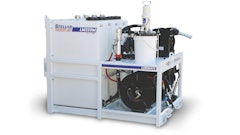
A fluid transfer cart - or filter cart/caddy - can remove microscopic particles, as well as water, from the fluid. "It moves the fluid across a 2-micron filter to take the majority of contamination or any water content out as you're transferring it from, say, a 55-gallon drum on the back of a lube truck," Urbano explains.
A filter cart can also remove contaminants already present in the hydraulic system. "Instead of draining and replacing contaminated hydraulic oil, it can continue to be used as long as the zinc content remains above 900 ppm," says Urbano. "The payback is getting twice the life out of your oil."
Filter carts can range from a couple thousand dollars up to $10,000 or more, depending on the size (gpm/lpm rating) and features. Yet, this is one tool where there is little question about ROI.
"From the financial point of view, a filter caddy can achieve two goals: extending the life of the fluid and extending the life of components," says Navarro.
Oxidation occurs due to the presence of water, solid particles and temperature extremes, he continues. Keeping the fluid clean can reduce the potential for oxidation and an increase in the TAN (Total Acid Number). This, in turn, facilitates extended service life.
"A big machine with a 100-gallon tank could represent $600 in materials," says Navarro. Add filters and labor, and it's roughly $1,000 every time you change fluids. "If you multiply that by the number of units in your fleet, and you can extend the life of the fluid 25 or 30 percent, that money accumulates."
Of course, the real payback is in reduced component wear. "If you use a caddy to keep fluid clean, and you prevent a hydraulic pump from failing, it can give you savings to buy several filter caddies," Navarro states.
In Urbano's opinion, using a filter cart is really just a matter of following proper maintenance procedures. "Intuitively, you know that cleaner hydraulic oil is going to give you less wear and tear on that hydraulic system," he comments, whereas, unfiltered oil can cause thousands of dollars worth of damage. "Say that you put unfiltered oil in a machine and it causes a pump to fail. A high-dollar piston pump can be $10,000 on one machine."
Filter carts are a necessary tool to help prevent such failures. "We don't really recognize this as an ROI piece of equipment," says Urbano. "It's just a mandatory way of doing the proper oil transfer."