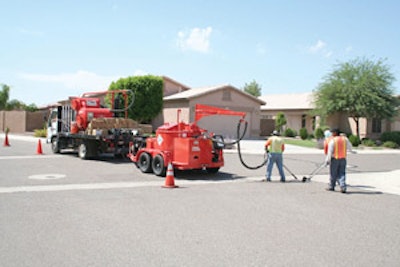
Sealing cracks may not be the most exciting job in town, but this service adds to your bottom line and adds value for your customers. Even by repairing cracks in small parking lots contractors can easily generate between $750 and $1,500 a day. By keeping water from intruding into cracks and prolonging pavement life, you're saving customers money, too.
The service is not only profitable, but delivering it is relatively easy, as well. At one end of the spectrum, small contractors may choose to clean/dry cracks with a backpack blower and then use a basic melter and pour pot to fill in cracks. Larger contractors doing bigger jobs can employ a melter/applicator - with a dedicated air compressor to clean/dry cracks and a pump/hose configuration to apply the sealant.
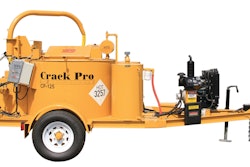
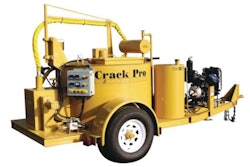
Melters come in several different configurations and sizes, ranging from 30 gallon capacities all the way up to 400 gallons and more, with options and features increasing with size. Smaller, inexpensive units will lack many of the bells and whistles of their larger counterparts, but depending on the application, they might very well deliver the best return on investment for the contractor. Similarly, larger units - with an hydraulic pump to agitate the material and deliver the sealant, digital controls and an automatic thermostat to keep the temperature constant, and a heated hose to ensure the crack seal is delivered at the optimum temperature - might be just the ticket for contractors cracksealing several thousand feet of driveways, parking lots, streets, and highways a day.
Small but efficient
"There's no doubt that the cracksealing business offers good profit margins for both large and small contractors," says Bryan Burke, general manager, Keizer-Morris International. "The buzz going around the industry is that a potential shortage in paving material may cause contractors to look for different ways to generate revenue. Sealing cracks is a good alternative. The challenge is to educate the customer about the value of this service - that it's a lot less expensive than putting down an overlay and if it's good enough for highway departments around the country, it's good enough for property owners."
Michigan-based Keizer-Morris manufactures the KM 55 melter, specifically designed for smaller contractors. The unit has a 55 gallon capacity and features a thermostatically controlled burner and manual agitation system. The KM 55, which weighs in at 340 lbs., features a 50,000 BTU propane heating element, a 2-in. flow valve for easy filling of application equipment, and a utility torch for heating the valve tools and pour pots. The melter, along with a KM 10 applicator pour pot, can easily fit onto a utility trailer.
For the contractor, sealing cracks is as easy as pulling up to the site, heating the material, drying and cleaning the cracks, and then filling them.
"When purchasing equipment, just like any other application, contractors must look for versatility," Burke says. "Getting the right product for the application will ensure a quick return on investment."
He says the cutoff for using a small melter versus a larger melter/applicator is generally around 5,000 linear feet.
Real money-maker
"It's not unusual for contractors to pay for their melter/applicators in half a season or less," says Mark Manning, vice president of marketing for Arizona-based Crafco. Echoing Burke's comments, he notes that as the cost of oil continues to go up (he emphasizes that within the last couple of years, the cost associated with putting down asphalt has more than doubled), sealing cracks instead of putting down an overlay becomes a more attractive option for customers.
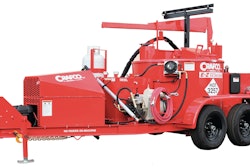
Crafco offers two melter/applicators models. E-Z Pour Melters are available in four sizes from the 50-gallon E-Z Pour 50 to the 400-gallon E-Z Pour 400. Super Shot Melters are available in three sizes from the Super Shot 60 to the Super Shot 250.
For contractors sealing cracks on driveways and parking lots, Manning suggests they look at the E-Z Pour 50 or the Super Shot 60.
"The E-Z Pour 50 is our least expensive unit and requires little training time to use. It features a one-hour heat-up time and applies all hot pour sealants. The Super Shot 60 is a pumping unit that also is easy to use. Among features is a 15-ft. heated applicator hose. This unit is ideal for sealing anywhere from several hundred feet to 4,000 to 5,000 feet of cracks a day."
When asked what contractors should look for when purchasing a melter/applicator, Manning, says categorically, "durability." "The primary asset in any melter/applicator is its durability. Heavy, rugged, and durable is the name of the game. Burners can heat steel to 1,200°F. At that temperature, heavy-gauge steel is important. Take a close look at the weight of the machine before making a purchase. The complete weight will disclose a lot about its durability."
Among special features and options to consider, he points to an integrated compressor as a feature that facilitates the drying out and cleaning of cracks while eliminating the need to drag around a compressor on a separate trailer (and the individual to drive the trailer). He notes, too, that all Super Shot models come standard with a heated hose that delivers the sealant to the crack at just the right temperature so it will adhere properly.
"If you're truly undecided about the brand, size of machine you need for the application, or the special features you may want, consider renting a melter/applicator prior to buying one," he says.
Direct versus indirect heat
Melters heat the material in one of two ways, either using direct or indirect heat. "Direct fire melters heat material virtually the same way a barbecue cooks a hamburger," says Brad Dunn, vice president of sales and marketing for Minnesota-based Cimline. "Material is loaded directly on tubes heated by a propane source. The trick is to always keep the tubes covered to avoid combustion. Direct-fire melters are less expensive than their indirect heated counterparts, but the sealant is more expensive.
"With melters using indirect heat, as the name suggests, the heated material never contacts the direct heat source. Instead, a burner heats transfer oil that is contained in an oil jacket."
Cimline offers three direct-fire models in its Heatwave Series and four sizes in its Magma indirect-heat models.
"I like to steer smaller contractors toward our 60- and 110- gallon Magma series models," says Dunn. "The 60-gallon unit is the least expensive but is only available with gravity feed. Our 110-gallon unit offers more flexibility, available as a gravity-feed version or with a pump to apply the sealant. Contractors can equip this model with either a heated or non-heated hose and choose between a propane or diesel engine to run the pump. They also have the option to equip the melter with an integrated air compressor."
Contractors have several decisions to make when purchasing a melter/applicator, says Dunn, and costs can be deceiving.
"A diesel engine, for example, lasts longer and is a less expensive to operate than one fueled by propane, but it is more expensive on the front end. A heated hose is substantially more costly than a standard hose, but it allows the contractor to apply sealant when temperatures are not ideal, in early spring and late fall. I would guess more than half of our contractor customers buy units with the heated hose."
Some operators purchase both heated and non-heated hoses, planning to use the non-heated hose during the summer months. Hoses get damaged and using a less-expensive standard hose in the summer makes economic sense for some operators.
All the above manufacturers point out that basing a purchase decision for any major piece of equipment, including a melter/applicator, on price alone is risky at best. Unless you have only sporadic use for the machine, it needs to be rugged and durable, have enough capacity to suit the application, and be fitted with features that will increase productivity and ease of use.
Getting fitted up
You have a truck, a trailer, and a melter/applicator. Now all you need are a few cracks to seal, and a few more pieces of equipment. The equipment list likely would include a tool to clean and dry cracks (a backpack blower or an air compressor, either stand alone or integrated into the melter/applicator) and pour pots, even if you have a unit with an applicator hose. Dunn says pour pots come in handy for smaller jobs.
A heat lance is great tool to have, as well. "By injecting super-heated air into a crack, it blows out the dirt and debris and warms the pavement. A small, walk-behind sweeper would come in handy, as would a router or random crack saw to widen the crack.
"Most contractors make a living doing multiple jobs and they may already have many of these tools on hand," Dunn says.
If not, they may want to consider what Keizer-Morris bills as a one-man crack preparation tool. The Crack Jet is self-contained heat lance that dries and blows out cracks while etching their walls and surface. It weighs 160 lbs. (without the propane bottle), has an air output of 90 cfm, and air temperature of 2,800°F. He says the tool virtually eliminates the need for a back pack blower or other air compressor, routers, and wire wheels.
Of course, there's also the sealant to consider and a squeegee to smooth out the application. "It's pretty easy, adds Burke. "One individual applies the rubber sealant and the other bands across with a squeegee."
The speed of application is due in part to new technology and new sealants, which he says are designed to accommodate specific applications and temperature ranges. Cimline's Dunn agrees, noting that most sealants today set up quickly to give sealant less opportunity to bond with something other than the crack surface, e.g., a vehicle tire. To speed up the process, though, contractors can use spray material or tissue applied to the surface that minimize bonding.
Equipment and technique will facilitate any crack sealing job, but Burke, Manning and Dunn emphasize that safety comes first in all applications - driveways, parking lots, roads, or wherever pavement cracks are being sealed.