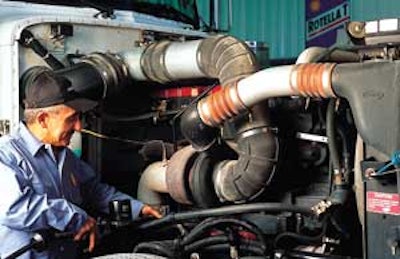
A new category of oil, American Petroleum Institute (API) CJ-4, will be required for the ’07 on-road diesel engines to meet the needs of after-treatment devices, such as diesel particulate filters. "These filters will be sensitive to fuel and lubricant byproducts," says Mark Betner, Citgo.
In the quest to make the lubricants compatible with after-treatment devices, a major breakthrough was accomplished. "This upgrade to the CJ-4 specification is probably the biggest advancement in engine oils in years," says Dan Arcy, Shell Oil. "Some of the improvements are in the areas of wear protection, high-temperature oxidation stability, deposit control and soot handling."
These advancements resulted from new formulation requirements. "This is the first time there have really been chemical restrictions put on the oil," says Arcy. These limits are 1.0% ash, 0.4% sulfur, 0.12% phosphorus and 13% volatility. "Just to put that into perspective, CI-4 Plus oils are between 1.3% and 1.5% ash."
"These chemical limits have been imposed in order to make the lubricant compatible with after-treatment devices," says Reginald Dias, director, commercial products, ConocoPhillips, 76 Lubricants. The resulting compounds have a lower total base number (TBN) than the previous CI-4 Plus oils. The TBN measures the ability to neutralize acids formed in the oil.
"The 1.0% maximum sulfated ash limit caps the allowable detergent level, which will limit the fresh oil TBN of some API CJ-4 formulations and prevent the use of very high TBN oils," says Mark Betner, Citgo.
"Today, the high quality CI-4 Plus oils are approximately 11 to 13 in TBN number," says Dias. "The high-quality CJ-4 oils will be somewhere between 9 to 10 TBN."
The lower TBN will not be an issue due to the introduction of ultra-low-sulfur diesel fuel (ULSD) to the on-highway market. ULSD has a sulfur level of a mere 15 ppm, down from the previous 500-ppm limit. "Because it has less sulfur, ultra-low-sulfur diesel fuel is less taxing on TBN," says Dias.
Turn up the heat
Oxidation stability allows the engine oil to withstand high temperatures, which is becoming more important.
"The 2007 engines will use higher levels of cooled exhaust-gas recirculation (EGR) to cool peak cylinder temperatures and further reduce oxides of nitrogen (NOx) emissions," says Nicole Fujishige, commercial lubricants marketing manager, Chevron Products Co. The engines will run hotter, requiring oil with improved oxidation resistance to prevent thermal breakdown and attendant loss of engine protection. "CJ-4 oils provide additional temperature oxidation stability."
Decreased wear
In addition, the CJ-4 oils might decrease wear in all engines. Laboratory wear tests indicate promising results.
"Chevron testing has shown a significant reduction in wear in pre-2007 engines based on the use of CJ-4 engine oils," says Fujishige. "In our engine tests, we have seen wear reduction of up to 70%, and in our field testing up to 30%."
Shell Oil has also noted positive results in its laboratory testing. "There are seven wear tests that you have to run in the industry," says Arcy. "If you put the average of where we perform in each of those wear tests vs. CI-4 Plus Rotella T, we have on average 50% less wear in the industry-required tests with the CJ-4 Rotella T."
Is it compatible?
"Accidently mixing the CI-4 and CJ-4 products should not create any chemical incompatibility problems. However, mixing oils might result in problems with exhaust after-treatment system compatibility since the whole purpose in going to CJ-4 oils was to achieve a level of compatibility," Betner points out. "Mixing CI-4 and CJ-4 oils will defeat that purpose."
Thus, manufacturers advise against product mixing. "Backwards compatibility is a design requirement for API CJ-4 oils, which offer enhanced engine protection compared with API CI-4 and CI-4 Plus oils," says Betner. "Therefore, there is no engine application need for a fleet operator to stock more than one product as long as the fleet is operating on ULSD fuel. If the fleet is using higher sulfur fuel, API CJ-4 oils will still provide advanced engine protection. However, the fleet should consult with the engine manufacturer as to the appropriate drain intervals, which may depend on the TBN of the API CJ-4 product."
There is no need to flush an older engine when switching from CI-4 or CI-4 Plus to CJ-4. In fact, it is perfectly acceptable to top off an engine filled with CI-4 or CI-4 Plus oil with CJ-4 product.
"The CJ-4 lubricant will meet the requirements of the CI-4," says Dias. "If someone uses CJ-4 oil on top of CI-4 Plus, technically there is no problem with that because CJ-4 oil is a better performing lubricant."
If you’re not sure what product was used to fill the engine, err toward CJ-4. "If you are uncertain, put CJ-4 in because CJ-4 can go on top of CI-4 Plus without any issues whatsoever," says Arcy.
However, care must be taken not to use CI-4 or CI-4 Plus products in ’07 on-road engines. "Failure to use CJ-4 engine oils can result in damage to exhaust after-treatment systems and warranty might be denied on that basis," cautions Betner.
Arcy adds, "You are going to plug up the diesel particulate filter. You are not going to have as good of wear protection or oxidation control as you would be getting with CJ-4."
Existing engines do not pose any problems. "Your warranty for pre-’07 engines should not be affected if CJ-4 oils are used in older engines," he adds. "However, keep in mind that many engine manufacturers have additional specifications and approvals that might be included with API CJ-4 recommendations, and these requirements need to be recognized in selecting an engine oil."
The choice for off-road
For applications that do not require API CJ-4, you have a choice. This oil is a higher performance product with many benefits, but it does come at a higher price. Shell estimates the price premium could be 10% to 15%.
Fujishige adds, "The specific price increase for Chevron’s CJ-4 product has not yet been determined, but it is expected to be in the 10% to 15% range."
Since only ’07 engines require the CJ-4 oils and there is a price differential, most oil companies will offer a choice of CI-4 Plus or CJ-4 products. "In this situation, there is clearly a need to retain the CI-4 Plus oil while introducing the CJ-4 product," says Fujishige. "Although backwards compatible, CJ-4 will likely be more expensive than CI-4 Plus and is not required for the off-road market or pre-2007 engines."
Yet, stocking one product can reduce the chance of misapplication. "It gives the contractor the ability to have one product for new and old equipment," says Arcy.
CJ-4 oil may also prove beneficial if you have retrofitted diesel particulate filters to your construction equipment fleet in order to take advantage of government incentive programs. "We have heard some issues with diesel particulate filters plugging up in these retrofits a little sooner than were anticipated," says Arcy. The CJ-4 product, with its lower ash content, will allow the equipment to run a third longer before the filter needs to be serviced.
If you do choose to use CJ-4 oils across the board, you must know the sulfur content of the fuel you are currently using in your off-highway fleet. "The use of API CJ-4 oils with higher sulfur fuels, such as those currently allowed for off-highway use that may contain up to 5,000-ppm sulfur fuel, may result in modified oil drain intervals and other maintenance recommendations," says Betner. This is the result of the lowered TBN levels with CJ-4 oils.
However, the on-road fuel supply will make ULSD widely available, even to the off-road market. "In the industry, there is going to be a transition," says Dias. "Because of logistics and the fuel transportation pipelines, a lot of the off-highway market will be using ultra-low-sulfur diesel fuel. But there could be pockets in the off-highway industry where they have no access to the ultra-low-sulfur diesel fuel."
As the fuel sources switch to ULSD, and CJ-4 oils become widely accepted, CI-4 oils will eventually be phased out.
Oil analysis
The change in the chemistry of the CJ-4 oils makes oil analysis an even more important tool. "With the CJ-4 oils, because they are significantly different, we advise our customers to start with a fresh baseline because the oils have a totally different fingerprint compared to CI-4 oils," says Dias.
For fleets that may be exposed to very high-sulfur diesel fuel, oil analysis also ensures the TBN of the CJ-4 oils is adequate to meet their application and service intervals, Dias points out.
"The use of oil analysis to assess oil condition and as a monitor for drain intervals is the best practice," says Betner. "Fleets should expect to see comparable or slightly lower levels of engine wear metals for engines operating on API CJ-4 engine oil."
The advanced formulation promises benefits for all applications. "API CJ-4 products are truly the most advanced lubricants in diesel engine lubrication available today," says Dias.