Concrete buggies are tremendous labor-saving devices, effectively reducing the need for manpower in a range of applications from concrete pouring to landscaping and demolition projects. To maximize the potential these machines have to offer, you need to select the right model for your job.
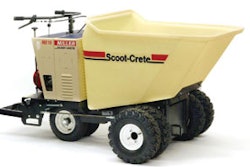
There are basically two types of power buggies: walk-behind and stand-on, says Fred Russell, regional sales manager with Miller Spreader. Walk-behind models typically have 10- or 11-cu.-ft. buckets and are powered by 8-hp gas engines. The rear steering wheel is caster-mounted. The operator steers the buggy using the handles to control the direction of the caster wheel.
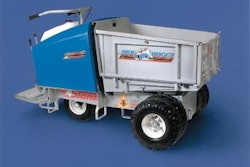
Stand-on buggies, on the other hand, are available with either 16- or 21-cu.-ft. buckets. The 16-cu.-ft. models usually are equipped with a 13-hp gas engine, while 21-cu.-ft. models usually have a 20-hp engine. As with the walk-behind unit, the rear tires do the steering. A steering handle controls the direction of the steering tires much like a handlebar on a tricycle.
Russell adds that two variations of the stand-on buggy are the all-wheel drive and tracked machines. The all-wheel-drive buggy has a hydraulic drive motor powering all three sets of tires. The track buggy uses the front-drive tires to drive the track. Steering in both variations is still the rear-tire assembly. Both varieties have 16-cu.-ft. buckets but use larger 18-hp engines.
According to Frank Wenzel, vice president of engineering at Stone Construction Equipment, the primary defining characteristic of a buggy is its hopper capacity. "They are offered in a variety of sizes with the most popular being 16 cu. ft.," he explains.
"There is also an emphasis on the ability of the unit to fit through a standard door frame."
Traditionally, buggies have been used in concrete transport and subsequent spreading or spot pouring. Today, however, buggies are considered a material mover and are being used in landscaping, demolition/site cleanup and nontraditional material transport.
What to look for
Wenzel notes there are several key points to consider when selecting a buggy. They include:
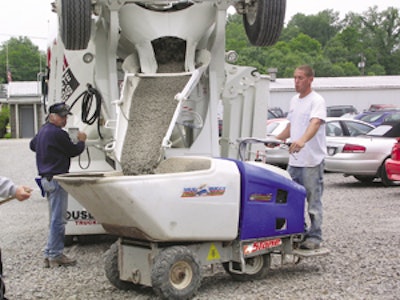
Hopper capacity — Buckets range from 10 to 21 cu. ft. "This is the most important consideration and requires some foresight into application," Wenzel says. "In a rental application for concrete material transport, size of the job and number of workers in the crew would be important. If material is being blended in a tow-behind mixer, a smaller machine would be in order. If it is a larger job utilizing a ready-mix truck, the larger-capacity machine would be more cost-effective."
Speed — In the traditional application of concrete transport, vehicle and dump speed are important because the purpose of the buggy is to move material from the source to the pad as quickly as possible. "These products are tremendous labor savers, from both an economical point of view and an ergonomic perspective," Wenzel says.
Safety — Design of hand controls, operator platform and braking system are very important. "Keeping the operator's hands on the control bar and their feet always on the platform is critical to maintaining safe control of a machine that can operate on uneven terrain," Wenzel says. "Location of brake and dump levers and pedals should not require an operator to step off the platform. Control of vehicle speed and direction should not require hands to be removed from the control bar."
Stability is also paramount to safe operation. Buggies should comply with the ASME B56.8-1993/B56.8a-1994 Standard for Lateral and Longitudinal Stability, Parking and Service Braking. Design elements such as frame thickness, braking system/type and balance address the stability issue.
Simplicity of design as well as easy access will facilitate proper maintenance and service of the machine. "Look for easily removable covers and an open architecture as features which address this issue," says Wenzel.
Responsiveness of controls is another feature to consider, according to Derrick Lowe, sales manager with Crown Construction Equipment. "When selecting a buggy, make sure it has responsive drive and dump controls that are simple for the operator to use," he says, noting that it's also vital that a buggy have "a balanced frame, industrial-grade hydraulic components and appropriate bucket dump height (at least six in. of clearance to avoid hitting forms when backing up)."
Metal vs. plastic
Plastic hoppers are more common than steel because the ability to form and mold plastic to difficult shapes allows an economical solution to creating hopper geometry that will benefit the operator. "Extended pour lips, angular dumping slope, curved and formed splash protection are molded features that facilitate material transport and placement," says Wenzel at Stone. "Additional aesthetic considerations can be achieved in plastic such as dent/rust prevention as well as curb appeal."
There is a place for metal hoppers, however, particularly in the demolition/cleanup application. "Poly tubs are easier to keep clean, but some applications like demolition debris cleanup, could damage poly," says Lowe at Crown.
Other hopper designs that allow for an easy transformation from a hopper to a flatbed increases utilization of the machine, Wenzel notes. "This feature allows the operator to quickly transition from the traditional material transport to a flatbed so that flat or stacked items can be transported," he says. "This feature requires no tools to complete the transformation."
Tires vs. tracks
Conventional rubber-tired buggies work best on dry, compacted surfaces free of ruts or potholes and large rocks or other debris, says Russell at Miller Spreader. Track buggies are designed to work in muddy, wet/slippery or rutted surfaces. The tracks increase the surface area in contact with the ground by approximately 400 percent, he says. This increase in surface area is analogous to walking through deep snow on snowshoes vs. boots. The increased surface area also allows a tracked buggy to climb steeper inclines than a rubber-tired buggy.
Russell notes that the steel tracks will mar concrete when the track buggy is operated on a concrete surface. A track buggy is also approximately 70 percent more expensive than a rubber-tired buggy.
Built tough
You want a power buggy in your fleet that is well built to take all the abuse that a concrete contractor can dish out. It also needs to be easy to service and to operate. Russell at Miller Spreader says there are three areas to focus on when looking for a quality machine: construction, convenience and safety.
With regard to construction, some areas to examine include:
Main frame — Frames constructed of solid steel vs. tubular steel are stronger. They also provide a lower center of gravity which improves stability. Additionally, Russell notes, solid-steel frames provide more weight over the front drive wheels for better traction.
Hydraulic components — Make sure the hydraulic motors, pumps, valves and hoses are protected but accessible for servicing.
Console — Consoles made of steel are the strongest and most durable. The thicker the steel, the more durable and longer lasting the console will be. Some manufacturers use a plastic tank to connect the side panels of the console. The plastic gas tank cannot provide the strength or rigidity of steel. Buggies of this design are particularly susceptible to developing stress cracks in the console side panels.
Steering handle — A solid-steel steering handle bolted to the steering column with two bolts at 90 degrees is stronger than a steering handle made of tube and held to the column with a roll pin.
Simplicity of design — The fewer parts required to perform the function reduces the number of parts that could break or require servicing and adjustment. Look for a buggy with a simple design and you will end up with a buggy that will provide years of service with minimal maintenance cost.
Where convenience is concerned, the following are things to consider:
- Ease of access to the hydraulic components for servicing
- Number and location of tie-downs
- Operator's ease of use of the controls
And lastly, for optimum safety, the power buggy should:
- Meet applicable ASME standards
- Have safety and operating instructions in both English and Spanish
- Have "on board" storage for the operator and safety manuals
Despite the simplicity of what power buggies have to offer on the jobsite, there are many things to consider when choosing the right one for your fleet. Start by analyzing what your buggy will be used for and you will be on the right track toward making the best choice.
Jenny Lescohier is an editor with Cygnus Business Media.
Read more Concrete Contractor articles at www.ForConstructionPros.com under the Concrete tab.