Concrete mixers, pumps and other attachments are enabling contractors to get more out of the skid steers in their fleets, while reducing equipment and labor costs. Following is a look at several available attachments and how they can be used to improve efficiency in a variety of concrete-handling tasks.
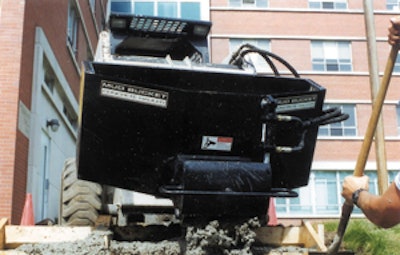
Loegering Mud Bucket
Transporting concrete with wheelbarrows is not only difficult and time-consuming, but it involves substantial hand labor.
However, an attachment such as the Loegering Mud Bucket can virtually eliminate the need to manually move material.
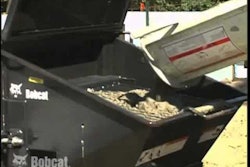
This attachment enables a skid steer to transport up to a 1/2 yd. of concrete or other flowable material directly to the jobsite. Its extension/reduction chute reduces to a 9-in.-wide opening for precise material placement, while a hydraulic gate allows for easy unloading.
"The Mud Bucket is most useful in situations where cement or flowable material needs to be transported into confined areas," says Tim Martin, marketing manager, Loegering Mfg. "These areas are found in all ranges of construction. However, they are most common in residential applications, such as pouring sidewalks or slabs in a limited space, which usually requires the use of wheelbarrows and extra labor costs."
The attachment is powered by standard auxiliary hydraulics, so it can be mounted to a variety of skid steers. Because it enables you to increase equipment utilization while simultaneously cutting labor requirements, it offers the potential for a quick ROI.
"We've received feedback from a customer that used the Mud Bucket to pour 1,600 yds. of concrete," says Martin. "Our product not only performed flawlessly — saving him many hours of back-breaking labor — it actually paid for itself in cost savings by the end of the job."
Toro Cement Bowl
The 3.5-cu.-ft. capacity Toro cement bowl attachment is designed to mount on the Dingo compact utility loader using the same high-torque or universal swivel auger power head used to run auger bits. Power is supplied by the loader auxiliary hydraulic system.
Specially designed auger flighting inside the cement bowl keeps material in the bowl during mixing. When the cement bowl rotation is reversed, this design also permits concrete to be poured without tipping the bowl forward.
The cement bowl attachment costs slightly more than a comparably sized dedicated mixer, yet offers several advantages that a stand-alone unit can't provide. The most obvious is versatility.
"If you're using a Dingo to auger holes for a deck or a fence, you can easily put the cement bowl attachment on," notes Greg Lawrence at Toro. "You don't need to haul in new equipment to fill that need."
And because it's mounted on the Dingo, you have added mobility. "It has the ability to get to places you probably couldn't with a traditional hand mixer or concrete mixer," says Lawrence. The Dingo's compact size enables it to pass through 36-in. gates or doorways. "You may or may not have that option with a dedicated cement mixer."
A lighter footprint also means lower restoration costs. "You won't cause any jobsite damage like you would if you were bringing in a bigger machine or pulling a trailer," says Lawrence. "It may take a little longer, but it beats using a wheelbarrow and a shovel."
Bobcat Concrete Pump Attachment
If you already have a skid steer on-site, a concrete pump attachment can be a cost-effective alternative to bringing in a dedicated pump.
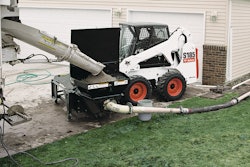
For example, Bobcat's concrete pump attachment delivers concrete up to a maximum 28 cu. yds. per hour (with high-flow loader), and pumps up to 250 ft. horizontally and two stories vertically. This is comparable to a trailer-mounted pump, but at roughly half the purchase price.
"Compared to trailer pumps of equal performance, the loader/concrete pump attachment combination will be much easier to maneuver and get situated," adds Justin Odegaard, a Bobcat attachment product specialist. "With the concrete pump attachment, the hopper can be placed on either the left or right side of the loader to help get into tight spots."
Even given these potential benefits, Gus Antoniou, president of G & D Excavating, Inc., Lyons, Ill., was skeptical. He arranged for an on-site demo of the attachment roughly six months ago. Despite his initial reservations, he purchased the attachment that same day.
"I thought I was making a mistake," he admits. "But it's probably one of the best attachments I've ever purchased. It paid for itself within the first 12 uses."
In addition to excavation and trucking services, G & D Excavating does a variety of horizontal and vertical concrete projects. It previously relied on trailer-mounted concrete pumps or boom trucks, even for smaller pours. Now, the attachment is used on these jobs instead.
"If I'm pouring a second-story deck and I have to place 15,000 to 20,000 sq. ft., I wouldn't use this machine," says Antoniou. "But for small placements between 4,000 and 8,000 ft., it's ideal."
G & D Excavating has seen a number of benefits. "You don't have to go out there with Georgia buggies, or a bunch of guys with wheelbarrows," Antoniou points out. "You're not dependent on a subcontractor to bring a pump. And you don't tie up your [boom] pump on a small job when you could put it on a big job."
The attachment travels on the same trailer as one of the company's Bobcat S300 skid steers. Once on-site, the skid steer moves the pump into position, then serves as its power source. "I have the ready-mix trucks dump right into the hopper and I use it basically as a transfer device to transfer material to the area that we're working," Antoniou explains. "I've pumped concrete 140 to 150 ft. away. We have actually set up the pump in the front, then pumped a foundation addition behind the building. And we did not disturb the area at all around the building with trucks."
The attachment has cut labor requirements. "You don't need as much support personnel for the machine as you would with the larger truck-mounted pumps," says Antoniou. "The same operator who runs the Bobcat can operate the pump."
In addition, it provides more precise material placement due to the steady material flow at a lower volume. "Although its concrete delivery is less than the larger pump trucks, its delivery is more detailed," Antoniou notes. "You have better control of the job."
The attachment proved particularly effective on a recent pour at a Chicago-area warehouse. The job called for an 8,000-sq.-ft. reinforced, structural post-tension slab on a mezzanine level. Rather than bring in a boom truck, which would have required cutting holes in the roof or opening vaults in the side of the building, the skid steer and attachment were driven inside.
"We started pouring with the machine at 7:30 a.m. We were done pouring by about 11:30 a.m. and then the finishers finished up," says Antoniou. "At idle speed, we were delivering 12 yds. an hour up 18 ft. onto the mezzanine. At high speed, we were delivering 18 yds."
Since it was purchased, the concrete pump attachment has been in almost constant use. Antoniou now has plans to add a second one to his fleet.
"It's a perfect residential machine and it's a perfect light commercial machine," he states. "And at the end of the day, you still have your Bobcat on the job.
"Even if I replace it once a year, it's worth it," he adds. "The convenience is key here."
Blastcrete Concrete Squeeze Pump
The Blastcrete RD 6536 concrete squeeze pump utilizes a peristaltic action to deliver concrete at rates up to 25 yds. per hour. It also pumps up to 100 ft. vertically and from 300 to 500 ft. horizontally, depending on the concrete mix.
"Our concrete pump attachment can offer a lot of diversity," says Jim Farrell, president, Blastcrete Equipment Co., "whether a contractor is already involved in concrete or masonry or recognizes an opportunity to get involved with this type of work."
Although the attachment offers comparable performance to a self-contained, trailer-mounted pump, it can cost anywhere from $8,000 to $12,000 less. In addition, it can provide substantial cost savings over subcontracting concrete delivery.
"The current upcharge for pumping concrete using a line pump is $25 per cu. yd.," Farrell notes. "The calculated output of this pump attachment is 25 yds. per hour. If you do the math, theoretically, this pump attachment can be paid for in 25 hours of pumping."
Although the attachment has been in its fleet for only a couple of weeks, Church Street Construction, Barrington, Ill., is already seeing the cost savings. This small concrete construction and excavating business specializes in pouring full basements beneath existing homes.
"We were renting the services of a pumping company as many as 12 to 20 times per project. That's anywhere from $500 to $750 per use for the company to come out and pump concrete," says Dave Mayes, president of Church Street Construction. "I got tired of throwing the money away."
Mayes stumbled across an article on the Blastcrete concrete squeeze pump and was intrigued by its peristaltic pumping action. "The setup, the mechanics and the engineering were very, very simple," he states. "The other thing that interested me was its low pressure. It doesn't require the huge amount of hydraulic pressure pushing the concrete, which really cuts down on the danger."
The lower pressure also results in a more even flow compared to a piston-style pump. "The other pumps surge," says Mayes. "It's harder for the guys to handle the large hoses."
The capacity of the pump is proving more than adequate for Church Street Construction's typical jobs. "They rate it at 25 yds. an hour. That's a lot of concrete to pump," Mayes points out. "That's the equivalent of three fully loaded 8-yd. concrete trucks dumping in one hour.
"For my type of work, the most I will ever put in the ground in a one-day period is probably 100 yds.," he continues. "This machine would handle that without any problem at all."
Creative Equipment Design Curbcat
They say "necessity is the mother of invention," and this is certainly true in the construction industry. Just ask Jack Johnson, president of Johnson Building Systems Inc., a general contractor and construction management firm based in Galesburg, Ill.
Seven years ago, crews had finished hand rolling an all-concrete lot for a seven-plex movie theater. "We had probably 4,000 yds. of concrete in this parking lot," Johnson says.
When they returned to the shop that night, inspiration struck. "The skid loader was sitting in the shop when we got back, and everybody's back was sore," says Johnson. "We said, ‘We're going to build a curb machine for the front of that.' And away we went."
The result was the Curbcat concrete slipforming attachment, and formation of Creative Equipment Design, which Johnson and his wife Lynn head up. The Curbcat enables a standard-flow skid steer to lay curb and gutter up to 18 in. tall and 24 in. wide using 2-in. slump concrete. Various molds accommodate a range of curb shapes and sizes.
The attachment operates off of a stringline. "We run everything off of a stringline just like the larger concrete pavers," Johnson explains. "The steering and grade are automatically controlled within the attachment."
Two control arms extend into the skid steer's cab, where they hook onto the steering levers and are used to automatically steer the machine. A grade sensor automatically raises and lowers the hydraulic cylinder to maintain proper curb elevation.
The concrete hopper is mounted on the left-hand side in front of the curb mold for easy access by ready-mix trucks. Inside the hopper are two Wyco hydraulic vibrators to consolidate the mix. "The hopper itself holds about a third of a yard of concrete," says Johnson. "We can pave anywhere from 5 to 6 fpm."
The Curbcat isn't intended for long-distance paving. "We're not looking at going out to pave five miles a day," says Johnson. However, it is capable of handling light commercial projects. "Even if you have two or three city blocks of a subdivision to do, there's no problem with a machine of this size."
With its capabilities, the attachment does require a fairly sizable investment. But the payback comes quickly. Johnson notes that his crews previously hand-rolled all curbing — a time- and labor-intensive process. Last fall, they used the Curbcat to place 1,400 ft. of curb and gutter on a bank project. The project took just five hours.
"If you did a half dozen commercial parking lots a year, you could probably pay for the machine with the labor savings alone," he asserts.
The attachment can also supplement existing paving units. Johnson cites a Michigan-based contractor who already owned two dedicated slip formers. "He bought this machine just for the small jobs so he didn't have to move his big slip-form pavers to do them," he states.
And once paving is completed, the attachment can be removed in minutes, allowing the skid steer to be used for other tasks.
"The advantage to this machine," says Johnson, "with it being on a skid loader, contractors are just buying an attachment instead of a $100,000+ machine that can only do curb and gutter."
Becky Schultz is an editor with Cygnus Business Media.