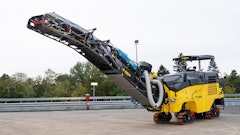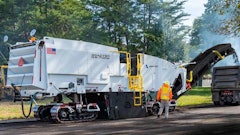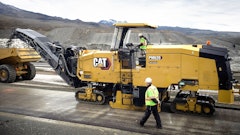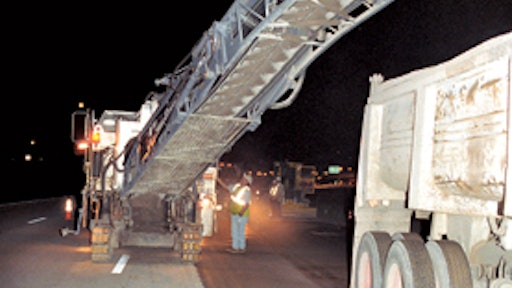
Being the second largest state in the country, as well as the second most populous state, Texans have a "do it up big" approach to life, but there are times when a finer approach is needed. That was the case this past summer when TexOp Construction opted to use a fine-toothed drum mounted on a Wirtgen W 2000 cold milling machine to precisely prepare the surface of the President George Bush Turnpike for a new thin overlay.
The Turnpike is a major east-west route in the northern half of the Dallas Metroplex, and is a 30.5-mile, six-lane, limited access toll highway which passes through or along the cities of Garland, Richardson, Plano, Dallas, Carrollton, Farmers Branch and Irving.
Near Carrollton, TX, the project owner — the North Texas Tollway Authority (NTTA), planned to overlay a section of the expressway with NovaChip high-performance, proprietary open-graded friction course. But such thin lifts — with maximum 3/8-in. stone — require extremely well-prepared and even surfaces for placement. Any irregularity in the existing pavement will reflect through the thin surfacing immediately. Conventional surface prep for worn pavements previously involved diamond grinding the pavement to precise tolerances, involving specialized mobile equipment, excessive lane closures and long project times.
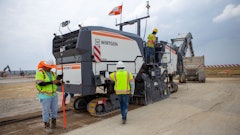
But cold milling subcontractor TexOp Construction, LP, of Roanoke, TX, and Wirtgen America Inc. had a different idea. In conjunction with its general contractor APAC, TexOp proposed using a W 2000 with a 6.56-foot fine-texture drum to prepare and level the aged asphalt pavement surface prior to the thin surfacing.
The Wirtgen fine-toothed drum removed all imperfections and bumps, and leveled the driving surface side-to-side, so a NovaChip surface could be placed using a Vögele 1800 SP paver. The NovaChip paving process places an ultra-thin, coarse aggregate hot mix over a special asphalt membrane applied in one pass over the existing pavement surface.
"On this particular job, fine-texturing with a cold mill saved the authority as much as $500,000 over diamond grinding, and the most critical thing is that the diamond grinders were asking for a minimum 90 days, and the contractor was on track to finish the same area in 30 to 40 days," says Britt Barnes, regional sales manager, Wirtgen America Inc. "My early calculations said we could do it in one-tenth the time, and even if it took more than that, it will have been a big success."
"There was a very high cost to the diamond grinding," says Danny Simpson, managing partner, TexOp Construction. "Also, the time it would take to do the diamond grinding was excessively long. We proposed to do the job in a much shorter period of time at a lower cost, but with the same benefit as the diamond grinding, 40 days versus 90 days, giving them exactly the same ride in a third of the time."
Milling machines benefit from precise multi-sensing grade controls, which don't exist on diamond grinders.
Originally diamond grinders were specified for the work. "Their only option was diamond grinding," Barnes says. "But diamond grinders are slow, tedious and expensive. We felt Wirtgen mills could do that job a lot better. Our fine-texture drum gives the toll authority that certain striation of the grooved line that they are looking for. Now APAC and the toll authority are happy about the smooth ride, and quietness of the ride that fine texturing will bring. And they are anticipating that the NovaChip will adhere to the surface better and give them a smoother end product."
While premium overlays and thin-lift hot mix asphalt overlays provide a durable driving surface, their thinness makes them very vulnerable to variations in the pavement substrate on which they are placed. The evenness and smoothness of these thin surface treatments depends entirely on the smoothness of the prepared surface, and that's where the fine texturing process comes in.
During the project, precision cold milling control systems were keeping the cut "on the level."
"TexOp is cutting with the Multiplex system, sometimes on both sides, sometimes with Multiplex on one side and wire rope sensor on the other," Barnes says. "The NTTA ran a profilograph over the existing highway, and then marked stations, so they knew where their worst areas were. And that's where most of the fine texturing efforts were focused."
Proving the process
Wirtgen and TexOp both worked with the toll authority to show the efficacy of the fine-milling process, culminating in test sections cut for the NTTA and the Texas Department of Transportation.
"We did a test project for Texas DOT using the fine-texture drum," Simpson says. "People came out, took a look and liked what they saw, including the smoothness of the ride and the pattern of the drum. They were skeptical, until they saw the process work. This job will give the turnpike back its rideability, and provide a surface that will bond well to the NovaChip paving."
The project had been designed with diamond grinding in the contract, so a change order was needed to switch to the cold mill process. The process is applicable to Portland cement concrete pavements and decks, as well as asphalt. But while fine-tooth milling of concrete is done elsewhere in the world, it's not common in the United States.
Wirtgen would like to change that. "Not only does this process mill for smoothness on asphalt, but it also has application for Portland cement concrete, benefiting the owner with low costs, short time-frame and the end product we get," Barnes says. "I have seen projects done by Wirtgen machines, such as airports in Germany, and I know it will work in Texas. The best way to level faulted slabs and improve traction on polished concrete is with a Wirtgen cold mill and fine-toothed drum. It's been done all over the world and the market is growing here."
Family business and reliable mills
TexOp has five cold mills, including Wirtgen's largest machines, a W 2000, W 2100, and W 2200. And there's a reason why TexOp leaves its biggest work to the biggest Wirtgen mills: their reliability.
"As a family-owned business we can't afford the downtime that you get with other machines," Simpson says. "Our Wirtgens have been up and running constantly since we've had them. Their engineering makes them so reliable. They're the right size for what we want to do on large or small jobs. With the four track design, they're very stable, and have been virtually trouble-free."
Simpson also found the Wirtgen fine-toothed drum superior to what he'd experienced with other machines. "In the past I've used fine-toothed drums with other machines, but I like to use the Wirtgen," he says. "They are of very high quality, with a beautiful pattern. It's German engineering at its best."
"What amazes me about a Wirtgen milling machine, and what impresses customers everywhere, is how clean it leaves the cut," Barnes says. "It mechanically sucks the millings up like a Hoover. On this particular application, we have taken the pressure off the drum housing back door and got it off the ground, because we wanted to leave the longitudinal striations to keep the appearance of a diamond cut. We are sure that the adhesion of the NovaChip will be enhanced by the greater surface area offered by the striations."
Now that fine grinding using a Wirtgen mill and fine-texture drum has made an impact in Texas, TexOp's Simpson sees a growth area. "In the long run, we see this getting much bigger," he says. "Most of the jobs now include a ride spec, whether they're on asphalt or concrete. Our machines have us positioned to take advantage of that spec."









![Screen Shot 2023 01 04 At 5 23 30 Pm[35]](https://img.forconstructionpros.com/files/base/acbm/fcp/image/2023/01/Screen_Shot_2023_01_04_at_5.23.30_PM_35_.63bc42696de27.png?auto=format%2Ccompress&fit=crop&h=135&q=70&w=240)


![Bm 2200 65 Cold Planer Release[17]](https://img.forconstructionpros.com/files/base/acbm/fcp/image/2023/06/BM_2200_65_Cold_Planer_release_17_.649359d81b660.png?auto=format%2Ccompress&fit=crop&h=135&q=70&w=240)