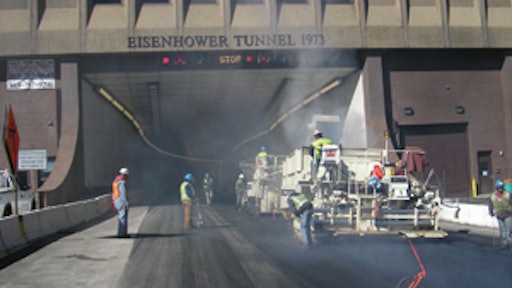
It wasn't the size of the 11,000 ton asphalt project that made paving the Eisenhower-Johnson Memorial Tunnel difficult. It was the myriad details and obstacles with this unique application that posed the challenges. From the tunnels' low clearance and pavement's specified mix design to the weather and trucking issues, Pavetec Inc., of Silverthorne, CO adapted well to the many twists and turns it faced.
Simply the altitude and ambient conditions of the tunnels, located just outside of Denver, made for difficult paving. Perched at more than 11,000 feet above sea level, the two, 1.7-mile long lanes of the westbound and eastbound bores are the highest vehicular tunnels in the world. "When paving at this height, you have to make sure your equipment is in top operating condition," says Mitch Olson, project coordinator for Pavetec.
Steep seven percent grade approaches and an average snowfall of 312 inches between November and April significantly wreak havoc on the pavement's surface. "When the snow flies in Colorado, the tire chains are put on," says Alan Adams, president of Pavetec. "Abrasion from the chains really affects the service life of the road."
The last complete overlay of the tunnel roads was in 1997, less than 10 years ago. "We design the surface for a 10-year life, but in this environment — heavy truck traffic, weather, salt and chains — we are satisfied with a seven- or eight-year life," explains Ina Zisman, resident engineer for the Colorado Department of Transportation (CDOT).
Low clearance
The tunnel itself forced the contractor to alter typical paving practices. A low, 15-foot clearance and maximum truck height of 13 feet 6 inches to compensate for message boards and signs hanging from the ceiling eliminated the prospect of using end-dump trucks. "We secured live-bottom trucks for this project," says Rusty Evans, transportation manager for Pavetec.
Inside the tunnel, constant temperatures hovering around 50 degrees Fahrenheit contributed to the decision not to use windrow paving. However, the mix design ultimately ruled out this continuous paving process. "The mix we are using is very tender, so we could not windrow the material," says Zisman.
CDOT specified an open-graded Stone Matrix Asphalt (SMA) PG 64-28 mix design with a 3/4-inch (19-mm) top aggregate size for the Eisenhower-Johnson Tunnel project. This coarse aggregate, polymerized mix with high oil content is expected to withstand the abuse of nearly 47,000 vehicles per day during peak season. However, paving with the mix proved to be difficult.
"You cannot handwork this mix," says Adams. "It has to be put down right the first time." An easier-to-handwork "SX" variation of the mix with a more evenly graded aggregate composition was used to pave around drainage openings and other obstacles along the tunnels' walls.
Critical specs
CDOT has stringent specifications for paving with an SMA mix design, calling for areas behind the paver showing signs of flushing to be immediately removed. Paving operations are to cease if segregated areas are discovered until the causes of the problem are discovered and corrected.
Pavetec had absolutely no time to deal with segregation issues. Since asphalt paving completely closed one bore to traffic — which redirected all traffic to the opposite bore, leaving only one lane open in each direction — Pavetec and the project's general contractor, American Civil Constructors of Denver, had limited time to complete the work.
The asphalt and concrete removal, resurfacing, repairs and other associated work for both bores had to be completed within a three-week time period. All lanes, however, had to be reopened to traffic during the weekends. "We chose to do the project in September because it has the lowest traffic counts at 25,000 vehicles per day," says Zisman.
The westbound bore lanes were to be closed from 9 p.m. Sunday, Sept. 10 through 9 a.m. Friday, Sept. 15 and again for this duration the week of Sept. 17 through Sept. 22. "The general contractor had some additional utility work in the westbound bore, so we had extra time," explains Adams. "We are going to be tight with the other tunnel."
The contractor faced stiff lane rental fees if these parameters were not met. The graduated fees start at $400 for the first hour and increase to $3,200 for the fourth hour and every hour thereafter. A maximum rental of up to $70,000 per day, per lane could have been assessed.
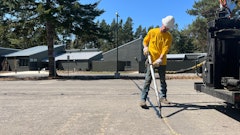
Laying a high quality mat was just as critical as meeting the time deadline. In addition to laying a mat void of segregation and flushing, Pavetec was required to meet the state's Category I Continuous Half Car Roughness Index (which measures both left- and right-hand wheel paths) of 135 inches per mile with no blanking band.
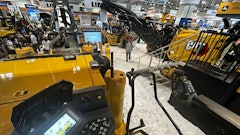
Original plans to use the contractor's existing 8-foot paver were scrapped in favor of a heavier, higher production 10-foot paver. Terex Roadbuilding supplied a Terex Cedarapids CR562 rubber track paver to help lay a smooth mat at the 13-foot paving widths. The Stretch 20 electric screed provided initial compaction of the tender mix.
"Giving the crew a new paver for a high profile project isn't the most ideal situation, but Pavetec's guys quickly became comfortable with the paver's operation," says Vince Egan, district manager for Terex Roadbuilding.
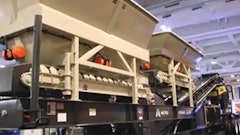
In order to help establish continuous, non-contact paving and ensure delivering a homogeneous mix to the paver, the Terex Cedarapids CR662RM RoadMix MTV was also added to the train. The RoadMix has a 16.7-ton receiving hopper that, when combined with the paver's hopper capacity, offers significant surge capacity for establishing non-stop paving. "Even with the low clearance inside the tunnel, we were able to use the RoadMix due to its 9-foot 2-inch operating height," adds Egan.
Inside the CR662RM's receiving hopper are four counter-rotating augers — grouped in sets of two — that continuously reblend the material. This helps to combat material segregation resulting from the storage, loading and transport stages.
More importantly for this project, the remixing process prevents thermal segregation, providing more uniform mat temperatures. This allowed the rollers to more readily reach specified densities, which ranged from 93 to 97 percent of the SMA mix's minimum specified gravity.
Overcoming trucking issues
While Pavetec used high production paving and compaction equipment for the project, the paving train would not be as effective if there weren't enough trucks to deliver mix to the site. Egan worked with Rusty Evans, transportation manager for Pavetec, to map and time the truck route to determine the right number of trucks.
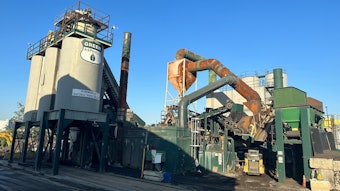
"The site was about 17 miles from the plant, and it took approximately 40 minutes under ideal driving conditions," says Evans. "We concluded that 16 live bottom trucks would be necessary to establish continuous paving."
Pavetec could only use live bottom trucks inside the tunnel because of the low clearance, so Evans lined up the 16 trucks for paving the westbound bore the week of Sept. 17. On the first day of paving, however, there was an obvious problem.
"Only nine trucks showed up to deliver mix to the site," says Olson. Not only did this lead to long wait times between truck loads — poorly employing the production capacities of the MTV and paver — it put meeting the Friday, 9 a.m. deadline in jeopardy.
Key personnel from Pavetec, American Civil Contractors and Terex Roadbuilding met after the first day of paving to discuss possible solutions to the truck shortage.
"We decided to split up the paving train in order to increase the number of trucks delivering mix," recalls Egan. "This would use the equipment more efficiently and improve paving production, so Pavetec could get the job done on time."
The RoadMix MTV was moved outside the Eisenhower Tunnel, so Evans could add seven readily available end-dump trucks to the cycle.
"After a live-bottom truck delivered its load from the plant, we staged it by the conveyor of the MTV," says Olson. Pavetec then used the RoadMix to transfer mix from an end-dump truck to the live-bottom truck, so it could go back into the tunnel to deliver more asphalt to the paver.
This creative solution to the shortage of trucks increased production of the paving train and saved the job. Pavetec's crew completed its portion of paving by Wednesday night, Sept. 20, beating the deadline and an early season snowstorm. It also gave American Civil Contractors time to complete its finish work in time to reopen the lanes to traffic by Friday morning.
"Terex Roadbuilding really bent over backward to help get the job done," say Adams. "Although splitting the paving train didn't accomplish the original purpose of the demo, Vince (Egan) told me, 'the main priority is getting the job done.'"
Work on the eastbound bore commenced the following week, and the crews had one less week to finish asphalt and concrete removal and paving of the final 3.4 lane miles of the Johnson Tunnel.
The preceding week's trucking issues were resolved, and the RoadMix once again delivered material directly to the CR562 paver. Pavetec was able to establish a continuous paving process on this bore. This improved the paving train's production, which helped the contractor complete the last stage of the project 18 hours ahead of schedule.
Interstate 70's Eisenhower-Johnson Memorial Tunnel serves as the major artery for vehicles to reach the mountain resorts. By adapting to adverse circumstances and improvising with a creative usage of the paving train, Pavetec was able to complete the project just in time to ensure that skiers and snowboarders will hit the slopes without delay.