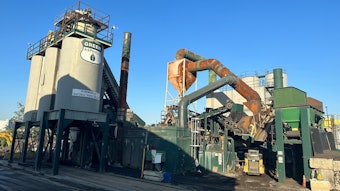
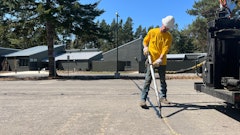
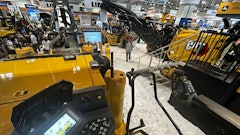
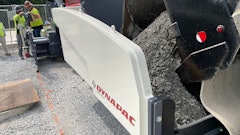
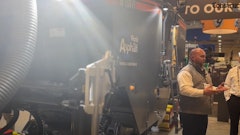
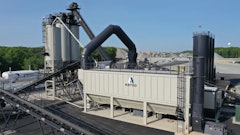
One of the biggest concerns to the asphalt industry today is rising fuel costs. Coal is currently one of the least expensive fuels available. Astec Inc. has developed a coal burner, the new Phoenix Coal, to help hot mix asphalt facilities take advantage of the lower cost of coal. Astec believes that under good operating procedures a coal burner offers a definite competitive advantage.
The efficient, low maintenance Phoenix Coal provides substantial fuel cost savings by burning pulverized coal with oil or gas as a support fuel. The Phoenix Coal requires no refractory, performs at the same production rates as gas or oil units and is highly responsive to load changes.
Astec recently completed installation of the Phoenix Coal at United Co. in Grand Junction, CO. (See the article, "United installs coal-fired burner," on page 46.)
Another new Astec burner, the Phoenix Phantom, is meeting the lowest emission requirements. While tests are still being conducted, the predicted emissions performance of nitrogen oxides (NOx) is at 18 ppm (at 3-percent oxygen) and of carbon monoxide (CO) is at 200 ppm (at 3-percent oxygen). In all other areas the performance is essentially identical to that of the standard gas burning Phoenix.
Astec's Phoenix burner was the first to bring premix gas to the market in a way that made it very usable. The Astec Phoenix Phantom takes the innovation further with a new mixing method. Instead of using gas injection tubes to put gas into the combustion air stream, the Phoenix Phantom injects gas into 3-inch-diameter turbulent mixing tubes as air passes through the tubes. This provides superb mixing that is the key to achieving ultra-low nitrogen oxide and carbon monoxide emissions without flue gas recirculation.
Astec designed this burner to meet the more stringent requirements of those parts of the country designated as "nonattainment" areas. The EPA defines "nonattainment" as any area that does not meet (or that contributes to ambient air quality in a nearby area that does not meet) the national primary or secondary ambient air quality standard for a pollutant.
The first Astec Phoenix Phantom burners were ordered for the California market. Astec expects demand in other nonattainment areas as well.
Leica Sprinter
M-Series Electronic Levels
Leica Geosystems offers new firmware for the Sprinter 100M electronic levels with new line-leveling applications and on-board GSI commands. The new line-leveling applications cover the most common field leveling procedures practiced by engineers and surveyors. The new on-board commands facilitate two-way communications between the instrument and a PDA or data collector. Existing Leica Sprinter 100M instruments can be upgraded for a nominal fee, and new units may be ordered with this optional firmware.
Vögele Super 700 Paver
Vögele America Inc. introduces the Super 700 with electrically heated AB 200 V screed. This paver combines highway class technology in a compact package suited for paving cart, bike and walking paths, confined areas, repair of milled areas, and conventional commercial applications. Unique to the Super 700 is the ability to drive through an opening less than 4 feet in width, pave within 2 inches of boundaries, and drive in a footprint of 113 inches. It can also be operated with one person and has two positions at which the operator can stand, either on the screed or on an elevated platform. The Super 700 is powered by 57-hp liquid-cooled Deutz BF3 M 2011 diesel engine. The unique ECO Mode allows the engine to provide sufficient power for all functions, but at a lower rpm for less fuel consumption, less noise and reduced wear. The power plant also includes an 8kW tractor-mounted generator for screed heating and lighting. Hopper capacity is 5.5 tons, and the hopper sides are equipped with hinges allowing for many material feed configurations.
Ingersoll Rand
Sweeper Attachments
Ingersoll Rand sweeper attachments have a bristle and bucket design and are comprehensive tools to sweep, collect and dump dirt and other debris. Sweeper attachment motion is available in forward or reverse. Two models offer sweep widths of 60 and 72 inches and bucket capacities of 10.8 to 14.4 cubic feet. An optional gutter brush to clean hard-to-reach areas, such as along curbs, in drainage depressions and next to buildings, is available.
Superior Pinnacle
Conveyor Line
Superior Industries now offers a portable radial stacking conveyor line with a 21.5-degree incline and a set back axle, giving more stockpile capacity. The totally portable Pinnacle conveyor is available in lengths of 80, 100, 110 and 125 feet with belt widths from 30 to 42 inches. Unit is available with a swing axle or patented FD axle and an expanded receiving hopper.
Komatsu
WA500-6 Wheel Loader
Komatsu's WA500-6 loader has an operating weight between 71,585 and 74,010 pounds. The standard 7.4-cubic-yard general-purpose bucket enables loading 32-ton trucks. Unit is powered by a 332-net-hp Komatsu SAA6D140E-5 Tier III engine coupled with a large-capacity torque converter and variable piston pumps. The WA500-6 features two selectable operating modes and Komtrax technology, which sends the machine operating information to a secure website via wireless technology.
XeVision HID Work Light
The HID (high intensity discharge) metal halide arc discharge technology with instant-on performance from XeVison offers an electric arc between sturdy thoriated tungsten electrodes in a specially formulated Xenon gas-filled quartz capsule, rather than using a fragile tungsten filament. This is done to generate a white light source of extremely bright intensity, mimicking daylight. Advantages include compact durable assembly, higher intensity, longer life, reduced power requirements, superior "whiter" color output and a well-defined light pattern. Life expectancy for HIDs range in excess of 3,000 hours; 100,000 for on/off cycles. Over 5,000 operating hours is not uncommon for night construction operations.