The hurricanes that hit the Gulf Coast last year left a path of destruction nobody could have predicted. "It is a situation where you really don't know what to expect until it happens," says Carl May, branch manager for the Nederland, TX, Mustang Cat Rental Store. "There were a lot of times when I was ready to throw up my hands. It was really easy to say I could go work somewhere where they have air conditioning and sleep in a nice bed.
"But the support of Mustang people in the area, the contractors I am friends with and everybody supporting each other and checking on each other really kept me intact," he states. "It kept you from just wanting to throw it all up and walk away. It was a situation where your fellow person was willing to help you out."
Many of the contractors we talked to expressed similar sentiments about how local communities came together to confront overwhelming challenges following the storms last August. The things we take for granted — electricity, phone service, water utilities, etc. — were wiped out. Bridges connecting communities were laid to waste, as well as entire housing tracts.
"It did bring everybody down to the same level where they needed one another's help," says Rob Chong, Pipeworks Plumbing & Demolition, a Harahan, LA-based demolition and plumbing contractor. The company has been in business 22 years, and Chong grew up in the community of around 10,000 residents. "Everybody needed everyone else's help. I have seen cooperation from every level."
In spite of the devastation, it didn't take long for contractors to mobilize equipment fleets and start the cleanup process. One year later, it becomes apparent they still face a monumental task. There are numerous houses that still need to be demolished, and work on the infrastructure is in the very early stages.
Yet, there has been progress. "Everything is coming back on line," says Dan Galvin, public information coordinator, Granite Construction Company. "The first time I went down there in November, it was just absolutely destroyed. I have never seen anything like that in my life.
"In early June, you could see significant improvement. The restaurants are re-opening and people are moving back into the repaired homes," he points out. "They are putting up new housing. It will be a long time before things get back to the way they were, if they ever do. There are some things that are gone forever. Overall, there is a certain critical mass that has been achieved."
Mississippi Getting roads open
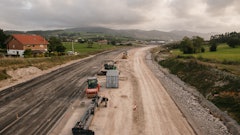
Immediately after Hurricane Katrina, an emphasis was placed on getting the roads open to traffic. Warren Paving, Hattiesburg, MS, was called on to make the necessary repairs on a section of Highway 90 between the Mississippi coastline and Gulfport.
"To start with, we were just repairing the worst places — trying to get it so traffic could get back on the highway," says Tony Broome, general manager. "We did one two-lane section, got the traffic on it, then did the other two lanes. We were down there approximately six months."
Broome originally purchased an excavator attachment to remove large concrete slabs. "We were doing punch-outs on concrete roadways where we were taking slabs out. We had to saw the slabs," he explains.
But plans changed once the project began; the slabs were broken up too badly from the storm. Instead, Caterpillar 325 excavators with buckets performed the task.
The work was made easier by the lack of traffic. "Highway 90 was not being travelled. They had everything blocked off south," says Broome.
The repairs made by Warren Paving proved crucial in getting traffic flowing again on Highway 90, but they are temporary. Eventually, it will need full reconstruction.
"There is lots of work here," reports Broome. "As far as [current] reconstruction, it is more or less just getting everything where traffic can get back on."
Bridging communities
The Bay St. Louis Bridge, which connects the community of the Bay of St. Louis, was washed out by Katrina; deck panels were actually flipped off their piers. Destruction of the bridge has created many hardships for residents. It turned a two-minute drive into about a 45-minute commute.
A $266.8 million reconstruction project, being completed by Granite Archer Western, a joint venture between Granite Construction Co. and Archer Western Contractors, will result in a totally different structure. The previous bridge sat approximately 20 ft. above the water's surface. "We are replacing it with an 85-ft.-tall structure, eliminating the need for a drawbridge and giving the bridge the ability to withstand a storm surge better than it did the last time," says Galvin.
The timeline for completion is rather aggressive. "It is a design/build project where we have to have one lane open in each direction by May 16," says Galvin. "The whole thing has to be completed by November 2007."
To get the project completed in a timely fashion, the new bridge is being built 150 ft. to the north of the old one. What remains of the old bridge is being dredged and removed.
Unlike some companies, equipment has not been much of a challenge for Granite Construction Co. "We had a couple months of staging — getting things up and running," says Galvin. But now the pile drivers are hard at work.
Similarly, it has not faced major issues with material availability. "We are a short barge trip away from some of the pre-cast concrete suppliers for the bridge piers," says Galvin.
The problem has actually been finding workers to operate the equipment. "Workforce has been one of our biggest challenges," says Galvin. "We could be doing three shifts if we had more people. We need pile drivers, crane operators and laborers. All levels of the workforce are missing in action."
Contributing to the problem is the housing situation. "Apartment buildings and homes were all washed away in many cases," says Galvin. "That's why we have offered housing. If they can't find housing on their own, one option is getting a place in our 'man camp.' "
Granite Construction Co. is confident it will meet its targets despite the labor issue. "To get all of this built in a year, it is a challenge," says Galvin. "It is taking on a bit of risk. But we would not have taken it on if we didn't think we could do it."
Louisiana
Pulling together
Pipeworks Plumbing & Demolition is no stranger to home demolition. "We were tearing down roughly 100 homes before the storm," says Chong. "We were working with contractors who were steadily tearing down older houses to build newer houses. We do a lot of demolition. Plus, we are plumbers."
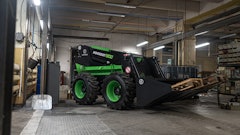
The company owns a diverse fleet of equipment. "We have a real buffet of machines to choose from," says Chong. The fleet includes three Bobcat track loaders (a T190 and two T300s), five Bobcat compact excavators (three 334s, a 442 and a 430), a Bobcat V723 telescopic handler, Caterpillar 320 excavators, a John Deere 120 excavator and a John Deere 80 compact excavator.
The fleet was immediately mobilized after Katrina. "We started cleaning up for the City of Harahan the first week after the storm," says Chong. "Our shop is in Harahan. I was born and raised in Harahan. Most of my people live in Harahan or Jefferson Parish.
"We were very fortunate that we did not get flooded," Chong adds. "My shop had electricity, even after the storm. We had a phone. We have a diesel tank, so we had fuel." Its equipment also sustained minimal damage. "I had two machines that did go under water that were in Orleans."
The first two weeks consisted of emergency work. Then it went to a bid process, and Pipeworks Plumbing & Demolition was awarded a contract to clean up the city. "The mayor, chief of police, fire chief — it was a team effort," says Chong. "We recruited other people on a smaller scale that had equipment."
Since there were no working phones in the city, communication became critical. "If I wanted to talk to the mayor, I had to ride around until I found him," says Chong.
Communication was aided by scheduled meeting times. "We would meet every morning and every evening at the fire station," says Chong. "That way, we could communicate. Because I have seen these people every day for the last 20 years, we didn't have as much red tape as maybe some other people."
Three days after the storm, Chong was at a dealership ordering additional equipment. He has since purchased over a half million dollars worth of new machinery. "We needed the equipment. Some of our stuff was worn out, some of it went under water and some stuff we added in order to do the cleanup," he explains.
One specialty piece of equipment added was the Bobcat V723 telehandler equipped with a 7-ft. grapple bucket. Trees were stored at the local playground during the cleanup until Pipeworks Plumbing & Demolition acquired a grinder. The telehandler was used to load tree waste into trucks after it was ground up. "We are in the demolition business, so it is still very handy to us," says Chong.
The company also upgraded a Caterpillar 312 for the larger 320 excavator, and two Bobcat T300s were purchased to replace the units lost in the flooding. In addition, a 44-ft. dump trailer with a two-way gate was added to the fleet.
The rubber track loaders have been a real benefit to the cleanup efforts. The football/baseball field that served as a temporary dump site became rutted by the continuous flow of dump trucks. "Tracks were good in the slop," says Chong. "The track machines were definitely a plus. In addition, there were a lot of nails on the street. You don't have flats."
In February, Harahan was declared cleaned up by FEMA and the contract with the city was terminated. Now, Pipeworks Plumbing & Demolition has transitioned back into the business of home demolition. "We still have a lot of work to do," says Chong.
There are neighborhoods blocks long that need to be demolished. "We get in a neighborhood and we will get 15 or 20 calls from other people on the street. We are basically doing the same thing we were doing before. We take down a house, take down a slab, bring in some sand and make it look what I call 'builder ready,' " says Chong.
The company plans to be even better prepared should a future disaster strike. "We have this one under our belt and we learned a lot from it," says Chong. "We know we have to be a little bit more prepared. We had to upgrade. We keep two of everything now. We have two sets of filters. We have a larger diesel tank. We have extra hoses. We keep hydraulic fluid. We have generators. We have a game plan in case it happens again, which I hope it doesn't because we still need a lot of time to clean this mess up."
Spanning the lake
Boh Brothers traces its roots in New Orleans back to 1909. Still based in the city, this heavy construction general contractor employs 1,500, and has permanent offices in Baton Rouge, LA, and Mobile, AL.
When the storm hit, Boh Brothers was called on to perform a considerable amount of work for the Corps of Engineers. "We had quite a few pieces of equipment that were flooded, so we had to assemble equipment from different places," says Robert Boh, president. "Some of it was obtained from renting; some of it was our own equipment that was undamaged; some of it was our own equipment that we were able to fix pretty quickly and get back to work."
Boh Brothers initially repaired levies and flood walls. "Most of the work we did after the hurricane is finished. We do have a couple of those projects that are still going. And there is talk of much more," says Boh. "The Corps of Engineers has a continuing program for upgrading of flood controls in the area."
However, one of Boh Brothers' most notable achievements has been the repair of the Interstate 10 twin spans over Lake Ponchartrain. These bridges were devastated by Katrina. Several deck spans floated off of the pier caps. The westbound bridge suffered the most damage with 20 spans missing and 303 misaligned. On the eastbound bridge, 38 spans fell off and 170 were misaligned.
Boh Brothers was awarded the $29.5 million contract to repair the twin spans based on a low bid proposal. The eastbound bridge was repaired in an impressive 17 days. Cranes on barges were used to reposition deck spans that had shifted. Crews took spans from the westbound bridge to complete the eastbound bridge.
A lot of engineering expertise came into play. Hydraulic steerable trailers were placed on barges and positioned under the spans. This allowed them to be precisely repositioned. A jack and slide system, which involved hydraulic rams and Teflon plates, was also used.
Deck spans that had fallen into the lake had to be removed and subsequently crushed into rip-rap for fill. A Manitowoc 4600 crane with specially rigged spreader bars was used to lift the slabs from the lake.
What makes the project even more impressive is that many of Boh Brothers workers had been displaced by the storm. "By the time we started that job, I guess we had about two-thirds of the employees back, and it increased from there," says Boh. "We set up some temporary facilities on some of our property and at one of our yards. We put in some bunk beds and offices. We just tried to meet the needs the best that we could."
It also took a lot longer than anticipated to get back into the main office. "It took until December for the phone lines to be reconnected," Boh says. "We couldn't move back to this building until then, even though the power came on about six weeks earlier. That was a big problem.
"Otherwise, it was just trying to do a lot of work in a short time," he continues. "It was long hours and long weeks."
Clearing the debris
Southern Gals Construction participates in first response. "Once a storm is predicted to make landfall in a certain area, we enter 24 hours in advance and wait for the storm to pass through," says Rebecca Zito. "Instantly, we go in and start clearing the streets so the emergency vehicles are able to enter the area."
The work is not easy. "There are plenty of crews that have been doing this for years, but it is a hard business to stay in," says Zito. "You have to stay on top of the regulations and you need to maintain productivity goals. So it is a constant battle."
Keeping debris cleared during reconstruction in New Orleans has proven a full-time job for contractors such as Southern Gals Construction and D&A Construction. According to Zito, these companies are running a combined fleet of seven trucks and two Bobcat T300 track loaders with grapple buckets. In addition, she notes, "You have these required types of dump trailers that have to meet certain criteria."
Contractors are paid by the load. Each load is driven under a tall tower where a FEMA estimator calculates the load size.
Contractors are also assigned the types of items they are allowed to pick up. "There are crews that go around just picking up white goods (washers, driers, dishwashers, refrigerators)," says Zito. "We basically pick up all the personal things that come out [of homes] that were destroyed by the storm. Also, when they tear out the walls, we pick up all of the sheetrock, wood and other household debris."
The work goes on seven days a week. "Basically, you start at 7:30 every morning," says Zito. "The dump where you take the debris closes every day at 6:30 p.m. Then you spend most of the evenings on maintenance of equipment."
Safety is heavily emphasized. "The Corps of Engineers watches it pretty closely," says Zito.
Basic working conditions continue to be difficult. "It is still pretty scarce to find someplace to eat, but service stations are starting to stay open more," says Zito. "Things are still pretty much cash only." There also remains an employee shortage.
Texas
Persevering in adverse conditions
May at the Mustang Cat Rental Store is proud of the way his company and employees responded to the crisis. "A lot of the guys here had their homes damaged and they left that alone to get equipment out to contractors for the cleanup," he states. "This last two weeks, one of our guys is just fixing his roof from the storm."
Reaction time to the storm was immediate. "We got back here on Monday when we could finally get in," says May. "At that time, we evaluated that our building was shot." Portable buildings were quickly brought in. "By Monday evening, we were receiving calls to ship equipment. We started shipping out on Tuesday."
Demand for equipment was intense. "Everybody was needing everything we could get our hands on," says May. Amazingly, the storm didn't damage Mustang Cat's existing equipment fleet. "We had one cracked windshield on one off-road dump."
Lifting equipment was particularly desirable. "Everybody was looking for telescopic handlers — anything you could lift the downed trees with," says May. "Front-end loaders, excavators with thumbs and grapple buckets were all very hot items. They were trying to get anything that could lift or reach and grab."
At first, May was worried about any non-traditional equipment he would need to bring in for the cleanup. It turned out the conventional items — lifts, grapples generators and excavators — met the demand. "We were bringing them in and shipping them out as quick as we could get them," he says.
The urgency of getting refineries in the Port Arthur area up and running as soon as possible created a strong demand for rental equipment. This meant being on call around the clock. "Some of the contractors had my phone number and radio number. They were calling at 3 p.m. or 4 p.m. on Sunday afternoon, at nights and whenever because of the situations that were arising and equipment needs," says May.
Mustang Cat used a night shuttle to accommodate equipment needs at all hours. "Basically, our trucks were running six to six every day just to try to keep up with the needs. Our trucks were booked," says May. "Some of the contractors had their own trucks. There were trucks from as far away as Mississippi. If they needed something, they would send a truck to come and get it."
The pace has finally started to slow a little. "Memorial Day was the first holiday people were not calling you all weekend long," says May.
As in other parts of the Gulf, lack of personnel is probably the biggest problem still facing local contractors. "The manpower is still a major problem here," says May. "Several contractors that I talked to said they had people tell them they were not coming back. They found jobs up north and they stayed with it."