One of the most devastating byproducts of Hurricane Katrina was the flood waters it left in its wake. As Chip Dupuy, project manager for Cajun Constructors, Inc., points out, the flooding in New Orleans was unlike any experienced in other regions.
"The majority of the time, when you see floods in other areas of the country, they dry up on their own as the waters recede or drain off," he notes. "The problem with New Orleans is there's no place for the water to drain off. It's just a big bowl surrounded by levees. So it had to be pumped out."
The process of "unwatering" the city seemed a nearly impossible task. Yet, a handful of contractors, including Cajun Constructors, rose to the challenge. Thanks to their efforts, what was expected to take months took just four weeks to complete.
Tackling the flood
Cajun Constructors is no stranger to dewatering operations. This large public works and industrial contractor, based in Baton Rouge, LA, is frequently involved in infrastructure projects, including water and waste water treatment plant construction.
"In the type of work we do, we're always dealing with ground water that we have to get rid of in excavations; or we have water or sewer waste we have to deal with on a temporary basis when we do renovation or tie-in work in a water or sewer plant," says Dupuy. "So the process of pumping water or sewage is something we knew how to do."
However, when it came to unwatering New Orleans' flooded areas, Cajun Constructors found a situation far beyond any it had previously encountered. "We had to take what we knew from past experience and just escalate it, or kick it up a notch, to a whole new volume of work," says Dupuy.
From various sources, Cajun Constructors rented 125 pumps ranging from 12 to 42 in. Models included 31 Godwin DPC300 Dri-Prime diesel-powered trash pumps with 12-in. openings, as well as 21 Thompson 12-in. centrifugal dry priming pumps, plus one 20-in., two 24-in. and five 18-in. units. Other similar-sized and larger pumps were rented from Service Pump & Compressor (a Hertz Equipment company), Rain for Rent and Andress Walsh.
"The reason we went with several different pump vendors was the immediate need and the volume of water to pump out of New Orleans," Dupuy states. It essentially boiled down to which suppliers could provide the right size pumps the fastest.
Once the necessary equipment was procured, the real challenges began. "There were no facilities there — you had to be self supported," says Dupuy of conditions in the city. "There was no power, running water, housing, hospitals or food easily available for personnel. And then there was the threat of looters and snipers and whatever else. We had to come fully equipped with our own support facilities and security to protect and support the workers for a 24-hour-a-day operation."
Setting up the pumps also proved a logistical nightmare. "When we got there, we placed the pumps wherever there was dry land and as close to the deepest water source we could find," Dupuy explains. "Strategically, we placed them around flood walls and drainage canals where we could find the deepest water source and didn't have too long a discharge to install."
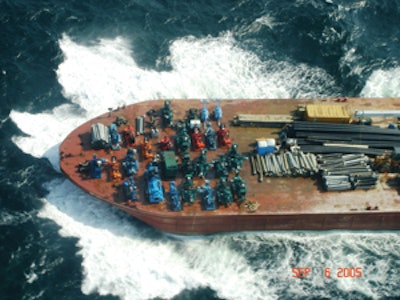
Getting to these dry spots wasn't easy. "Initially, some of the roads were under water and we had to mobilize some of the equipment by water instead of by land," says Dupuy. This meant using marine equipment in place of trucks to transport pumps and construction equipment.
Setup and tear-down of pumps was also a nearly continuous process. Pumps were often set up in the morning, then moved again the same afternoon or the next day.
In addition, the pumps had to be continually fueled and serviced. However, because of the flooding and lack of electricity, local fuel suppliers were out of business. The solution came in the form of a fuel barge, which Cajun used as backup storage. "We kept over 100,000 gal. of fuel in the barge so we could place it into a fuel truck and transport it to fuel pods around where the pumps were located," says Dupuy. "When the fuel barge was low, it went upriver to a facility for refilling."
Keeping the pumps in good operating condition fell largely on the shoulders of service and setup technicians supplied by the pump vendors. For example, Godwin Pumps provided a two-person crew working in 12-hour shifts; staff from Thompson Pump and Service Pump also assisted in setup and service. In all cases, the technicians helped out "without regard to whose name was on the pump," says Dupuy. "All these guys wanted to make a difference and they did so without hesitation."
Ultimately, unwatering the city was a "pretty inconceivable feat," Dupuy admits. Yet, it was accomplished in an amazingly short period of time. "Initially, we thought we would be there about three months," he says. "It did come off a whole lot quicker than everybody thought.
Dupuy attributes the shorter duration to the dedication of the Cajun employees and the pump and equipment vendors who put their hearts and souls into the task. "We called guys off of other jobs and Labor Day vacations, and we made calls at all hours of the day and night," he states. "Not one said 'no'."
Cajun Constructors continues to be actively involved in various phases of the hurricane recovery, including restoration of damaged water and sewer plants, repairing underground pipelines, restoring damaged flood walls around New Orleans, etc. It has even assisted in setting up several FEMA trailer parks established in the Baton Rouge and New Orleans area.
"That's a new market," says Dupuy. "We weren't really in the trailer park business, but they came to us because we knew how to put the infrastructure in place."
Making it livable
Although the flood waters are long since gone, pumps continue to play a key role in returning the hardest hit parts of New Orleans to livable conditions. After the initial emergency had passed, the city put contracts out for bid to supply temporary pumps to lift stations throughout the city. Many of the electric submersible pumps in the lift stations had been damaged or remained without electrical service.
The goal was to restore basic services so residents could move back as quickly as possible. "Once the city got an area cleaned up, they started letting people come back in," notes Johnny Britt, Gulf Coast Region Manager, Thompson Pump. "They wouldn't open an area until it was livable."
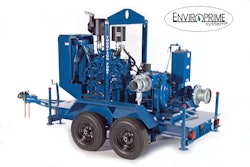
Thompson Pump was awarded a contract to supply 17 lift stations with 6-, 8- and 12-in. EnviroPrime diesel-powered trash pumps. Each lift station can support roughly 200 homes or 100 businesses. However, the pumps are largely servicing the FEMA trailer parks now in place.
The size of pump placed is based on historic demand for the particular area. "We look at the chart and see what the performance was of the pumps they had in the hole. Then we compare it to one of our engine-driven portable pumps," Britt explains. The pump is delivered to the lift station, then tied into the force main connected to the treatment plant. Floats are used to kick the pump on and off — whenever the floats reach a certain level, the pump automatically starts up.
Initially, the pumps were contracted to be in place for three months. "They extended the contract and they think we could be there for a while," says Britt. "Before they remove one of our pumps, they have to get power run to the lift station. Once they do that, they test to see if the pumps that are down in the hole are still functional. If so, they remove our pump. If not, they have to pull those pumps out of the lift station and send them to get repaired. That takes a period of time."
Keeping the diesel-powered pumps in operation over several months requires constant diligence. "As part of the contract, the city requires us to check the pumps at least twice a day," says Britt. "We do it more than that. We want to make sure these things are running."
A crew with a service truck checks the pumps frequently, ensuring they are fueled, serviced and performing properly.
Recently, Thompson was awarded a second contract for 11 pumps to accommodate additional lift stations. The pumps are currently being installed in the Ninth Ward and New Orleans East, which experienced some of the worst damage.
"The areas we're in right now are areas where you can't even drive down because the houses are off their slabs in the road," says Britt. "You could probably go down there right now and still see refrigerators and cars in trees."
Yet, Britt believes the city continues to make progress. "These are old houses," he observes. "If there's a house sitting in the middle of the road, it's not like you can just move it with a bulldozer. Some of these houses might have asbestos material, so cleanup is slower. Or some of them might be contaminated from water or sewage. It's just a lengthy process."
In the meantime, the company continues to put pumps in place as cleanup operations allow. "We still have five or six lift stations to put on line, so that's five or six areas they have still not finished clearing," notes Britt. "As soon as they clear them, they're going to bring in the temporary trailers and they're going to want us to put the pumps there."
He adds, "There's still work to be done, but they're proceeding about as well as anyone could under the conditions."