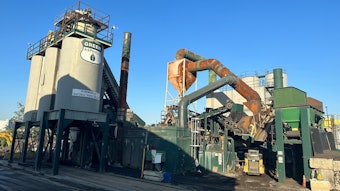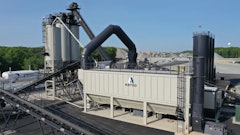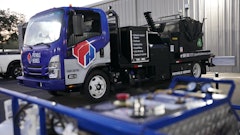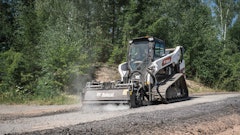
Although winter takes a toll on many industries, one of the hardest hit is road-building and pavement repair. Government restrictions on using asphalt in low temperature situations leads to seasonal fluctuations in demand. As a result, most of the plants that produce hot mix asphalt shut down for some or all of the coldest months.
Without access to hot mix asphalt, most paving contractors and highway departments are left in the cold when it comes to pavement repairs. Needed repairs are put off until springtime or they’re forced to use cold-patch, an alternative to hot mix that does not last nearly as long and costs far more. But because more and more contractors are seeking year-round access to hot mix, mobile asphalt recycling plants (MARPs) are attracting a lot of attention.
Hot Mix Where and When You Want It
MARPs reduce or eliminate dependence on fixed location hot mix producers without compromising the advantages of hot mix. Set up at or near almost any job, MARPs can provide contractors and DOTs with a dedicated source of hot mix exactly where and when it's needed 365 days a year.
- Crews can fill potholes in the dead of winter with hot mix, when hot mix plants are closed.
- MARPs also have proved to be remarkably beneficial on airfields where nighttime repair is the standard and daytime runway closure is unthinkable.
- Towns such as Colonie, NY, which has a steady stream of water main breaks have turned to PavementGroup’s PT-PRO Series recycler to provide hot mix when the local plants were shut down.
The best-designed MARPs require only one person to load and operate, and every 20 minutes can deliver as much as five tons of hot mix ready for lay down. This newfound freedom allows faster responsiveness and offers greater efficiencies in laying or repairing paved surfaces. With a cost of only $20/ton, recycling RAP is proving to be highly lucrative for pavers and offers equally important cost reductions for municipal owners.
RAP Rules
First introduced in the 1970s following the oil embargo, reclaimed asphalt pavement (RAP) has become one of the most recycled materials in the U.S. Unlike cold-patch materials which often rely on petroleum cutback to soften the material for application, RAP can be reheated to reclaim its inherent strength and stability, yielding both excellent performance and significantly lower price compared with virgin asphalt and cold patch materials. This has made it a staple product for the paving industry... when it's available.
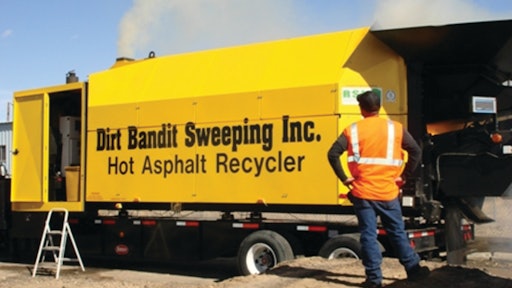
“In the Four Corners area, the only two asphalt plants shut down from December to March,” says Phil McKinney, owner of Dirt Bandit Sweeping, a full-service asphalt maintenance and paving company in Farmington, NM. “I couldn't take on any jobs when they were closed. Now that I've got my own mini-plant we're the only paving company that can make asphalt during the winter. We use it for our own jobs, but we also sell RAP to municipalities that need it."
Sustainability - Waste In, Hot Mix Out
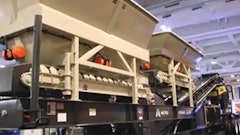
MARPs, such as PavementGroup’s PT-Pro Series Recyclers, provide immediate, on-site access to hot mix wherever RAP is available. Batch recyclers allow asphalt millings and chunks to be processed simultaneously, mixing and heating the material. Material torn up from streets, highways, runways, parking lots, driveways and other asphalt surfaces can go directly into the MARP for reheating. Small quantities of pelletized asphalt and/or rejuvenators can be added.
The resulting hot mix is ideal for pavement repair work such as patches, potholes, utility trenches, foot-paths and base course.
“With good stockpile management, RAP can be recycled into a good quality top course,” says Mark Reeves, PavementGroup president. “Our customers making top course are generally screening and crushing their RAP and generally use our additive to improve workability and performance.”
He says that in 2009 he used the PT-PRO to recycle his driveway, and “whatever came up went back down. We documented the project so we could show off the results and I’d say the resulting job was a better binder than a top. She’s holding well although for a finer smooth finish I’d have needed to control the RAP by screening or crushing.”
Plant or Recycler?
Some mobile recyclers also second as a portable asphalt plant, making virgin hot mix on a smaller scale. The U.S. Air Force, working with the National Center for Asphalt Technology, developed and tested the system for airfield repairs. The USAF embraced the technology and is using NiTech Corp.’s system of prepackaged pelletized asphalt along with small skid-steer mounted mixers for greater mobility and PavementGroup’s PT-PRO recycler for larger volume hot mix delivery.
“They (USAF) spent millions testing products and equipment,” Reeves says. “They even constructed a runway then…blew it up...for testing purposes. Our equipment worked well because the PT-PRO produces a homogenous mix of whatever goes in and its size and output capacity make for an ideal fit. The real secret was NiTech’s pelletized asphalt which exceeded the Air Force’s every expectation.”
“We generally load the machine with chunk asphalt that’s been torn up from previous pavings,” McKinney says. “Depending on temperatures, we may have to add up to a gallon of SS1H per ton for better binding. The machine rejuvenates and reheats the asphalt until it comes out as a nice, new, beautiful material. You can’t tell its recycled, and I have zero materials cost.”
When lower transportation costs, the reduced burden of handling waste materials, and the savings in tipping fees at landfills are factored in, MARPs offer significant savings over the cost of hot mix from conventional, fixed-location plants. In fact, the right MARP can pay for itself in the first year or two.
Reeves says that depending on where contractors are located in the U.S. they can pay anywhere from $55 to $125 per ton for virgin HMA; packaged cold patch runs to $600 per ton. “Meanwhile, contractors could be stockpiling their RAP and recycling it for $20 per ton,” Reeves says. “That’s a huge savings. Recycle 50 tons on Monday and you’re talking about saving $1,500 bucks -- a day! We ask our customers, can you afford not to (recycle)?”
McKinney said he is excited about the financial impact his MARP will have on his business.
“I’ve only had this recycler about six months and it’s already saved me nearly $100,000,” McKinney says. “This next year is going to be gangbusters for us.”
Robert Moskowitz has been a business writer since 1968.