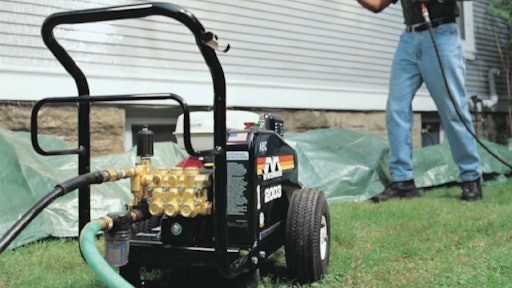
Just about every homeowner can find a use for a pressure washer. They’re ideal for cleaning decks, siding, driveways and sidewalks, boats, vehicles and more. They are so useful, in fact, that many homeowners opt to buy a pressure washer to have on hand at all times. And since many retail outlets, particularly the big box chains, offer pressure washers for as low as $200, it can seem like a wise purchase.
The trouble is, the more home-owners who go out and buy a pressure washer, the fewer there will be in your rental center to rent them. What a lot of homeowners don’t realize is that renting a commercial-grade pressure washer is most often a more economical and sound decision than buying a consumer-grade unit. You know this, but how can you persuade the homeowners out there who are your potential customers?
Explain the difference
Seasoned rental professionals and contractors don’t need to be sold on the quality differences between commercial- and consumer-grade pressure washers. It’s like anything else... “you get what you pay for.” But the average homeowner sees his neighbor across the street using his pressure washer to do everything around the house short of washing the dog. That same homeowner asks his neighbor where he got his pressure washer and before you know it, another unsuspecting customer has gone to a big box retail outlet and plunked down a couple hundred bucks for a pressure washer to call his own.
The rest of the story is a well-kept secret. The $200 pressure washer works great for the first season. The homeowner is pleased with his seemingly savvy purchase until winter comes and this big machine is taking up a lot of space in the garage. Then, when spring rolls around again, the pressure washer doesn’t work because the homeowner didn’t know certain steps should have been taken to maintain the unit.
“If a pressure washer is being stored in a cold area, the operator should run antifreeze through the pump,” says Daniel Leiss, president of Steam Jenny. “Any water that is left in the pump can freeze and cause components to crack.”
In addition to the upkeep, consumer-grade pressure washers are simply not meant for long-term, intense usage.
“Some units on the market are practically disposable,” says Leiss. According to him, some manufacturers design their pressure washers for little to no routine maintenance. When something goes wrong, the machine must simply be replaced.
Keith Price, vice president and general manager at Shark Pressure Washers agrees, adding, “The life of a consumer-grade pressure washer is measured in hours while commercial-grade models, if properly maintained, will last for years. It’s little wonder that consumer-grade pressure washers are gaining a reputation for being disposable. It’s not easy to find parts or even someone to service them when they break down.”
One thing that tends to entice homeowners into buying is the relatively reasonable price of units found in retail outlets. According to Price, gas engine pressure washers can cost as little as $199 while a good commercial-grade machine starts at $500 and up.
“For a homeowner to purchase a pressure washer, they have to evaluate their utilization of the pressure washer,” says Kevin Anstoetter with Mi-T-M Corp. “Can they justify spending [the money] for an entry-level gas unit to be used once or twice a year? Renting affords the consumer the luxury of using a high-performance unit that’s well maintained, which eventually translates into less time and a better finished product.”
Price notes that rental businesses should also be sure to point out to their customers the relationship between pressure and water volume.
“There’s a major difference between commercial- and consumer-grade pressure washers in terms of what comes out the end of the nozzle,” he says. “Most consumer models are specified with high pressures and lower water volume (gpm). What they don’t tell you is that high water volume, balanced with high pressure, produces the most effective cleaning. That’s because water volume provides weight to the cleaning stream and creates more impact to a surface. Commercial-grade machines offer that ideal balance between volume and pressure to deliver faster, more effective cleaning.”
Buyers beware
Besides the cost and performance issues, there are other reasons to promote the concept of renting a pressure washer over purchasing one. Storage can be a big issue, for example.
“Why store a machine in your garage 361 days when you’re only going to use it for four?” asks Price at Shark. “It takes up space and the hose, if not properly stored, is a nuisance. Moreover, in cold weather states, pressure washers must be properly winterized. Because of this inconvenience, many consumer models end up lasting only one season.”
Flexibility is another factor. Renting allows the user to choose from a full range of gallon/pressure that can be geared to the job at hand. For instance, washing vinyl siding might require the use of a 2,000-psi machine while deep cleaning a parking pad would be best done with a 4,000- or 5,000-psi unit.
“[Users] who rent not only get a dependable machine that has been properly serviced, but they usually have available to them a selection of pressure washers for matching to a variety of applications,” says Price. “Even for those extra-challenging jobs, [users] will often find in a rental center’s fleet pressure washers that deliver up to 5,000 psi.
Conversely, someone who purchases a pressure washer is stuck with that one machine for every job. Simply stated, renting offers more versatility and dependability to the user.”
In addition to your selection of equipment, you can also offer your customers something else: expertise.
“Most consumers are unaware of their needs, and they don’t understand what qualities make a good pressure washer,” says Leiss. “It’s the job of a rental center to offer high-quality products and help customers rent the right equipment for their specific projects.”
Is it worth it?
Clearly, there is a demand among consumers for smaller pressure washers to tackle numerous jobs around the house that don’t require the “big guns.” Some rental businesses, however, have focused their inventory on the bigger machines, however, because they believe consumers are more likely to buy the smaller units vs. renting them. This does a disservice to the consumer and removes a potential revenue stream from the rental business.
“I feel many rental businesses can still do profitable business renting the smaller items, but marketing changes may be necessary,” says Dick Detmer of Detmer Consulting. “It may be necessary to restructure some rental rates. Also, I believe one of the unspoken lures of purchasing some items is the fact that the tool is brand new when the customer is using it, whereas some of the tools and equipment at some rental businesses may look a little rough. So, be sure you are not losing rentals because your pressure washers are visually or mechanically not up to par, for example.”
He continues, “Also, it would be wise to promote the expert advice your staff provides with the rental, which is not likely to happen when a person is purchasing an item in a box on a shelf in a retail store.”
Detmer stresses that despite the fact that what were once high-profit items are possibly no longer your best money-makers, it’s not always in your best interest to do away with these smaller tools in your inventory. “Even though some small items will continue to be losers even with a stonger marketing plan, it may still be wise to avoid dumping all of the smaller items from a profitability standpoint,” he says. “The benefit to having a broad mix of tools and equipment, including small items that may not be renting as well as they used to, may outweigh the benefits of getting out of the smaller items altogether.”
Getting the word out
Whether or not your business enjoys a brisk turnaround of its pressure washer inventory, there’s always room for better promotion. Letting your homeowner customer base know what you have in stock and why it can be their solution to their cleaning needs can serve to boost your bottom line, if done effectively.
“Rental centers can be successful by promoting the convenience of pressure washers to homeowners. For example, there are no storage or winterizing issues. Plus, rental centers can match pressure washers with other popular equipment that homeowners need, such as pumps and paint sprayers,” notes Price. “This offers utility and adds value to the homeowner’s rental. Contractors have the same issues, but dependability is their biggest benefit. They need the most reliable machine, one that is matched to the job. The rental center that displays a wide variety of machines will be the most successful.”
And while the benefits of renting over buying have been the center of discussion in this article, rental centers can also stand to make money off of pressure washer sales.
“Given the popularity and interest consumers have in pressure washers, the rental center has tremendous potential in renting and retailing low-cost units as well,” says Price. “It’s assumed that a rental center cannot compete with the big box stores but they can and do every day. For some it will take a shift in merchandising philosophy, but pressure washers can be a very lucrative business in terms of renting and selling.”
That being said, however, the bottom line is that rental centers can and should promote themselves as the number one solution for homeowners seeking methods of completing everyday cleaning tasks. Renting a commercial-grade pressure washer has distinct advantages over buying a consumer-grade unit and can offer significant economical benefits.
“The rental business can offer a better product, reduce the project time and sell [homeowners] on a positive experience with a hassle-free rental,” says Anstoetter at Mi-T-M. “The consumer can rent a pressure washer for six to seven years for the price he can purchase a unit that he might be happy with.