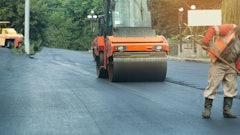
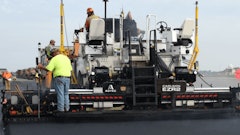
The decision between wheels and rubber tracks for your asphalt paver often boils down to preference - what you have used in the past and whether you have been satisfied with the results.
"If your crew is satisfied with the machine, they will give you quality work," says Tom Chastain, product manager - pavers/planers, Dynapac. "If they're comfortable with the pavers, whatever the configuration, everything else will run smoothly."
However, just because you've always used a particular configuration doesn't mean it's the best choice for a particular paving job.
"There are a lot of perceptions, and some contractors may have already made up their minds," notes Bill Rieken, paver application specialist, Terex Roadbuilding. "But you should consider the types of jobs you're doing and take at look at the cost of operation before making a final decision."
That being said, periodically evaluate the pros and cons of each configuration to ensure you're using the machine that gives you optimum results and cost effectiveness.
Touting tires Basically, the decision between wheels and tracks boils down to the type of work you are doing, and how much you are willing to pay for the unit itself and the corresponding operational and maintenance costs.
If you're doing overlay work on an existing surface, the best choice is likely going to be tires. You have a solid base on which to work, so the extra traction and flotation you gain from rubber tracks isn't needed.
Tires also have a lower initial price and lower maintenance and operations costs post-purchase. While prices vary from manufacturer to manufacturer, expect to pay about 10% more for rubber tracks initially, says Scott Wiley, marketing manager for large pavers, Volvo. However, that difference is minimized when you add front-wheel-assist to a wheeled paver.
Maintenance and operating costs will be higher with rubber tracks, because there are more components in an undercarriage as compared to a simpler wheel-based system that requires a set of drive tires and a set or two of front bogie wheels. And undercarriage components are more expensive to replace, with the big-ticket item being the tracks.
However, advancements made in rubber compounds and designs to extend service life continue to bring the cost differences between tracks and tires closer together. "Although there will likely always be an up-front cost differential for a tracked machine because of the components of the undercarriage," says Wiley.
Faster travel speeds of a wheel unit can also give them an upper hand if you're roading the paver from jobsite to jobsite, rather than loading it onto a trailer. A rubber-tired paver typically travels at about 10 to 13 mph, compared to a rubber-tracked paver at about 9 to 10 mph.
"Travel speeds become important in cases such as a municipality that is doing patchwork on a street," says Wiley. "Rather than load up the paver, they may road it from one patch job to another without putting a trailer underneath it."
Roading a paver can also be hard on rubber tracks, notes Steve McClellan, inside sales manager, Vögele America. "If you road the machine a lot you will wear out the undercarriage, and it will be more costly to repair," he says.
Benefits of tracks
There are times when you will need, and want, tracks. Steel tracks can be an option in some situations, and they offer many of the same benefits as rubber. But within the last decade, rubber tracks have virtually overtaken the track market in the U.S., in large part because of their faster travel speeds. Steel tracks top out at only 4 to 5 mph.
Technological advances in rubber tracks, as well as in the pavers themselves, have enhanced their popularity. With features such as the SmartTrac System on Terex machines, detracking is minimized and track life is extended, since it automatically tensions the track for optimum pressure of the tensioning cylinder and pistons in both forward and reverse, notes Rieken.
"Rubber tracks have the combined benefits of wheels and old [steel] track pavers," says Chastain. "They give the tractive effort of a steel track with the rideability of a wheeled machine."
Plus, they offer maximum flotation, which shines in soft sub base conditions, such as what you would find in new construction.
"You don't want to put a rubber tire in a soft base where there's a lot of sand or loose dirt," says Chastain. "All you will do is sink the paver. The track machine will give you better tractive effort and spread the weight out across the entire track versus just the rear drive tire."
Rubber tracks have an advantage when paving wide and/or deep lifts, as well. "Tracks will give you more stability," says Wiley. "That stability is important because if you get any type of movement in the machine when you're trying to push the trucks, that movement can show up in the mat and you don't want any variation. You want stability for more uniformity and consistency. Rubber tires have more flex and bounce that can reverberate through the screed and effect changes in the automation system."
Paving on steeper terrain can also be more efficient with a tracked machine. While front-wheel-assist on wheeled machines can improve traction on hills, it still won't provide the contact advantages of tracks.
"Contractors often choose tracks if they have gradeability issues," Wiley comments. "For example, if you're paving in the mountains, tracks provide more stability and tractive effort to push big trucks."
Tracks are also beneficial in confined areas. "The turning radius on a track machine is tighter, since most counter-rotate so you can turn it around within itself," says McClellan. "A wheeled machine takes a bigger area to turn. So if you're paving in tight spaces and need to turn tightly, a track machine will be the better choice."
A matter of price
In the end, contractors often opt to keep both configurations of asphalt pavers in their fleets.
"There are a lot of contractors who buy rubber tracks to have the versatility within their fleet to be able to handle various and more difficult jobs, but still have the rideability and faster paving speeds," Wiley points out. "With tracks, a contractor can do an overlay project, then go into a new parking lot in late season, where the subgrade might not be ideal, and still be able to pave. The flotation provided by tracks can protect the base upon which the pavement is being placed, thus extending the life of the pavement."
"But if your applications match up with both machines, it may come down to costs," says Chastain. "If you don't have to spend the extra money for tracks, don't."
Kim Berndtson is an editor for Equipment Today magazine.