There’s no question that density specifications on today’s high-production paving projects are getting harder and harder to achieve. Strict smoothness requirements, tight project timelines, variations in mix quality, changing weather conditions and various other factors can all seem to conspire against you. Your ability to overcome these obstacles and still meet the numbers can mean the difference between getting the bonus or incurring a penalty upon completion.
High-frequency vibratory rollers have emerged as an important weapon in the fight to achieve specs and still maintain the necessary production rates. In fact, they often set the pace on high-tonnage projects.
“We pave depending on the speed of the rollers,” says Rick Ricker, paving specialist at P.J. Keating Co., Lunenburg, MA, and a trainer with Team Paving Consulting. “If I’m going into battle, I want to know there’s a good chance I am going to get maximum speed out of my whole [paving] train... With the high frequency, if I’m having a good day and it’s going well, I can max out the equipment and get my production.”
Staying within the envelope
When compacting hot-mix asphalt, there is a limited temperature envelope during which the asphalt maintains a certain amount of pliability, notes Bruce Monical, marketing manager, Hamm Compaction Division, Wirtgen America. If the paver is moving fast, and the rollers can’t keep up, you lose your window of opportunity to effectively achieve density.
“It all boils down to time and temperature,” Ricker agrees. “The sooner we can get to the mix - the hotter it is - we’re going to achieve a greater density with that material.”
According to Dale Starry, director of strategic technology, Roadbuilding Division, Volvo Construction, successful paving operations require a careful balance between all of the elements of the paving process. “You want the paver and compactor to be able to process all of the mix that you can produce and deliver to the jobsite,” he states. “You don’t want an imbalance one way or the other, because it will cause you to be inefficient, less productive and less profitable.”
For example, say you have a paver that’s capable of 250 tph, but a roller that’s only capable of 100 tph. You would need three rollers to keep up with that one paver, Starry indicates. “Because of simple coordination, it may not be possible to have three rollers in the breakdown and intermediate rolling zones and achieve the air void removal before the mix has cooled,” he says.
“So ideally, what you would want is a roller with greater capability.”
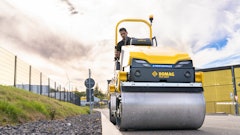
This is where a high-frequency machine comes in. “You want to stay close to a certain temperature range, and a higher frequency compactor allows you to impact more often per foot traveled,” says Bill Stalzer, product manager - asphalt products, BOMAG Americas. “That allows higher production without causing a washboard because you’re trying to hurry.”
Faster rollers for fast pavers
Vibration frequency is the number of rotations/vibrations per minute of the eccentric (unbalanced weight) that can be achieved within the roller drums. “High frequency” is generally accepted as 3,600 vpm and above, though it varies depending on the manufacturer.
A roller’s vibration frequency determines how fast it can travel and still maintain the necessary impacts to achieve density. As a general rule of thumb, optimal impact spacing is viewed as 10 to 12 impacts per linear foot.
A high-frequency roller is specifically designed to achieve optimal impact spacing at higher rates of travel. For example, a 3,800-vpm roller can maintain 10 impacts per foot at 380 feet per minute (fpm), vs. 240 fpm for a 2,400-vpm model. This enables it to keep up with faster pavers and still meet density specs.
“If you have a fast paver speed, you have to have a roller that can also operate pretty fast and still maintain impact spacing,” says Terry Humphrey, training manager, Caterpillar Paving. “The high-frequency compactor can operate at a higher working speed and still maintain good mat quality.”
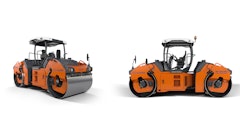
P.J. Keating Co. specializes in highway work, but also paves airport runways, parking lots and other large asphalt jobs. Its fleet includes 66- and 84-in. Hypac (Bomag) high-frequency rollers, although it has also utilized a Hamm oscillatory roller.
“It was brought in for a particular job where we were doing asphalt over concrete,” Ricker notes. In this situation, traditional methods of vibration could have damaged the mat. “We didn’t want to shatter the concrete or split the asphalt.”
P.J. Keating typically uses its 84-in. high-frequency rollers on high-profile tonnages. “With the 84-in. Hypacs, we’re [rolling] the mat less times because of the width, and we’re able to stay with the paver,” says Ricker.
A shuttle buggy is often used to speed delivery of the mix to the paver. This necessitates faster rolling speeds. “The shuttle buggy allows us to stay at a high rate of speed, but still use best practices,” says Ricker. “And we don’t outrun the rollers. [Our operators] have learned how to take the [frequency] envelope to the top and stay within the impacts. So we’re always going to maximum, and we’re getting more tonnage and a good quality job. But we’re able to do so because of the high-frequency rollers.”
Well suited to thinner lifts
Thinner lifts are where high frequency really shines. “That’s when the vibratory high-frequency roller shows its value - on these thinner layers of smaller stone size mixes,” says Starry. “With a thin layer, we have less time available for compaction, which means we need to achieve air void removal more quickly. The high-frequency roller does that.
“A thinner layer will allow the paver to move faster and place more linear feet of pavement per hour,” he continues. “And that’s really why the high-frequency roller was developed - to try to keep up with the faster moving pavers.”
High frequency is typically not well suited for compacting thicker lifts. In order to achieve higher frequency levels, manufacturers have been required to decrease the load on the bearings by reducing the weight of the eccentric, Starry notes. This, in turn, limits the amount of drum movement, or amplitude, the roller is able to produce.
“Many high-frequency vibratory systems can only be associated with a relatively low amplitude,” says Humphrey. “So if I have high frequency... I might not be able to get thick density as easily because I can’t use as much force.”
“If you have a thicker lift, and you need more energy in that material, you have to go slower,” Monical adds. “This offsets the very advantage of a high-frequency roller, which is speed.”
Advantages of variables
Many of today’s high-frequency rollers offer the ability to adjust frequency and amplitude to conditions.
“Most of the time, the modern compactor offers high and standard frequency on one machine,” says Humphrey. “That adds to the versatility. It means the contractor doesn’t have to say, ‘Do I need a high frequency or do I need a conventional frequency?’ They can get one machine that covers a wide range of applications, and the price difference is not very much [compared to a dedicated] high-frequency unit.”
Variable frequency allows the operator to apply vibration in a single drum or both drums, as well as adjust frequency in mid-process.
“I couldn’t even begin to tell you how many times the adjustable frequency has saved us,” says Ricker. “I’m able to communicate with my roller operator and quickly [adjust] either up or down, and he’s doing it on the fly. We’re finding that we’re not damaging the material, the material is going to last longer and we’re getting the numbers so much quicker.”
P.J. Keating typically uses high frequency in the breakdown stage, a pneumatic roller in the intermediate stage and a static roller for finishing. However, variable-frequency rollers may pull double duty in the No. 3 position.
“My goal is to try to achieve [final] density without vibration. We’re getting it 90% of the time,” says Ricker. “But if we do need to bump it up a little bit, we can go in there and play with the variable frequencies. We find we can go in with one drum static, one drum vibrating with a very low vpm and get the number we’re looking for without doing damage to the mat.”
Variable frequency also enables P.J. Keating to use its 66-in. rollers in applications such as parking lots, where static rolling is the norm.
“There’s a misunderstanding in the industry where roller operators or foremen/supervisors, when they hear the words ‘vibratory’ and ‘parking lot’, in their minds they don’t mix,” Ricker comments. However, just because you have high-frequency capability, doesn’t mean you have to use it all the time.
“We can take that 66-in. roller and start off static, then as the material and the subbase allow, we can slowly put a little vibration into the roller,” he explains. “Even if we’re only hitting at 2,400 vpm, it’s better than running static. The product is going to last a lot longer and the customer is very happy.”
Price vs. productivity
Because the bearings, motors and pumps are engineered to withstand higher loads, high-frequency rollers tend to carry an initial premium from 5% to 15% vs. conventional vibratory models.
“There is a price that you pay for the high frequency,” Stalzer admits. “It has to do with bearing life and bearing temperature, and optimizing the vibrator system for those factors.” However, he adds that there is also a huge advantage in terms of productivity.
Starry cites the importance of weighing the initial purchase cost against the potential productivity gains in high-speed, high-production applications. “The productivity is easily 35% greater, and can be as much as 50% greater,” he asserts. “Taking the acquisition cost plus the operating costs and evaluating it on the basis of the number of tons successfully compacted, the [high-frequency roller] will actually be less expensive than a standard frequency compactor.”
The cost per ton of material compacted is also significantly lower, says Monical. “If a contractor has a job that is 100,000 tons and he estimates it will take a month, and instead it takes three weeks with a high-frequency roller, then his entire overhead cost is reduced by 25%,” he points out. “And hopefully his gain will be such.”
At P.J. Keating, these gains have been easy to quantify. Its high-frequency rollers have generated full bonuses for density on three major projects in the past two years.
“You will see your results real quick with these rollers,” Ricker emphasizes. “If you use the rollers throughout the summer on jobs where you’re going to get paid or a deduct [based on density]... I think you will find your rollers will be paid off a whole lot quicker. They’re certainly going to pay for themselves.”