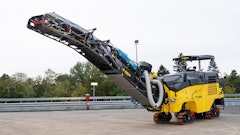
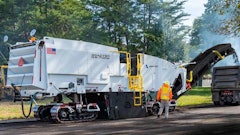
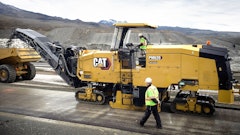
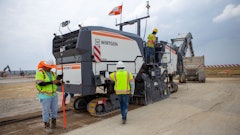
H & S Construction used a new Roadtec RX-900 - a 950-hp cold planer with a standard machine width of 9 feet and a working weight of about 95,800 pounds, to mill a 12’ 6” wide swath down both sides of the centerline of a deteriorating U.S. Rte. 182 near Patterson, LA in the fall of 2007.
The job called for removing and recycling approximately 32,000 square yards of crumbling old asphalt from the roadway and then placing 7,700 tons of Superpave hot mix asphalt. The new rehabilitated Rte. 182 now has two 12-foot-wide travel lanes plus two six-foot-wide shoulders of binder and top mix asphalt.
LADOTD Project Engineer Chris J. Lissard says “the challenges were everywhere, caused primarily by the old 20-foot-wide, two-lane road itself and the need to maintain at least one lane of open traffic at all times. There simply were just too many small businesses, residences and through-traffic to totally shut down the road.”
The Lafayette, LA.-based contractor had a $1.1-million contract with a 60-day completion with the Louisiana Department of Transportation and Development (LADOTD). The work called for H & S to mill, resurface and, in some areas, widen a 2.1-mile long section of Rte. 182, preferably before the Christmas holiday.
To cope with the quandaries posed by the various challenges, the contractor brought in a full equipment spread led by the new Roadtec RX-900 milling machine and a Roadtec RX-400. The RX-900 was milling 12.5 feet wide on the old mainline; the RX-400 was working on the shoulders.
Upgrade essential
The roadway was originally built and designated Rte. 90 in the 1930s as a state-of-the-art concrete road. At that time, the road followed the twisting course of the Bayou Teche with two 9-foot-wide lanes to meet the traffic needs of the day. When it was replaced with the new divided U.S. Rte 90, the old road was partially modified, upgraded and redesignated. Over the years, in belated attempts to keep pace with traffic demands some patching and partial overlays were made.
At the time of rehabilitating Rte. 182 in the middle of December, it was an unusual 80 degrees F, traffic was heavy, and Christmas shoppers were out in force. It was also nearing the end of the sugar cane harvest season and the massive, heavy cane trucks were moving their wide, seemingly endless loads, to the processing mills. On top of every thing else, it was intermittingly raining. This turned some sections of the cane sprinkled road into an extremely slippery surface.
Before beginning the milling operation, the contractor’s crew set out traffic delineating safety cones well ahead of the day’s proposed work zones. Flagmen were also placed out ahead of and behind the Roadtec RX-900 and moved along with it. Once milling started, pilot cars convoyed vehicles through the work areas.
The first 4,200 feet of the project, (the west end) consisted only of a 20-foot-wide roadway. The remainder of the road had been previously widened to include two 12-foot-wide, non-divided lanes and partial shoulders on both sides. The old 20-foot-wide road was milled full width in two passes, and widened to two 12-foot-wide non-divided lanes. A total paving overlay was added including new shoulders.
To expedite the project timeline the contractor stockpiled the milled material as it was removed at selected local onsite areas. This, according to Vice President Shannon Elliot, was done to reduce the number and cost of leased trucks rather than hauling it immediately back to the contractor’s plant sites for recycling. An onsite loader rehandled this at a later date when the asphalt hauling trucks normally would have been making the return trips empty.
“We are entitled to retain 75 percent of the millings we recover. The LADOTD retains the other 25 percent and will use their share for highway maintenance,” says Elliot.
“It’s no secret that we often spend as much time on logistical planning as we do on pursuing the jobs,” he says. “Even then, our team must remain flexible at all times in order to cope with those unanticipated situations. Weather is normally no problem when milling with our Roadtec milling machines.
“The crews simply put on foul weather gear and keep on going. The exception to this is when in doing so; it would endanger either our crews or the motoring public. In that event, of course, we shut the job down,” he adds.
“We are attempting to maintain the same 2 percent mainline slope on the shoulders instead of the more normal 5 or 6 percent. This is being done because of the total number of asphalt and concrete driveways that intersect with the main road. The original road was laid out at a 1.3 to 1.7 percent slope which will be changed to a full 2 percent slope,” notes Lissard.
By milling at the 12.5-foot width, H & S crews were able to complete the mainline milling in only two smooth passes instead of the more normal three or four cuts. This saved both time and money and required fewer leased trucks. By using the accurate dial-in slope and grade elevation controls on the machine, a smooth flat surface was established across the whole lane. It was also easier for the crew to dial in the super elevations at every 50 feet while milling on a curve without having to stop the progress to manually change this - going from 2 percent to sometimes a 5 percent slope. The result of this was a smoother resurfacing mat because the paver was simply following the already established grade and slope.
In using special combination Kennametal carbide teeth on the cutter drum, H & S crews were able to mill both the asphalt mainline and into the concrete driveways. The only change required, when the driveways were encountered, was that the operator simply slowed down the RX-900’s forward speed a bit.
“It’s a given in the industry today that you can’t economically compete with yesterday’s equipment,” says Gerald Hanchey, president, owner and founder of H & S Construction. “The technology is changing too fast. You must invest in the latest, most modern machines and you must employ crews that have the experience to get the maximum quality from them.
“The Louisiana Highway Department has bonus monies available on many projects,” he adds. “This, however, is awarded for quality rather than simply for productivity. Over the years we have owned and operated various machines. However, few if any, have performed as well or been as versatile and productive for us as our new Roadtec RX-900.”










![Screen Shot 2023 01 04 At 5 23 30 Pm[35]](https://img.forconstructionpros.com/files/base/acbm/fcp/image/2023/01/Screen_Shot_2023_01_04_at_5.23.30_PM_35_.63bc42696de27.png?auto=format%2Ccompress&fit=crop&h=135&q=70&w=240)


![Bm 2200 65 Cold Planer Release[17]](https://img.forconstructionpros.com/files/base/acbm/fcp/image/2023/06/BM_2200_65_Cold_Planer_release_17_.649359d81b660.png?auto=format%2Ccompress&fit=crop&h=135&q=70&w=240)