A workshop on full-depth reconstruction of city streets, presented Sept. 12 by the City of San Antonio in conjunction with the 2007 International Public Works Congress and Exposition highlighted various reclamation techniques available to road agencies today.
At the workshop, hundreds of public works personnel from around the United States viewed all phases of a full-depth street reconstruction project, including lime-slurry base soil stabilization, asphalt emulsion-stabilization of the pavement base, stabilized base compaction, and paving with warm mix asphalt.
Previously, the deteriorated pavement and layers below had been removed using a cold milling machine and stockpiled separately. This material later was brought back to site for use for the stabilized base layer.
San Antonio partnered with the Lime Association of Texas in producing the workshop. Chemical Lime Co. provided the lime slurry and delivered it to the site. Ergon Asphalt provided the asphalt emulsion for the reclaimed base as well as the process for the Evotherm warm-mix technology. Vulcan Materials Co. produced the warm-mix asphalt while Valero Asphalt provided the asphalt cement, with The Asphalt Institute providing technical support for both the base and surface layers. Engineering and construction testing services was provided by Fugro Engineering Consultants Inc.
Additional assistance and Wirtgen Group equipment to supplement city-owned Wirtgen Group equipment was provided by Cooper Equipment Co. Inc., San Antonio.
The field demo was preceded by a classroom session which brought together materials experts Larry Peirce, executive director, Lime Association of Texas, Gary Fitts, P.E., senior district engineer, The Asphalt Institute, and Harry Bush, manager, technical services, Vulcan Materials Company, San Antonio.
Demo presented in stages
Field work was staged so that different elements of reconstruction could be exhibited at the same time.
The street on which emulsion-base stabilization was taking place had been soil-stabilized before the workshop, and the street on which paving was taking place had been both soil-stabilized and base-stabilized previously. The street on which soil stabilization was taking place was milled down to the soil most recently but would be base-stabilized and paved after the workshop had ended.
"We were able to simultaneously construct the different treatments within the pavement structure on three different streets so the attendees could be 'moved' from one process to the next," says Texas Lime's Peirce. "Thus they would be able to see each of the different pavement layers being reconstructed at the same time."
The streets selected exhibited poor subgrade soils that were lime-stabilized. For the overlying base layers, a reclaimed asphalt emulsion stabilized base was constructed using existing surface and base materials milled up from the original roadway. And the pavement surface was the new "warm-mix" design incorporating Evotherm technology.
The streets reconstructed were residential drives just east of downtown San Antonio. The existing asphalt surface and black base sat directly on top of a highly expansive clay subgrade, which has caused many problems with performance, ultimately leading to premature failure.
"No matter what you design or build, your street is only as good as the foundation it sits on," Peirce says. "These three different treatments were implemented to completely reconstruct these pavements while using the existing materials to save money and expedite construction."
The existing, problematic, expansive clay subgrade was lime-stabilized using an amount of lime engineered to permanently change it into a strong and stable foundation layer.
After the lime-stabilized layer, the former hot-mix and asphalt base material that was milled up and stockpiled was brought back to the site, laid down and mixed with an asphalt emulsion to create a strong yet flexible base layer. And the final surface was completed with the warm-mix asphalt overlay.
City forces used their Wirtgen W 1900 mill to remove the asphalt surface and base material. This material was hauled off to a remote location where it was stockpiled until the subgrade treatment was completed, at which time it was brought back to the jobsite and treated with asphalt emulsion and reused. The milling was done at a depth to the top of subgrade, and care was taken to keep the expansive clay material from being milled up into the material that was to be used later.
"For the highly plastic subgrade on the jobsite, stabilization is a must to ensure that the pavement will have any chance of living its intended life," Peirce says. "Lime stabilization has been used extensively in Texas for this purpose for over 50 years."
Peirce described lime is being produced from limestone, and the resulting product, calcium oxide (CaO) has a natural chemical affinity to react with the chemical components found in clay. "Native Texas clay is dense, sticky and hard to work with," Peirce says. "It exhibits all the qualities you don't want for construction purposes. It expands greatly when wet, and contracts when dry, causing problems for any pavement material placed on top of it. It's also difficult to compact and is a poor foundation material."
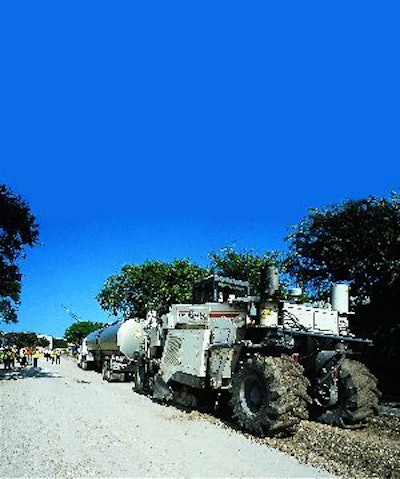
Mixed with sufficient quantities of lime and water - as with the Wirtgen WR 2000 XL recycler/stabilizer on the demo site, or San Antonio's Wirtgen WR 2500 recycler/stabilizer used for base stabilization on the project - a great change occurs.
"The clay soil changes into a much more useful material, a granular type of soil that is easier to compact and can accept fluctuations in moisture without swelling and shrinking like it did in its former state," Peirce says. "The lime is placed in a slurry form, in which it's loaded as a dry material into a special slaker tank that blends the lime with water to form a 'lime-slurry' with an approximately 38 percent solids content, and then is loaded into distributor trailers."
Prior to the placement, Peirce says, the soil is scarified to break it up a little, aiding the lime react and mix more easily. The depth of treatment for this project was 6 inches, and through careful soils testing, the amount of lime used was determined to be 9 percent by weight of soil.
"Normally the percentage would be slightly less, probably on the order of 6 to 7 percent, but organics present in the soil necessitated the increased percentage," he says. "The mixing of the lime slurry into the soil begins immediately after placement. The mixing machine is powerful and is able to substantially mix the lime after just one pass."
In order for the lime to work most effectively, and to penetrate into the clay to create the chemical reaction that ultimately changes it into a workable material, a second pass of mixing is completed on the first day.
Lime stabilization is a two-mixing-stage process, so after the first stage - two passes of mixing - the lime-soil mixture is left to "mellow" in a loosely compacted state to ensure that the chemical reaction between the calcium in the lime and the minerals in the clay continues.
For this project, the mellowing period was 48 hours because the clay was highly plastic, but the mellowing period can often be as short as 24 hours and for a lower volume residential street such as this one; light traffic such as passenger cars can drive on it during the mellowing period in order to access driveways at night and early in the morning.
Once the mellowing period has passed, the mixing machine is brought back out and it processes the material as it did on the first day. By this time the lime has really broken down the clay, and the material looks like a sandy loam as the mixing machine processes it.
After final mixing, compaction immediately begins. A segmented wheel or padfoot roller is used to achieve initial compaction. After the padfoot, a steel drum roller and pneumatic tire roller are used to "knit" the surface and create a smooth consistent surface. Laboratory testing is required to make sure that the compaction densities and optimum moisture contents are achieved
Constructing reclaimed base
After lime stabilization, construction of the reclaimed asphalt emulsion base begins. Material that was removed from the original pavement and stockpiled was brought back out to the jobsite and spread evenly over the roadway. Then, using the city's WR 2500, an asphalt emulsion was added to the material and left in-place.
"Typically, in-place reclamation with emulsion stabilization would have taken place without milling of the existing surface and base, stockpiling, soil stabilization, and return of millings and base with stabilization using asphalt emulsion, as we had here," says the Asphalt Institute's Fitts. "However, the condition of the expansive clay soils under these pavements required complete removal of the pavement and stabilization of the soils, so we started from scratch, so to speak, demonstrating soil stabilization, emulsion stabilization of base, compaction, and paving with warm mix."
Asphalt emulsion stabilized base treatment is an effective way to take existing worn out materials and turn them into something new, strong and durable. Using the WR 2500 and Hamm 3410P roller, an asphalt-stabilized base was created that provided an extremely strong, yet non-rigid layer between the stabilized subgrade and the warm-mix surface.
The appropriate stabilizing agent depends on the materials present, especially the amount of dust-sized (P200) particles.
"Significant amounts of plastic fines suggest the need for lime treatment before or with the addition of other materials," Fitts notes. "Asphalt emulsions work best with relatively clean materials, with less than 10 percent passing 200, but the gradation can be modified by adding aggregates or RAP. Foamed asphalt as a stabilizing agent requires substantial non-plastic fines, from 5 to 20 percent."
Warm mix demonstration
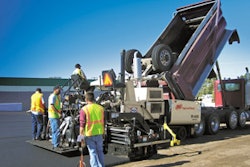
The final step in the process was the placement of the warm-mix asphalt surface course using San Antonio's Vögele America 1110 WB, predecessor to the 10-foot 2219W and today's Vision 5203-2. Although most warm-mix processes are still in the research and development, the design is similar to that of traditional hot-mix asphalt.
While today's Superpave is a U.S.-developed product, some of the most innovative improvements in HMA mix technology have migrated from Europe. These include stone matrix asphalt (SMA) and open-graded friction courses (OGFCs). But the latest import from Europe is so-called "warm" asphalt mixes, mixed and placed at temperatures 100 degrees below that formerly considered feasible.
"The typical temperature of a U.S. hot mix is 350 degrees F, and some of the mix types in Europe will go up to 400 degrees F," says Vulcan's Bush. "The higher you go the more emissions that are released. Warm mix ranges from 275 to 220 degrees F. We're producing the warm mix for this project using Evotherm, and it's produced at about 220 to 240 degrees F and will be laid at about 200."
Immediate benefits of warm mixes include lower costs of fuel required to heat the asphalt mix in production, reduction in asphalt fumes produced, change in the chemical nature of the fumes, and big reduction in emissions from asphalt plants both in volatile organic hydrocarbons (VOCs) and greenhouse gases such as carbon dioxide and water vapor.
The Evotherm process is based on a chemical process that includes additives to improve aggregate coating and workability, adhesion promoters, and emulsification agents. The Evotherm product is delivered in the form of a high residue emulsion (70 percent).
Evotherm's technology permits placement of asphalt at temperatures that are 100 to 130 degrees F lower than traditional hot-mix applications including surface, binder and polymer-modified mixes; mixes containing reclaimed asphalt pavement (RAP); and thin and ultra-thin lift asphalt mixes.
While warm mixes as used in San Antonio are part of the roadbuilder's toolbox of pavement solutions, low-energy cold mixes offer alternatives to warm mix asphalt with even fewer emissions, the ability to incorporate up to 100 percent RAP in the mix, and without costly plant retrofits. Such cold mixes can be topped with a thin HMA lift, slurry surfacing, NovaChip, or chip seal and hold up well to traffic.