Janie Franz
Eric M. Reimschiissel, Vice President and Division Manger of the Pavement Maintenance Division of the American Asphalt and Grading, Co., is a busy man. His experience keeps his crews equally busy and helps him stay on top of his booming business. As a past President and Slurry Seal Workshop Committee Chairman of the International Slurry Surfacing Association, he has been active in the Slurry Seal industry for 30 years, providing industry guidance on applications and specifications in several states. He has also been promoting the use of Slurry Seals and pavement preservation for three decades and currently operates a seal coat manufacturing facility, making mineral field emulsion seal coat
Based in Las Vegas, the Pavement Maintenance Division grew out of a customer demand from the parent company, American Asphalt and Grading, a large paving and grading business with two decades of experience. "I started my part of the company in 2001," Reimschiissel says. "The goal was to set up a full service pavement maintenance company, providing services and applications to benefit asphalt owners. We have built the business based on customer service."
In its early days, Reimschiissel's company had one seal coat crew and one slurry crew. Today, the company has 75 employees working in California, Nevada, Utah and Arizona doing a variety of services. "We provide services and solutions for asphalt pavement maintenance, including but not limited to Slurry Seal, seal coating, crack sealing, asphalt paving, asphalt repairs, and pavement marking and striping," says Reimschiissel. "I now have two paving / patching crews, two Slurry Seal crews, four seal coat crews, a crack seal crew, and a striping crew. I also manufacture AMERICOAT, an asphalt emulsion seal coat." He places Slurry Seal in three states placing Slurry Seal, but in southern Nevada, he keeps his paving, seal coat, and striping crews hopping.
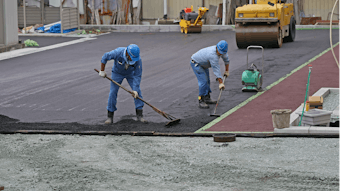
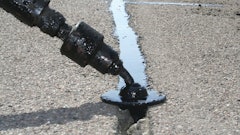
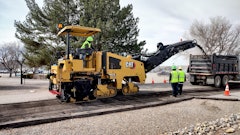
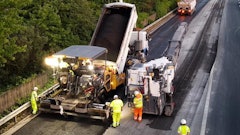
Annually, his division lays down 325,000 tons of asphalt on highways, city streets, subdivisions, and homeowner association streets, as well as paving commercial, industrial, and residential parking lots. One of his 11-man crews laid more than 5,200 tons of black paving in a ten-hour period. His maintenance crews do type 1 (fine, used for low wear traffic areas), 2 (general, used for most roadwork) and 3 (coarse, used for severe surface defects) Slurry Seals, seal coat, spray application fog seals and rejuvenation seals, crack sealing (hot and cold applied), asphalt overlays, and asphalt repairs, divots, percot, and patching.
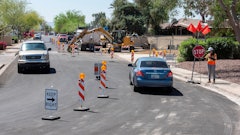
Not only are Reimschiissel's crews efficient, they are precise and tidy. That is extremely important in cities such as Las Vegas. "Southern Nevada has many requirements from city agencies that are stricter than other areas due to the amount of growth from the past. The requirements and expectations are high, and businesses have expectations of keeping their property looking good due to the tourist industry. The Slurry Seal we place here is very competitive on price so the production rates must be high and crew capabilities must be very good. We are facing tight schedules every day," says Reimschiissel.
Because Las Vegas is a major tourist attraction, the city expects their streets and public lots to be pristine. Even asphalt street patches have to be perfect. "It's just a quality level for the Slurry Seal and the asphalt," Reimschiissel says. "Officials will come out and look at a patch you do in the street. They are definitely stricter than any other place I have worked." Some of the requirements for asphalt quality include neat seams and having to grind off oil spots. Crews also have to be neat and make sure nothing is left on the curb line. "If you get anything on the curb line, you have to clean it off," Reimschiissel says. "Here they also have dust requirements." And those are strictly enforced with some thirty-odd dust inspectors who check for mud on the street and other restrictions.
In addition, the crews must repair the streets first before applying the slurry. "Some places don't even do the repairs of their streets before they put slurry on them," Reimschiissel adds.
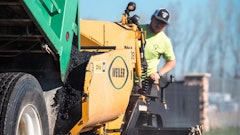
Not only does Reimschiissel need experienced and efficient crews, he needs good equipment. "I use Valley Slurry Seal Macropavers to meet the production needs we have here," he says. "It is critical that machinery must be able to achieve high production every day and be tough enough to continue that high pace without down time. The machine pugmills must be able to mix the materials completely and quickly to assure a good Slurry Seal product on the road." Reimschiissel continues, "The reason I choose Valley Slurry Seal Macropavers is that they are built like a tank. They're very durable. They just don't break down. I have had less trouble with the Macropaver than other machines I have used in the past."
When a Macropaver does need service, Reimschiissel's mechanics are able to do the repairs in-house. Usually repairs are for the conveyor belts and pug mills. Mechanics keep those parts in stock and just replace them as needed. So, instead of being down for a whole day, the machine can be refitted and back on the road with little production time lost.
"But, most importantly, they will lay the amount of material I need laid in a fast manner, where other machines just can't keep up with that production."
Though Reimschiissel notes that his experienced crews could operate most any machine, the Valley Slurry Seal Macropavers are very user-friendly and make handling their production load a lot easier. "The crews like the fact that the machines run every day," he says. "If the machines do not run they will not have work. The operators enjoy the ease of the machine operations and the joy stick controls."
"I am very proud to work with the people I do. I have some of the best people in the industry," Reimschiissel adds. "The crews are very proud of their work. I require people to have pride and like what they do. If you do not like what you do, you will never be good at what you do. The crews realize that for them to be successful the company must be successful and that they reflect on the company image. We all work as a team."
That teamwork has resulted in big successes last year for the American Asphalt and Grading, Co. "We were low bidder on the City of Las Vegas Slurry Seal project, which as far as I know is the largest Slurry Seal project ever bid in the nation," Reimschiissel says proudly.
Like many other companies in the nation, winter is the off season for Reimschiissel and his crews. "The summer is by far the busiest time of the year. The crews are usually working a lot of overtime to get the work load completed," he says. "The crews usually take time off of work or continue to work paving and doing other miscellaneous jobs during the winter. Because we are a multitask company, we have been fortunate to have worked for many people during the slower months." And, those that take a break during the off season are quick to return when business picks up.
Reimschiissel thinks that is one reason that separates his company from other asphalt businesses. "American Asphalt and Grading is different from others because of our employees and the good work they do," he emphasizes quickly. "We are also different than other companies due to our customer service; we really do care and take pride in our work. We do not argue with customers."
That personal touch is vital, but so is knowledge and skill. "Because the pavement maintenance industry is about taking care of and repairing asphalt, we must be able to know how to do this. We are a company that is knowledgeable and can find solutions to our customers' needs and problems. If our customers have a problem we will solve it." In addition, his crews also keep abreast of new techniques or technology. "Our division learns from being involved in the industry. We are involved and participate in many trade associations, and we learn from others. We are also leaders in our industry."
Though Reimschiissel bases his company's growth on doing excellent work and providing quality customer service, he does do some advertising and networking. "We belong to associations," he says. "When we get the chance, we send out some flyers for various company services. We're a full service maintenance contractor where we do everything." But for much of his Slurry Seal business, Reimschiissel relies on drafting the best bid to a public works agency and not advertising. However, for other services his company offers, he concentrates on building a good reputation and getting the word out about that. "For the seal coat and patching part of the business, there are relationships you have to build with people in businesses," he says. "We have a lot of good relationships with people. And we do do a lot of marketing for that." It must be working because American Asphalt and Grading is the largest seal coating company in southern Nevada.
With the proper equipment, the right experience, and a great work ethic, Reimschiissel and his crews stay busy as they keep their image-conscious customers happy.