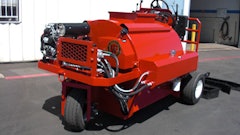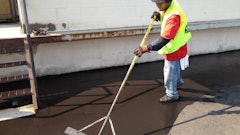
Failure to conduct proper maintenance during the season makes a sealcoating machine less effective, less productive, and results in equipment downtime. Inefficient equipment also adversely affects job quality.
Doing the "little things" throughout the year will allow you to keep your sealcoating equipment operating at peak efficiency, allowing you to consistently make more money.
Lines, pumps and filters
Keeping your material lines, filters, and pumps flushed prevents most problems. If you have to take a pipe wrench and cheater bar to open your material gate valve because you left sealer to dry in it, you're better served by installing a new one.
In fact, just because the handle turns doesn't mean the gate inside the valve is open. The handle stem has male threads and the gate has female threads. Forcing the handle to turn can strip the male threads right out of the female threads. The handle turns and appears open, but the gate is still in the bottom of the valve restricting the flow.
On diaphragm material pumps dried sealer can cause a variety of problems. Dried sealer inside the material lines can chip off and get into the material pump. If the chunk has a sharp edge on it, it can puncture the diaphragm. If air bubbles are coming out from the end of a spray wand, it means your diaphragm is punctured or ripped.
Also, sealer that dries on check balls and checkball seats will cause a spraying pressure loss. This happens because the ball and seat must meet without any gaps. Dried sealer on either will cause gaps.
If the chunks make it through your pump they will flow to the wand and clog the spray tip. All these issues will cause extensive downtime, which means lost revenue. Keeping lines flushed with water after job completion can prevent these problems.
System hydraulics
Most sealcoating equipment includes some form of hydraulics. Keeping hydraulic oil and filters changed is very important.
Hydraulic parts have a lot of small "port holes" in them where contaminants can get clogged. This can cause a system to shut down instantly.
Old hydraulic oil can affect performance because the viscosity breakdown and dirty oil will cause hydraulic parts to wear out quicker. Keeping oil and filters changed regularly will keep a hydraulic system operating at peak performance.
It's also a good idea to stock repair kits for hydraulic parts. When the parts are leaking they can make a mess of your machine and seep over the pavement being sealed. Once the parts begin leaking oil there is nothing you can do short of replacing the part. Rebuild them when the smallest leak appears.
Pump maintenance
Diaphragm pumps are popular in sealcoating equipment. The pumps work well for sealer with sand – if maintained and if checkballs, checkball seat, and diaphragms are made from the correct material.
A material named Hytrel works well against abrasive materials. Neoprene tends to swell when contaminated with some types of sealcoating material. Swelling increases the size of checkballs, which causes them to seat incorrectly and hang in the chamber, resulting in pressure loss and might keep the pump from cycling. Rebuild diaphragm pumps annually.
Moisture is the worst enemy to your air-operated diaphragm pump. Condensation forms inside the air tank and goes through the air line. Water separators will catch most of it, but not all of it. Once moisture enters the air valve it washes away the lubrication inside. If parts in the air valve don't move, the pump won't cycle.
Many air valves have lithium grease in them, which works fairly well against moisture. However, I have found Vaseline petroleum jelly works best. To test it just apply some to your hands and place your hands under a running faucet; the petroleum jelly won't wash off. This is the desired effect for internal air valve parts. A good way to prevent moisture from entering air lines is to crack open the petcock on the bottom of the compressor tank. Open it slightly while it's running, to allow the moisture to drain so it doesn't enter into the air line.
Sealing agitation systems
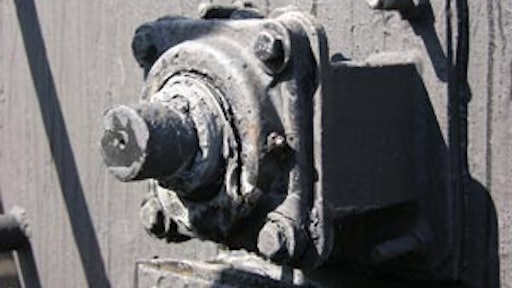
Most sealcoating equipment includes agitation, usually consisting of a shaft extending through both ends of the tank. A seal around the shaft prevents the sealer from being released. Always keep seals maintained and replace them when necessary.
Some agitators have packing glands, which is a gland with mechanical packing inside, wrapped around the shaft with a packing pipe holding it in. Always check the tension of the nuts which hold the packing pipe. The nuts will work themselves loose, enabling sealer to run down the shaft and into the bearing.
Once the abrasive material enters the bearing it will erode the ball bearings inside. Bearings can be expensive to replace. Once the packing pipe has been tightened down to its maximum, put more mechanical packing inside.
Other sealcoating agitation machinery includes a rubber seal, a steel plate, and a bearing. Keeping the nuts tight on this type of machinery will apply pressure on the rubber seal, keeping it from leaking sealer. Always replace the rubber seal at the first sign of leakage.
Worn seals also allow sealer to leak on machinery. You appear more professional pulling onto a jobsite with a clean machine rather than on which appears as if it were just pulled from a tar pit.
Michael Bechtel, SealMaster/Thorworks Industries, began fabricating and welding sealcoating machinery in 1980. Since 1986 he has been selling equipment and providing troubleshooting advice to contractors.

















![Screen Shot 2023 01 04 At 5 23 30 Pm[35]](https://img.forconstructionpros.com/files/base/acbm/fcp/image/2023/01/Screen_Shot_2023_01_04_at_5.23.30_PM_35_.63bc42696de27.png?auto=format%2Ccompress&fit=crop&h=135&q=70&w=240)